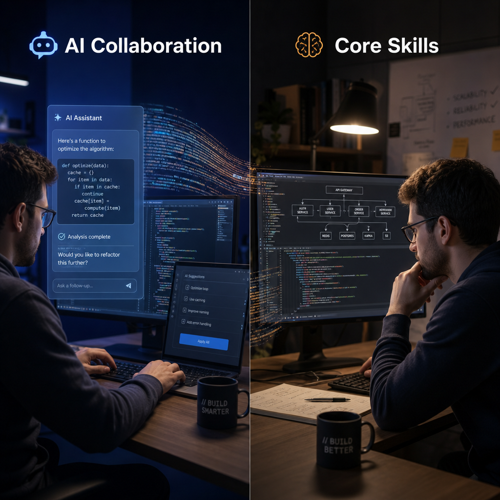
Recently, a few friends asked me a tough question: "Should my kids still study Information Technology at university, or will AI completely replace programmers by the time they graduate?"
That’s a fair question. There’s no doubt that Artificial Intelligence is changing the software industry in big ways. Still, my answer was clear: Yes, they should study IT, but they need to realize that the way we build software is changing for good.
Here’s how I see the future of programming and what the next generation of tech professionals should get ready for.
1. Humans are Still in the Driver’s Seat
AI is a powerful tool, but it still needs someone to steer it. For now and in the near future, we need people to guide, direct, and check what AI produces.
AI doesn’t really get business logic, human empathy, or the unique needs of each company. Skilled people are needed to define the problem, design the solution, and ensure AI builds what’s actually needed. We’re not being replaced—our jobs are shifting from just coding to guiding the process.
2. From "Line-by-Line" to Agentic Programming
The old way of coding, where you write software line by line, is changing fast. We’re moving into the era of Agentic Programming.
Instead of writing every loop and function ourselves, we’ll be managing networks of AI agents. As developers, our work will shift to things like:
Designing high-level system architectures.
Defining precise workflows and guardrails for AI agents.
Reviewing, debugging, and integrating AI-generated code.
In the future, programmers won’t just need to memorize syntax. The real skills will be problem-solving, logical thinking, and the ability to manage complex systems. I’m hopeful about tech’s future, but we also need to be honest about the challenges ahead. The usual entry-level “junior developer” jobs will become less common.
We have to be realistic about the immediate challenges. The traditional entry-level "junior developer" role will shrink.
Since AI can now handle basic code, write simple tests, and do routine debugging, companies won’t need as many people for entry-level work. This raises the bar for new grads. They can’t just know basic coding—they’ll need to use AI tools to work at a mid-level right after university.
The Verdict: Adapt and Thrive
If students go to university just to learn how to write code line by line, they might struggle in a few years. But if they focus on the basics of computer science, data structures, system design, and critical thinking, they’ll do well.
AI won’t take over programming jobs. But programmers who know how to use AI will outpace those who don’t.
What do you think?
Does this tone match your style, or would you prefer to include more technical details or personal stories?