
Australia Banned Card Surcharges. So Who Really Pays Now?
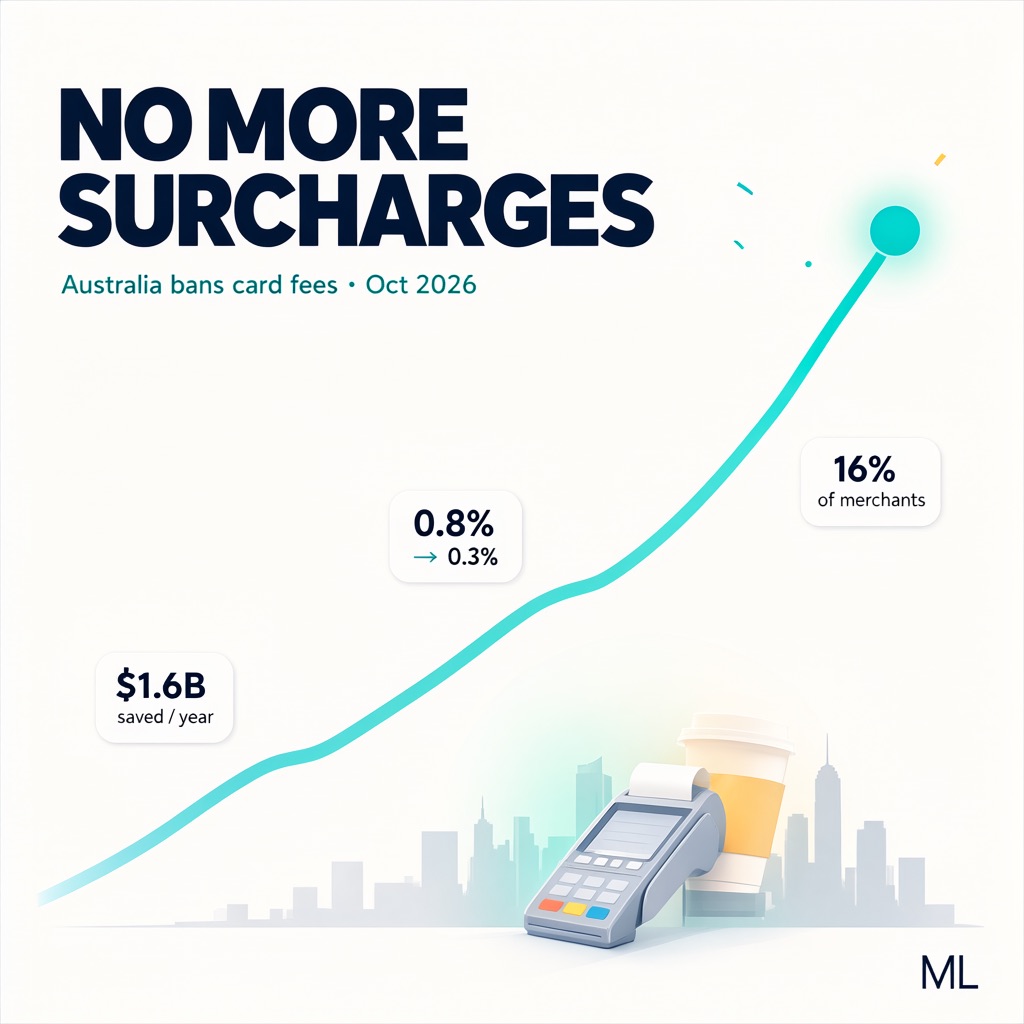
Illustration · image created for this article
From 1 October 2026, the surcharge line at the checkout is gone: businesses can no longer add an extra fee when you tap or insert a Visa, Mastercard or eftpos card, in person or online. The Reserve Bank calls it a win for price transparency worth about $1.6 billion a year to consumers.
But a cost does not disappear because a line item does. Merchants told the Reserve Bank, in its own consultation, that they would simply fold card fees into sticker prices. Card issuers — whose rewards were funded by the very fees just capped — are already repricing: American Express has notified customers that grandfathered no-annual-fee Amex cards are getting a $99 rewards fee, and CommBank has announced it will shut its Awards program. This article follows the money: where the fee went, who now pays it, and what it means for the drift toward a cashless Australia.
The ban, in short
- Effective
- 1 October 2026
- Covers
- eftpos, Mastercard, Visa — in person and online
- Not covered
- American Express, BNPL (review from mid-2026)
- Surcharges before
- 16% of merchants, ~$1.8b collected (2024–25)
- Consumer saving
- ~$1.6b a year (RBA estimate)
- Interchange caps
- Credit 0.8% → 0.3%; debit 0.2% → 0.16%
- Merchant saving
- ~$910m a year (RBA estimate)
- Enforcement
- Ban made by legislative instrument (April 2026), enforced by the ACCC
Will businesses just raise prices instead?
This is not cynicism; it is in the official record. Merchant representatives argued exactly this to the Reserve Bank: card acceptance is a business cost like rent or electricity, and if it can no longer be shown as a separate line, it will be recovered through the advertised price. Analysts agree the effect will be biggest at small merchants on thin margins, who can least afford to absorb it.
The RBA’s defence rests on two findings. First, the old surcharge was a weak price signal anyway: in a study of more than a million merchants, a $1-million-a-year merchant saved just $36 a year in card fees by surcharging, because customers barely changed how they paid. Second, the interchange cuts (worth ~$910m a year to merchants) shrink the cost that needs to be recovered. In the UK and Europe, where surcharging was also banned, credit card use did not jump and prices did not spike.
Where the money goes now
Sources: RBA Conclusions Paper, March 2026; PaymentsJournal. Estimates, not audited actuals.
So the honest answer to “will prices rise?” is: some prices, somewhat, once — and the RBA has bet that the net effect is smaller than what the surcharge line used to show you. Whether that bet pays off is checkable: compare sticker prices six to twelve months from now with the old price-plus-surcharge totals.
The unseen change: interchange caps fell too
The surcharge ban grabbed the headlines, but the deeper reform is the one nobody sees at the till: interchange — the wholesale fee the merchant’s bank pays the cardholder’s bank on every transaction. It is the money that funds points, cashback and lounge passes. The RBA cut it hard:
| Card type | Old cap | New cap | Change |
|---|---|---|---|
| Consumer credit (domestic) | 0.80% | 0.30% | −0.50 pp |
| Debit | 0.20% | 0.16% | −0.04 pp |
| Commercial credit | 0.80% | 0.80% | unchanged |
| Foreign-issued cards | uncapped | 1.00% | from 1 Apr 2027 |
Reserve Bank of Australia, Review of Merchant Card Payment Costs and Surcharging — Conclusions Paper, March 2026.
Lower interchange is the RBA’s compensation to merchants for losing the surcharge — and the reason your rewards are being repriced.
The clawback: your rewards are the funding source
Here is the part cardholders are feeling personally. Interchange fees are a revenue line for card issuers, and that revenue paid for rewards. Cut the funding by more than half on consumer credit, and the benefits get repriced. That is not speculation — it started before the ban even took effect:
| Issuer / program | Change | When |
|---|---|---|
| Amex — grandfathered no-annual-fee cards | Rewards Program fee $0 → $99/yr (opt-out keeps the card, loses points) | Nov 2026 – 2027, by card anniversary |
| CommBank Awards | Program closing; features and fees changing | announced 2026 |
| Frequent flyer earning generally | “about to drastically change” as interchange revenue falls | 2026–27 |
Sources: American Express customer notices (Aug 2026); CommBank Awards customer notice; The Age / Traveller, September 2026.
“Following a review of our products, and to help maintain the benefits and services associated with your Card… the annual Rewards Program fee will increase from $0 to $99.”
American Express Australia — customer notice on grandfathered no-annual-fee Gold cards, August 2026
If your “free” Amex is suddenly $99 a year, you have three options, and Amex’s notice spells them out: pay it, opt out of rewards and keep the card free (you keep Amex Offers and the interest-free period, but no points), or close it. Note the pattern rather than the single fee: the cost of the payments system did not vanish — it moved from the merchant’s terminal to your annual fee and the sticker price. On the RBA’s stated reasoning, that is the intended effect rather than a side effect: rewards operated as a hidden cross-subsidy that all cardholders and cash-payers paid into through prices.
The Amex-shaped hole in the ban
One network is conspicuously absent from the ban: American Express is not covered. It is a three-party network (issuer and scheme are the same company), sits outside the RBA’s interchange regulation, and many merchants will still be allowed to surcharge it — or drop it. Amex cards tend to carry the richest rewards, a difference commonly attributed to their higher acceptance costs.
This was the most contested part of the RBA’s review. Merchants warned that customers will now be steered toward high-cost Amex cards with no price signal at the till; the RBA’s own data suggests the effect will be modest, and it has promised a separate review of Amex-style networks and BNPL from mid-2026. Until then, the surcharge ban has a visible exception — and it happens to be the card whose fees just went up for cardholders.
And Australia goes cashless… by design, and by drift
A quiet reason the RBA felt safe killing surcharges: cash is no longer a real escape hatch. Its 2025 Consumer Payments Survey found about 20% of consumers avoided a surcharge by switching payment method — and those people were far more likely to pay cash. With the surcharge gone, the RBA projects roughly 2.5 percentage points of in-person payments shift from cash to card. Its other finding is blunter: because cash handling has grown so expensive, paying cash is no longer clearly cheaper for merchants than taking cards.
That is the cashless drift: not a decree, but the removal of each remaining reason to carry notes. There is a counter-current — the government is separately moving to mandate cash acceptance for essentials, and cash use ticked up during the cost-of-living squeeze. Both things are true: Australia is becoming functionally cashless, while policy tries to keep cash alive for those who still need it.
Why now stings: the macro backdrop
The reform lands in the worst possible week for household patience. On 29 September the RBA raised the cash rate 25 basis points to 4.60% — the fourth rise of 2026, a full percentage point since January. The next day the ABS reported annual CPI at 4.0%, driven by housing and fuel. A reform that quietly embeds card costs into consumer prices is small beer against that — the RBA estimates ~0.1%, once — but the timing is why every checkout conversation this month sounds like a grievance.
So — who really pays?
- Everyone, a little, in sticker prices. Merchants said they would fold card costs into prices; the RBA’s interchange cuts are designed to keep that increase smaller than the old surcharge. Expect rounding, not line items.
- Rewards cardholders, visibly. The interchange cut defunded points programs. Amex’s $99 rewards fee and CommBank’s Awards closure are the first wave, not the last.
- Cash users, in principle. They used to dodge surcharges; now they cross-subsidise card costs like everyone else — which is exactly the “fairness” the RBA argues for, and exactly what a cashless drift makes permanent.
- Nobody saves $1.6 billion in the way the headline implies. That is a transfer, not a windfall: from the checkout line and honest pricing to opaque prices and annual fees. Whether the new arrangement is better is the transparency argument the RBA won — now it has to live with the receipts.
Questions, answered
What does the surcharge ban actually change?
From 1 October 2026, businesses cannot add a surcharge to Visa, Mastercard or eftpos payments, in person or online. Surcharges on American Express are not covered by the ban. At the same time, interchange caps fell sharply: consumer credit 0.8% → 0.3%, debit 0.2% → 0.16%.
Will businesses just put the fee into the price instead?
Many will — they told the RBA exactly that. The RBA’s bet is that lower interchange fees mean the baked-in rise is smaller than the old surcharge, and that fully absorbed surcharges equal only ~0.1% of consumer prices, once. Watch sticker prices over the next six to twelve months.
Why is my no-annual-fee Amex suddenly charging $99?
According to its customer notices, Amex is adding a $99 annual Rewards Program fee to grandfathered free cards, staged from late 2026 through 2027. You can opt out and keep the card fee-free, but you stop earning points. CommBank is closing its Awards program for the same underlying reason: interchange revenue that funded rewards has been capped down.
Is Amex covered by the surcharge ban?
No. Amex is a three-party network outside the RBA’s interchange regulation. Merchants may still surcharge it or decline it. The RBA plans a separate review of Amex-style networks and BNPL from mid-2026.
Does this make Australia cashless?
It removes the last everyday reason to carry cash: dodging surcharges. The RBA expects ~2.5 percentage points of in-person payments to shift from cash to card. Separately, the government is working on mandating cash acceptance for essential purchases — so the drift is real, but cash is not being banned.
What to watch next
- Sticker prices, 6–12 months out. The RBA’s claim that baked-in rises beat old price-plus-surcharge totals is testable — keep a receipt.
- The Amex/BNPL review from mid-2026. Whether the last surchargeable, richest-rewards networks get pulled into regulation.
- More rewards devaluations. If your card’s points value drops or fees creep up, interchange is why.
- The cash mandate bills. Whether Parliament protects cash acceptance while the market abandons it.
Sources
- Reserve Bank of Australia — Review of Merchant Card Payment Costs and Surcharging: Conclusions Paper
- Commonwealth of Australia — Explanatory Statement F2026L00434 (surcharge ban legislation)
- PaymentsJournal — Australia’s Ban on Debit and Credit Card Surcharges Takes Effect
- American Express Australia — customer notices on Rewards Program fee changes
- Commonwealth Bank — Important Notice to Awards Credit Card Customers
- Reserve Bank of Australia — Consumer Payments Survey / Consumer Payment Behaviour in Australia
- Reserve Bank of Australia — Monetary Policy Decision
- Australian Bureau of Statistics — Consumer Price Index, Australia, August 2026
- The Age / Traveller — How you earn frequent flyer points is about to drastically change
- Yahoo Finance — RBA reveals surprise change in payments trend amid calls for greater cash mandate
Not financial advice. This article is general commentary on publicly released data from the Reserve Bank of Australia, the Australian Bureau of Statistics, published legislation and reporting, written on 1 October 2026. It does not take your objectives, financial situation or needs into account. Dollar figures marked as estimates are the RBA’s own published estimates; card fee and rewards changes described are as notified by the issuers to their customers and may vary by card product — check your own card’s terms. The RBA’s Amex/BNPL review and the cash acceptance mandate are works in progress and this page will not update automatically.
Found this useful?
Buy me a coffee ☕
Everything here is free and ad-free. A coffee or a AU$1/month membership keeps new articles, games and tools coming.
Also in the shop: VoidFill · The Architect’s Monologue · Brisbane photo prints