
Rocket Spelling: a free Year 4 spelling game that reads the words aloud

Cover illustration made for this page. Real screenshots of the game are further down.
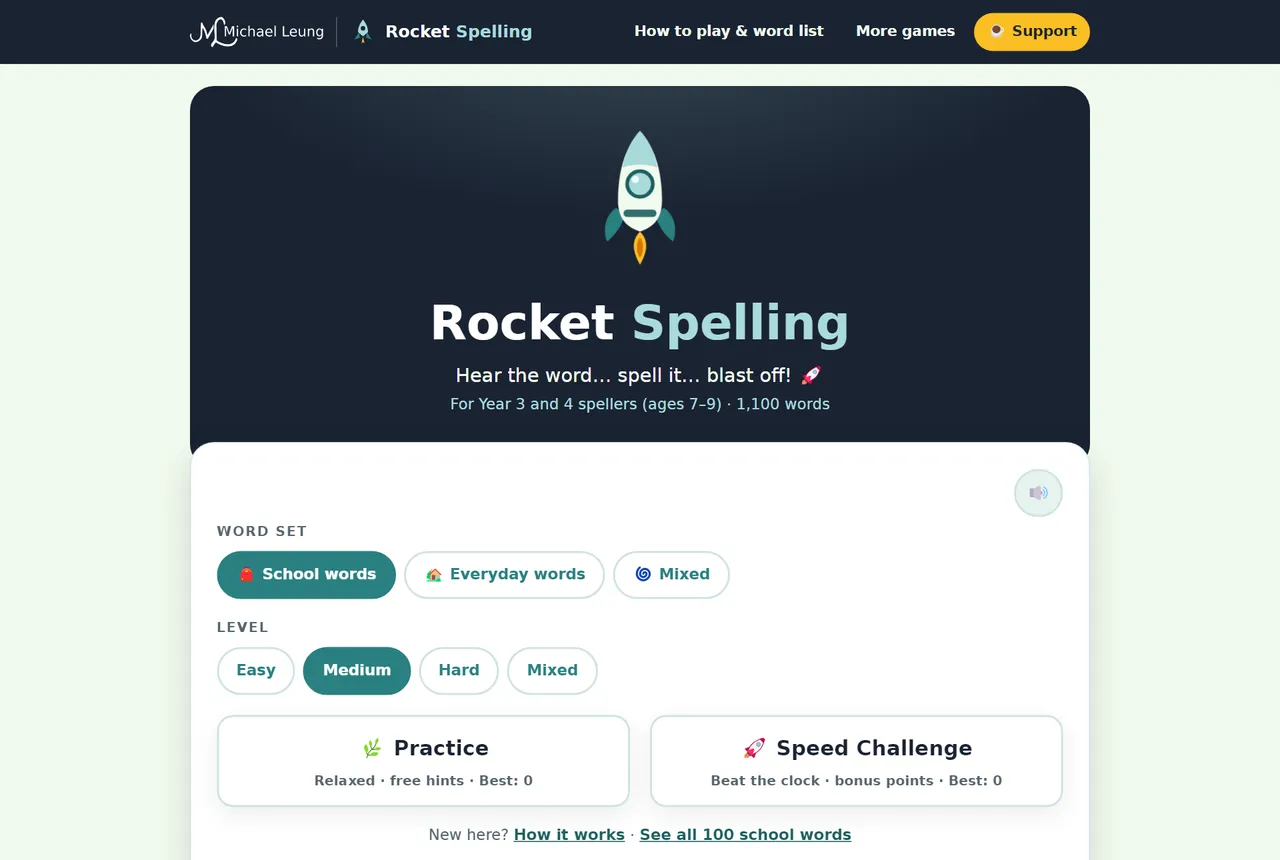
Rocket Spelling is a spelling test that runs itself. The game says a word out loud, your child types it, and they find out straight away whether it was right. Ten words make a round, and a round takes a few minutes.
It is built around the 100 statutory Year 3 and 4 words from England’s National Curriculum (believe, February, separate, though and the rest), plus 1,000 everyday words in three levels. Words your child gets wrong come back sooner, and after every round they can practise just the ones they missed.
It runs in the browser on a computer, tablet or phone. No download, no adverts, no account.
How does Rocket Spelling work?
Each round is ten words. Your child needs sound on, or headphones.
- Pick the words and a level. School words, everyday words or a mix, then Easy, Medium, Hard or Mixed.
- Choose Practice or Speed Challenge. Practice has no clock. Speed Challenge gives a bonus for quick answers.
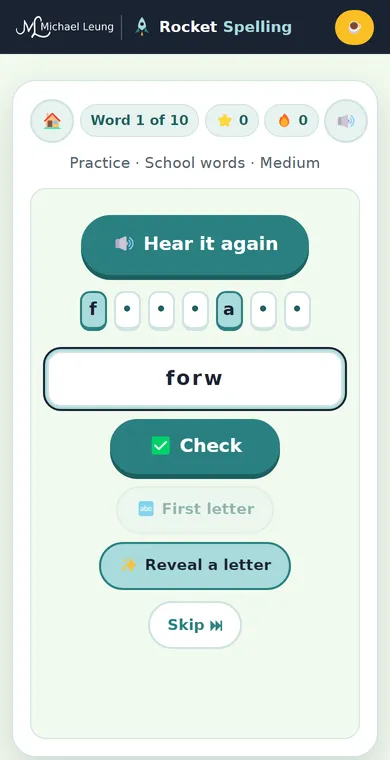
- Listen, then type. The game says the word. One box per letter shows how long it is. Press Hear it again as often as you like.
- Check. A right answer earns points and keeps the streak going. A wrong one shows the correct spelling for a few seconds, then the next word comes.
- See the results. Up to three stars, the score, and the words to practise, with a button to go over those words again straight away.
Practice or Speed Challenge?
Start in Practice. Once your child gets three stars there, try the same words against the clock.
| Rule | Practice | Speed Challenge |
|---|---|---|
| Timer | None | Per word: 25 s (easy), 20 s (medium), 15 s (hard) |
| Hints: first letter, reveal a letter | Free | −2 points each |
| Points for a right answer | 10 | 10, plus up to 10 for speed |
| Three stars | 9 or 10 right | 9 right, or 8 if your answers were quick |
Two stars needs 6 right (5 in a quick Speed Challenge) and one star needs 3. Skip shows the word and moves on, with no penalty beyond losing the streak.
Which words are in the game?
School words are the statutory word list for Years 3 and 4 in England’s National Curriculum (English Appendix 1). Schools there teach these words across Years 3 and 4. Where the official list gives two forms, such as accident(ally) or woman/women, the game uses the harder one.
I split the list into two levels myself, because the official list is not graded. The first half follows more regular patterns. The second half is where the silent letters, double letters, ie/ei and -ough words live.
Medium: 50 more regular words
- answer
- appear
- arrive
- breath
- build
- calendar
- caught
- circle
- complete
- consider
- continue
- decide
- describe
- different
- early
- earth
- famous
- favourite
- forward
- fruit
- group
- heard
- heart
- history
- important
- increase
- interest
- learn
- length
- library
- material
- mention
- minute
- natural
- notice
- often
- opposite
- ordinary
- perhaps
- popular
- position
- possible
- potatoes
- probably
- promise
- purpose
- quarter
- question
- recent
- regular
Hard: 50 trickier words
- accidentally
- actually
- address
- believe
- bicycle
- breathe
- business
- centre
- century
- certain
- difficult
- disappear
- eighth
- enough
- exercise
- experience
- experiment
- extreme
- February
- grammar
- guard
- guide
- height
- imagine
- island
- knowledge
- medicine
- naughty
- occasionally
- particular
- peculiar
- possession
- pressure
- reign
- remember
- sentence
- separate
- special
- straight
- strange
- strength
- suppose
- surprise
- therefore
- though
- thought
- through
- various
- weight
- women
Everyday words are 1,000 common words for this age: 400 easy (boat, frog, soup), 350 medium (bridge, garden, thumb) and 250 hard (breakfast, neighbour, vegetable). They were chosen from the open-source word-list dictionary and checked by hand.
Is this the Australian Year 4 spelling list?
Not exactly, because there isn’t one. The Australian Curriculum describes what Year 4 spellers should be able to do, such as using letter patterns, double letters, prefixes and suffixes, and spelling a large core of high-frequency words. It doesn’t publish a national word list, so each school picks its own.
The England list is a useful stand-in. It is short, it is public, and its words are the kind Year 4 children trip over. Australian spelling follows British spelling, so centre and favourite are spelled the way your child’s teacher expects. If the school sends home its own list, practise that as well.
How to use it at home in ten minutes
- Short and often beats long. One or two rounds after school, most days, works better than an hour on Sunday.
- Always press “Practise missed words”. It replays only the words they got wrong, with no timer, while the right spelling is still fresh.
- Say the word in a sentence. The game reads each word on its own, so heard can sound like herd and weight like wait. If your child types the other word, that is a listening slip, not a spelling one. Say it in a sentence and try again.
- Move the tricky ones onto paper. For a word that keeps coming back, try look, say, cover, write, check: look at it, say it, cover it, write it from memory, then compare.
- Watch the “words mastered” count. A word counts as mastered after three correct spellings. It is a better measure of progress than the score.
Good to know
- The voice: words are read by your device’s built-in voice, slightly slowed down. The game picks a British or Australian English voice when there is one. If a device has no voice at all, the word flashes on screen for a moment instead.
- Typing: capital letters don’t matter, and the answer box only takes as many letters as the word has.
- Which words come up: the words your child has practised least come first, so a few rounds work through the whole set.
- Privacy: scores, stars and mastered words are saved only in this browser. Nothing is sent anywhere. The site counts visits with Google Analytics.
Questions parents ask
Is Rocket Spelling free?
Yes. No adverts, no in-game purchases, no paid version and no sign-up. If you find it useful, there is an optional Buy Me a Coffee link for grown-ups.
What age is it for?
It was made for Year 4 (ages 8 to 9). The school words are the Year 3 and 4 list, so Year 3 children can use it too, and the easy everyday words suit younger or newer spellers.
Does it work on an iPad or phone?
Yes. It runs in Safari and Chrome on tablets and phones and uses the on-screen keyboard. Turn the volume up so your child can hear the words.
Can my child practise only the words they got wrong?
Yes. After each round the Practise missed words button starts a short round of just those words, with no timer. The game also brings back words they have spelled correctly fewer times.
Where is progress saved?
In the browser’s storage on that device. Clearing your browser data resets it, and another device or browser starts from zero.
Ready for ten words?
Free, no adverts and no sign-up. One round takes a few minutes.
Play Rocket Spelling nowSources
Word lists: UK Department for Education, English Appendix 1: Spelling (Crown copyright, Open Government Licence v3.0), and word-list by Sindre Sorhus (MIT). Australian Curriculum: ACARA, English Year 4 content descriptions on spelling. Checked 8 October 2026. Full credits: licence notice.
Found this useful?
Buy me a coffee ☕
Everything here is free and ad-free. A coffee or a AU$1/month membership keeps new articles, games and tools coming.