NVIDIA has released an open-weight image generator: Nemotron-Labs-Image-30B-A3B. I love that NVIDIA keeps putting weights on Hugging Face for anyone to download. It already did that for language, speech and science models, and now image generation joins the list. So how does it stack up against Qwen Image 2.1, the open image model I already run every week on my 8GB GPU?
My short answer: on the one benchmark both companies report, Qwen Image 2.1 wins, 60.28 to 52.46, with a much smaller model. Nemotron is more interesting for how it makes pictures than for the score. It also needs data-centre GPUs, not a home graphics card. Both models are for non-commercial use only.
Below: what Nemotron-Labs-Image is, the benchmarks side by side, the hardware you need, the licences, and which one I'd use. I haven't run Nemotron myself yet. Every Nemotron number here comes from NVIDIA's model card, and every Qwen number from Qwen's own blog.
What is Nemotron-Labs-Image-30B-A3B?
It's an image generator that writes a picture the way a language model writes text, one token at a time. Most image models, including Qwen Image 2.1, are diffusion models. They start from noise and clean it up over 20 to 40 steps. Nemotron is autoregressive: it predicts image patches in rows, like words in a sentence.
- Size: 30B parameters in total, but only about 3B are active for each token (a mixture-of-experts design). It starts from NVIDIA's Nemotron 3 Nano language model.
- Image tokenizer: a separate ~642M-parameter encoder and decoder turns each 16×16-pixel patch into one of 196,560 fixed "visual words".
- Training: progressive mid-training, then GRPO reinforcement learning to improve prompt following and image quality.
- Resolution: any size where width and height are multiples of 16. NVIDIA recommends 1024×1024, 1248×832 and similar.
- What it does: text-to-image only. The model card doesn't mention image editing.
It's the first piece of a bigger NVIDIA project called Nemotron-Labs-VisualCreation, which pairs the image model with "VisionCode" models that write charts, SVGs and web pages as code. NVIDIA says those other parts will come later, "upon legal clearance". NVIDIA's technical report went up on Hugging Face around 22 November 2026.
Is Nemotron better than Qwen Image 2.1?
Not on the one test they share. On Qwen-Image-Bench, Qwen Image 2.1 scores 60.28 and Nemotron scores 52.46.
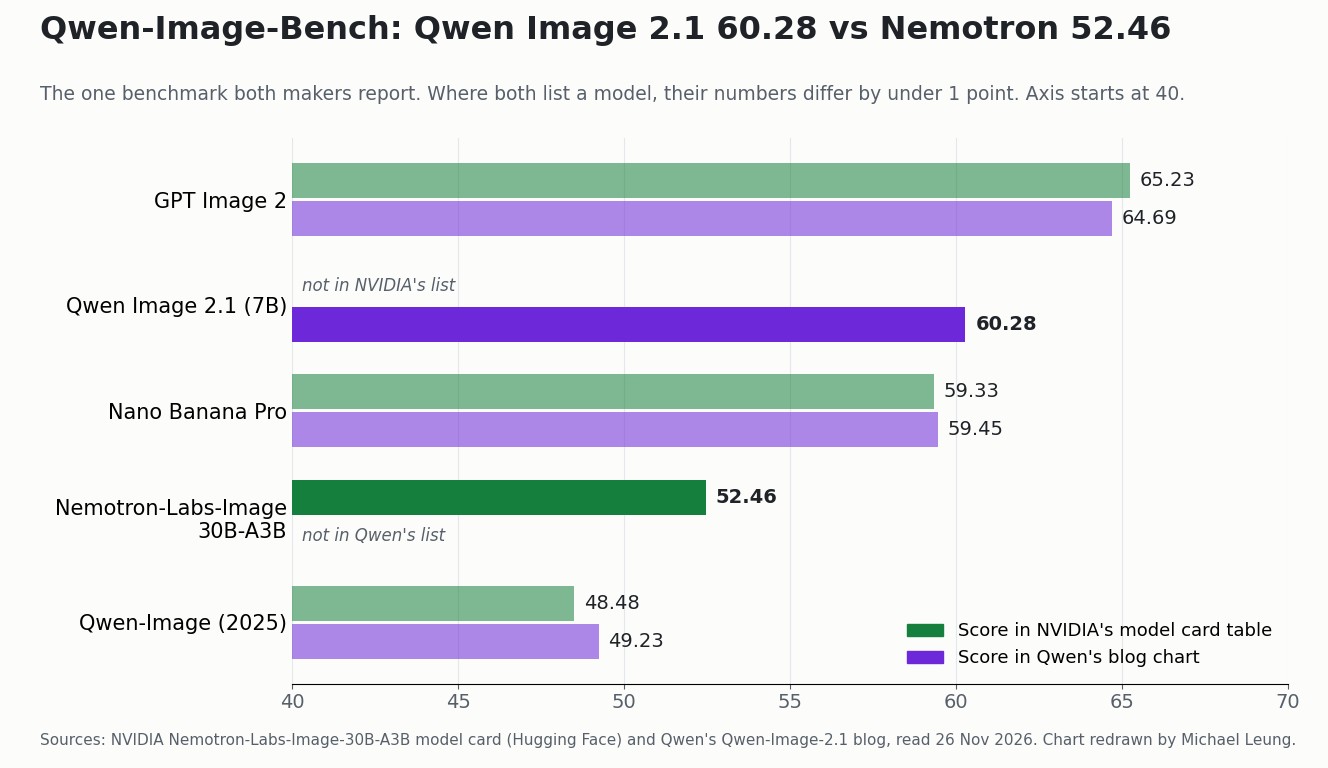
There's a catch here: neither company tested the other's new model. NVIDIA's table compares Nemotron with the original 2025 Qwen-Image, and Qwen's chart doesn't include Nemotron. So I put the two lists side by side. The models that appear in both lists (GPT Image 2, Nano Banana Pro and the original Qwen-Image) get nearly the same score in each, less than one point apart. That makes me fairly comfortable comparing 60.28 with 52.46, but it is still two separate test runs, not one head-to-head.
On NVIDIA's own wider set of tests, Nemotron does very well. These are NVIDIA's numbers, with the original Qwen-Image as the only Qwen model listed:
| Benchmark (higher is better) | Nemotron-Labs-Image | GPT Image 2 | Nano Banana Pro | FLUX.2 Dev | Qwen-Image (2025) |
|---|---|---|---|---|---|
| GenEval | 92.86 | 89.00 | – | 87.00 | 86.83 |
| GenEval2 | 65.43 | 81.00 | 59.00 | – | 33.80 |
| UniGenBench++ (long) | 94.25 | – | 94.20 | 90.31 | 83.94 |
| LongTextBench | 97.98 | 96.00 | 97.60 | 96.30 | 94.30 |
| CVTG-2K (text in images) | 92.53 | 90.03 | 77.90 | 89.26 | 82.88 |
| OneIG | 54.63 | 51.60 | 58.30 | – | 53.90 |
| Qwen-Image-Bench | 52.46 | 65.23 | 59.33 | – | 48.48 |
| WISE (world knowledge) | 91.50 | – | 87.60 | 56.50 | 51.00 |
| BizGenEval (business graphics) | 86.0 | 83.2 | 76.7 | 4.9 | 6.3 |
A dash means NVIDIA didn't report a score. Two results stand out to me. WISE asks for pictures that need real-world knowledge, and BizGenEval asks for business graphics like infographics. On both, Nemotron is far ahead of the open diffusion models in NVIDIA's table. That fits a model built on a language model: it "knows" more about the world. The weak spot is Qwen-Image-Bench, where even the closed GPT Image 2 and Nano Banana Pro are clearly ahead.
Qwen hasn't published GenEval, WISE or the other scores for Qwen Image 2.1, so I can't line those up. On Qwen's own chart, Qwen Image 2.1 (7B) sits just above Nano Banana Pro and Nano Banana 2.0. Of the models on that chart with a published size, it's the top scorer and also one of the smallest.
Can I run Nemotron-Labs-Image on an 8GB GPU?
Not officially. NVIDIA's example runs on four NVIDIA H100 80GB cards with vLLM. Qwen Image 2.1 runs on my RTX 4060 Ti 8GB in ComfyUI, about 32 seconds for a 768×1328 image.
Here's how the two compare for someone at home:
- Nemotron-Labs-Image: Linux, Python 3.12, CUDA 13, vLLM plus NVIDIA's own decoder code. It is not a Diffusers pipeline, and there's no official ComfyUI support. NVIDIA's model card gives no VRAM figure. Only 3B parameters are active per token, but all 30B still have to sit in memory, which is roughly 60GB or more at bfloat16.
- Qwen Image 2.1: official Diffusers, ComfyUI, vLLM-Omni and SGLang support from day one, plus an 8-step Turbo version. I use an int8 build in ComfyUI. My Qwen Image 2.1 on an 8GB GPU guide has the full setup The images in this post were made with it.
Community members have already uploaded quantised versions of Nemotron to Hugging Face, including GGUF and MLX builds, and even a ComfyUI port. They're not from NVIDIA, and I haven't tried them yet. If one of them fits in 8GB of VRAM with the rest offloaded to my 64GB of system RAM, I'll test it and write it up in my Local AI on an 8GB GPU series.
Is Nemotron-Labs-Image really open source?
It's open weight, not open source in the strict sense, and that's true of Qwen Image 2.1 as well. You can download both, run them and study them, but both licences limit you to non-commercial use.

- Nemotron-Labs-Image: NVIDIA's model card says it is "licensed for non-commercial research and evaluation" under the NVIDIA OneWay Noncommercial License.
- Qwen Image 2.1: the Qwen Research License Agreement, for non-commercial purposes only. Commercial users need a separate licence from Qwen, or can use the paid Qwen Image 2.1 Pro and Turbo APIs.
This is different from NVIDIA's Nemotron for Science model last week, which allows commercial use. Even so, I'm glad NVIDIA shared the weights, the tokenizer, the inference code and a full technical report. Researchers and hobbyists can learn a lot from a big autoregressive image model they can actually open up. That's how open AI moves forward.
Which one should you use?
- You have a normal gaming GPU and want good images today: Qwen Image 2.1. It scores higher on the shared benchmark, runs on 8GB, edits images and makes transparent PNGs.
- You're a researcher, or you have access to big NVIDIA GPUs: try Nemotron-Labs-Image. Its strong world-knowledge and business-graphics scores, and the autoregressive design, make it worth studying.
- You need images for a business: check the licences first. Neither open model allows commercial use without extra permission.
I'll keep watching both. If NVIDIA releases a smaller Nemotron image model, or a community build runs well on my 4060 Ti, I'll test it against Qwen Image 2.1 with the same prompts.
Sources (checked 26 November 2026)
- NVIDIA, Nemotron-Labs-Image-30B-A3B model card on Hugging Face: architecture, hardware, licence and all Nemotron benchmark tables.
- Qwen, Qwen-Image-2.1 blog (Qwen-Image-Bench chart) and model card and licence.
- My own Qwen Image 2.1 timing on an RTX 4060 Ti 8GB, from my data video post.
I wrote this article with help from AI for research and drafting. I checked the numbers against the official pages above and redrew the chart myself. Images were made with Qwen Image 2.1 on my own PC.