NVIDIA has released Nemotron for Science, a free kit for building AI agents that do lab work. The core is an open-weight model, Nemotron 3.5 Super VL, and NVIDIA ships it with a chemistry dataset, science tests and the recipes to train the model on your own data. You can download all of it from Hugging Face and use it commercially.
I support open source, so I like this release a lot. A big company that could keep its best science model behind an API has handed labs the weights, the data and the method. You still need serious hardware to run it, though. It won't fit on the 8GB GPU I use for my home tests.
What is Nemotron for Science?
It's a toolkit for building science agents, announced by NVIDIA on 16 November 2026. An agent built with it can read scientific papers and images, write code and call lab software, including NVIDIA's CUDA-X tools.
The kit has four parts:
- The model: Nemotron 3.5 Super VL, an open vision-language model with 120B parameters (12B active).
- A chemistry dataset: LitmusBench v0.2, with 47,118 training questions and 2,056 test questions about molecule properties.
- Science tests for checking how well an agent does in your field.
- Post-training recipes for tuning the model on your own lab results.
The model itself went up on Hugging Face as version 1.0 on 15 October. What's new this month is the science package around it, plus the partner results NVIDIA published with it.
How big is Nemotron 3.5 Super VL, and what can it read?
It has 120 billion parameters, but only about 12 billion are active for each token. It takes text, images and up to two minutes of video, and it answers in text, with a context window of up to 1 million tokens.
Under the hood it mixes Mamba-2 layers with Transformer layers in a mixture-of-experts design, with 512 experts in each expert layer. You can switch reasoning on or off. Few active parameters means each answer is cheaper to compute, which matters when an agent runs all night.
Is Nemotron for Science really open source?
The weights are open and free for commercial use, under the OpenMDW License 1.1. The model card says it is "ready for commercial or non-commercial use".
The chemistry dataset is open too. Questions built from ChEMBL data use CC BY-SA 4.0, and the rest use OpenMDW 1.1. With the weights, data and recipes all public, a university or a small biotech can tune the model on its own results and keep it in-house. Nobody has to send private lab data to a cloud API.

Why would NVIDIA give this away? My guess is simple: every lab that builds on Nemotron needs NVIDIA hardware to train and run it. Whatever the reason, open weights are good for science. Other people can check the results, repeat them and build on them, and that is how science is meant to work.
Does it actually help in the lab?
NVIDIA's partners report clear gains after tuning the model on their own data. These are vendor and partner numbers, not independent tests:
- Lila Sciences: tuning with lab feedback nearly doubled accuracy at making quantum dots, to 61%. NVIDIA compares that with 54% for GPT-6 Astra, at 10 to 20 times lower inference cost.
- Terray Therapeutics: the model pulled about 76% of the reactions out of chemistry diagrams on the RxnScribe test.
- Therna: tuning nearly doubled accuracy at predicting protein expression ranges, and scientists preferred its explanations in 96% of comparisons with the base model.
- KTH Royal Institute of Technology: an agent fixed 81% of test cases in one overnight run on a single DGX Spark, with the GROMACS simulation software checking every fix.
Argonne National Laboratory, Jülich Supercomputing Centre and RIKEN are also on board. The pattern is the same each time: the general model is decent, and tuning it on a lab's own data is what makes it good.
How does it compare with other open models?
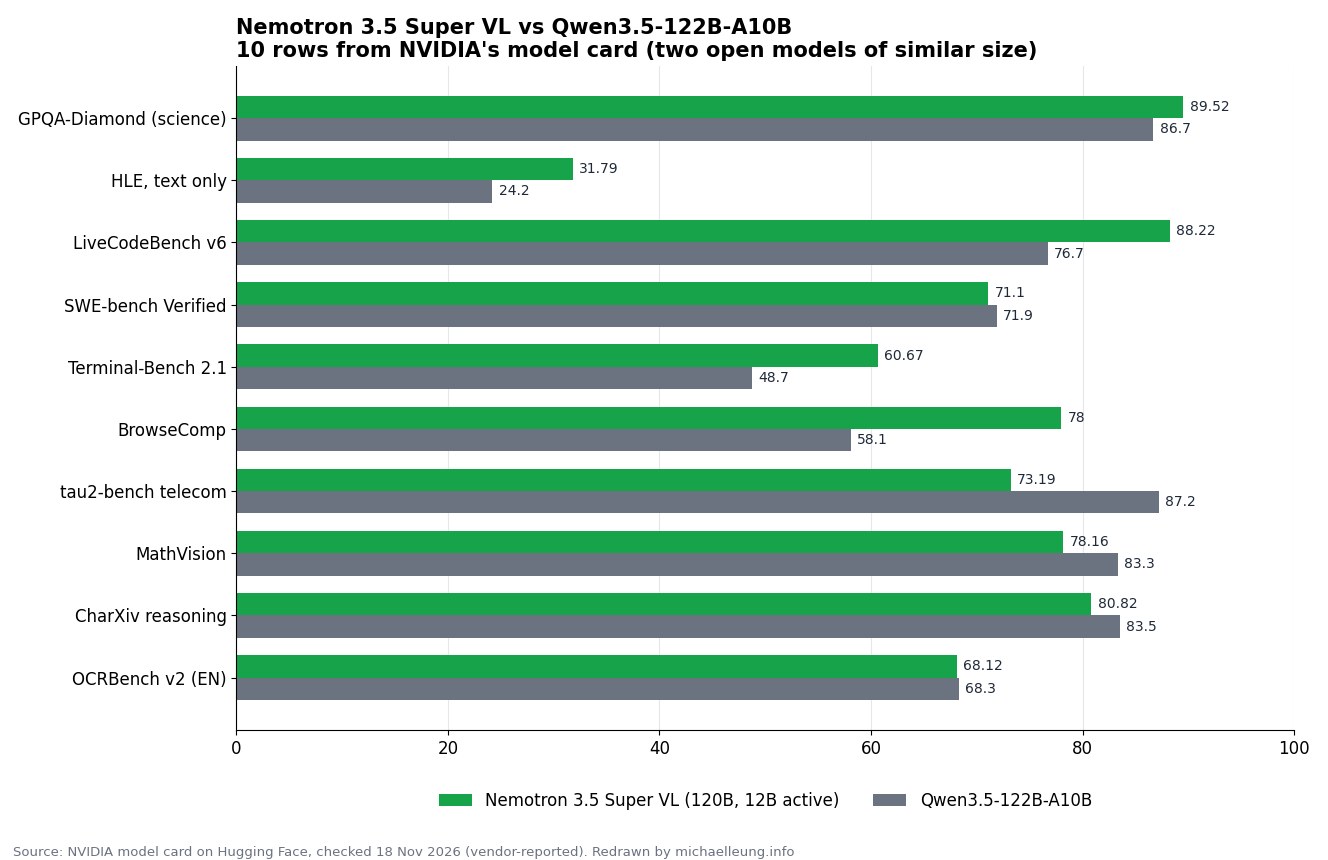
Against Qwen3.5-122B-A10B, an open model of about the same size, Nemotron 3.5 Super VL wins most of the reasoning, coding and agent tests on NVIDIA's model card. Qwen's model wins on maths in images, chart reading and the tau2 customer-service test.
| Benchmark (NVIDIA's card) | Nemotron 3.5 Super VL | Qwen3.5-122B-A10B | Qwen3.8-Flash-Next |
|---|---|---|---|
| GPQA-Diamond (science) | 89.52 | 86.7 | 92.7 |
| Humanity's Last Exam (text) | 31.79 | 24.2 | 39.6 |
| LiveCodeBench v6 | 88.22 | 76.7 | 94.1 |
| SWE-bench Verified | 71.10 | 71.9 | 78.7 |
| Terminal-Bench 2.1 | 60.67 | 48.7 | 85.8 |
| BrowseComp | 78 | 58.1 | 89.0 |
| tau2-bench telecom | 73.19 | 87.2 | 90.4 |
| MathVision | 78.16 | 83.3 | 87.5 |
| CharXiv reasoning | 80.82 | 83.5 | 85.8 |
| OCRBench v2 (English) | 68.12 | 68.3 | 67.9 |
Numbers from NVIDIA's model card; higher is better. Bold = best of these three (OCRBench is a near three-way tie). NVIDIA ran several tests with its own harnesses, so small gaps don't mean much.
One honest point: the newer Qwen3.8-Flash-Next beats Nemotron on nearly every row of NVIDIA's own table, sometimes by a lot (Terminal-Bench 85.8 vs 60.67). So Nemotron isn't the strongest open model on general tests. Its selling point is the science kit around it and a licence labs can build on. I tested Qwen3.8-Flash-Next on my own PC in this article.
Can you run Nemotron 3.5 Super VL at home?
Not on a normal gaming PC. NVIDIA's model card lists four H100s or two GB200s, and NVIDIA says the model was tuned to run locally on a DGX Spark with 128GB of memory.
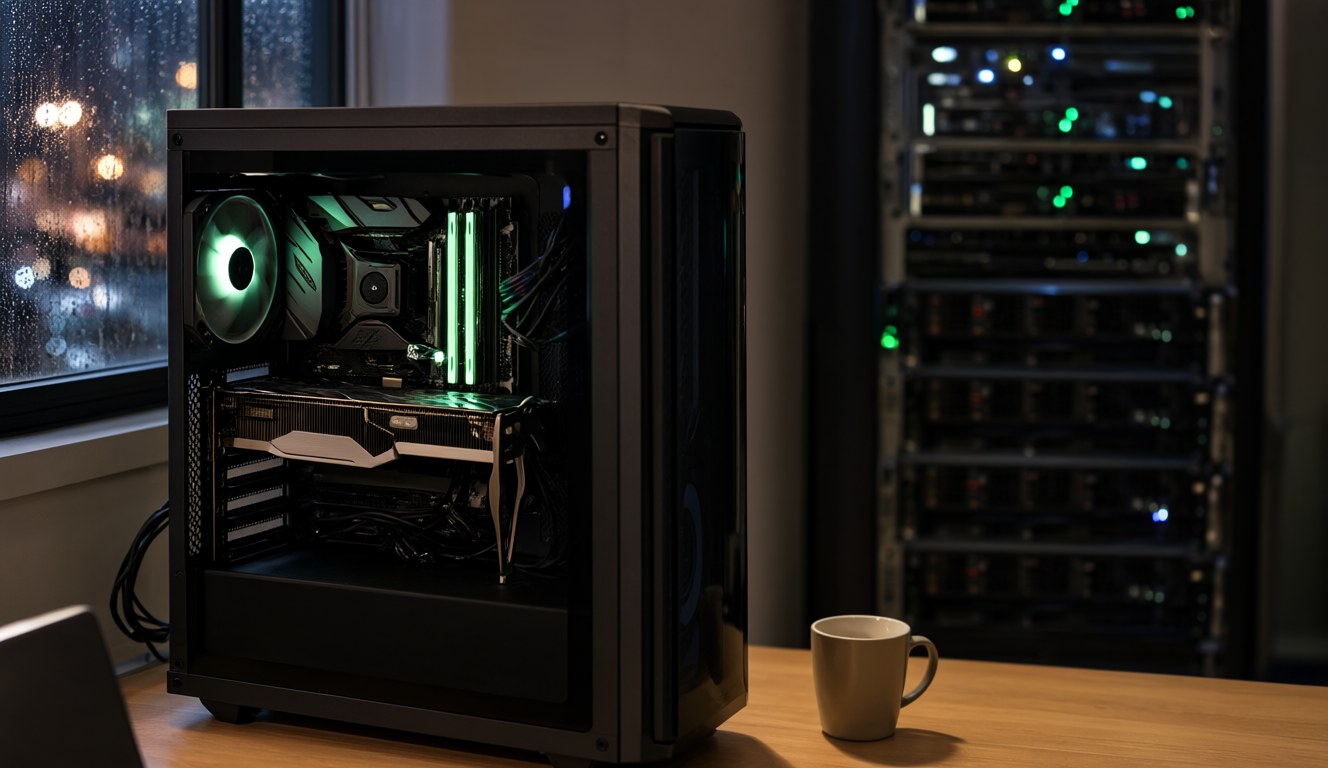
My home PC has an 8GB RTX 4060 Ti and 64GB of RAM (the build is in my 64GB RAM, 8GB GPU article). By my own rough maths, 120 billion parameters at 4 bits is about 60GB of weights before any memory for the context, so it would barely squeeze in and run very slowly. NVIDIA also offers an NVFP4 version, but there's no official GGUF file for llama.cpp or Ollama yet. I haven't tried it, and I won't claim a speed I haven't measured.
This model is for university labs, research institutes and biotech companies. For home users the bigger win is indirect: open science models make results easier to check and cheaper to reproduce.
What does this mean for open-weight AI?
It's another sign that open weights are becoming normal for serious models. In the past few weeks I've written about Ripple-65B, an open coding model, and Runway's open robot model Praxis-1. Now a science model joins them, and this one comes from NVIDIA itself.
I'd like to see the next step: a smaller Nemotron science model that fits on a home GPU, so students and hobby chemists can try this too. If NVIDIA releases one, I'll test it on my 8GB card. Have you tried Nemotron for Science in a lab? Tell me how it went on the contact page.
Sources
- NVIDIA Newsroom: NVIDIA Introduces Nemotron for Science to Accelerate Discoveries With Agents (16 Nov 2026), including the partner results.
- Hugging Face model card: NVIDIA-Nemotron-3.5-Super-VL-120B-A12B-BF16, for size, architecture, licence, hardware and benchmarks.
- Hugging Face dataset card: Nemotron-RL-litmus-bench-v0.2, for the dataset size and licences.
Checked 18 November 2026. All benchmark and partner figures are reported by NVIDIA and its partners; I haven't run the model myself. I redrew the benchmark chart from the model card numbers; the other images were made locally with Qwen Image 2.1. AI helped me research and edit this article.