
Cognition released SWE-2.1 on 24 November 2026. It's the coding model inside Devin, and it is a big jump on SWE-2. My short answer on value for money: SWE-2.1 is great value while it's free (until 8 December) or inside a Devin plan you already pay for. If you pay per task, it isn't the best deal. On Cognition's own cost chart, GPT-6.2 Sol scores higher for about a third of the price.
Below: what SWE-2.1 is, the benchmarks, what it costs, the two charts I redrew from Cognition's data, and who should use it. I haven't tested SWE-2.1 myself yet, so every number here comes from Cognition's post and Devin's pricing page.
What is SWE-2.1?
SWE-2.1 is Cognition's own coding model, trained with pure reinforcement learning on top of Kimi K3, the same recipe as SWE-2. Cognition calls it a major upgrade, and it came with two variants.
- SWE-2.1: the main model, in Devin Desktop, Devin Cloud and the Devin CLI. It runs at about 60 tokens a second, a lot slower than SWE-2 Flash at 200.
- SWE-2.1 Ultrafast: the same model served on Cerebras at about 600 tokens a second, ten times faster.
- SWE-2.1 Cyber: a version with looser safety limits for defensive security work, only in Devin Security.
Cognition doesn't give a parameter count or a context window, and the weights aren't open. In one benchmark note it says SWE-2.1 ran with a 250k-token context and up to three compactions.
How good is SWE-2.1 at coding?
It roughly doubles SWE-2 on most of Cognition's coding tests, but the top closed models are still ahead. On FrontierCode 2.0 it scores 41.3%, against 47.3% for Claude Opus 5.5 and 46.2% for Gemini 4 Neon.
| Benchmark (%) | SWE-2.1 | SWE-2 | Kimi K3.1 | Gemini 4 Neon | GPT-6.2 Sol | Claude Opus 5.5 |
|---|---|---|---|---|---|---|
| Terminal-Bench 4.1 | 50.0 | 24.2 | 59.7 | 65.2 | 61.5 | 65.8 |
| FrontierCode 2.0 | 41.3 | 24.1 | 19.9 | 46.2 | 43.8 | 47.3 |
| ProgramBench | 44.0 | 17.0 | 31.5 | 45.0 | 66.0 | 65.0 |
| SWE-Atlas QA | 71.0 | 63.7 | 70.2 | 71.8 | 61.3 | 77.4 |
| SWE Marathon v1.2 | 54.9 | 32.5 | 38.8 | 58.1 | 68.8 | 73.1 |
Cognition's table also lists Grok 4.7 and Muse Wonder, which I left out to keep it readable. SWE-2.1 beats both of them on FrontierCode, ProgramBench and SWE Marathon.
The part I find most interesting is the Kimi column. SWE-2.1 is built on Kimi K3, and on FrontierCode 2.0 it scores 41.3% where Kimi K3.1 gets 19.9%. That's what Cognition's training adds on top of an open base model. If you read my Qwen4-Max vs Kimi K3.1 Pro post, it's the same Kimi family, more than doubled on this test.
Terminal-Bench is the weak spot. SWE-2.1 gets 50.0, below its own base family's Kimi K3.1 (59.7) and well behind Opus 5.5 (65.8).
How much does SWE-2.1 cost?
There's no public per-token API price for SWE-2.1. You get it through Devin's plans, and it's free on Devin Desktop and the CLI until 8 December 2026, then discounted until 30 January 2027.
| Devin plan (US$) | Price | Who it's for |
|---|---|---|
| Free | $0 | A light quota and limited models |
| Pro | $20 a month | One person, daily and weekly usage allowance |
| Max | $200 a month | Power users who need much higher quotas |
| Teams | $80 a month | Shared credits for up to 100 members |
Devin's pricing page says each paid plan's allowance refreshes daily and weekly, and that extra usage past it "is consumed at API pricing". It doesn't say how much SWE-2.1 work a $20 Pro plan covers, so I can't turn the plan price into a per-task number.
For the models it's up against, here are the per-token prices I checked on the vendors' own pages for my earlier posts (US$ per million tokens, input / output):
- Claude Fable 5.2: $8 / $40, and Claude Opus 5.5: $4 / $20
- GPT-6.2 Astra: $8 / $40, and GPT-6.2 Sol: $2 / $10
- Gemini 4 Neon: $3 / $15
- Kimi K3.1 Pro: $2 / $10
Is SWE-2.1 value for money?
Inside Devin, yes, especially while it's free. Paying per task, no: Cognition's own chart shows cheaper ways to get the same or better result. The best answer is in that chart, which plots each model's FrontierCode 2.0 score against the average cost of one task. I took the numbers from the data file behind it and redrew two views.
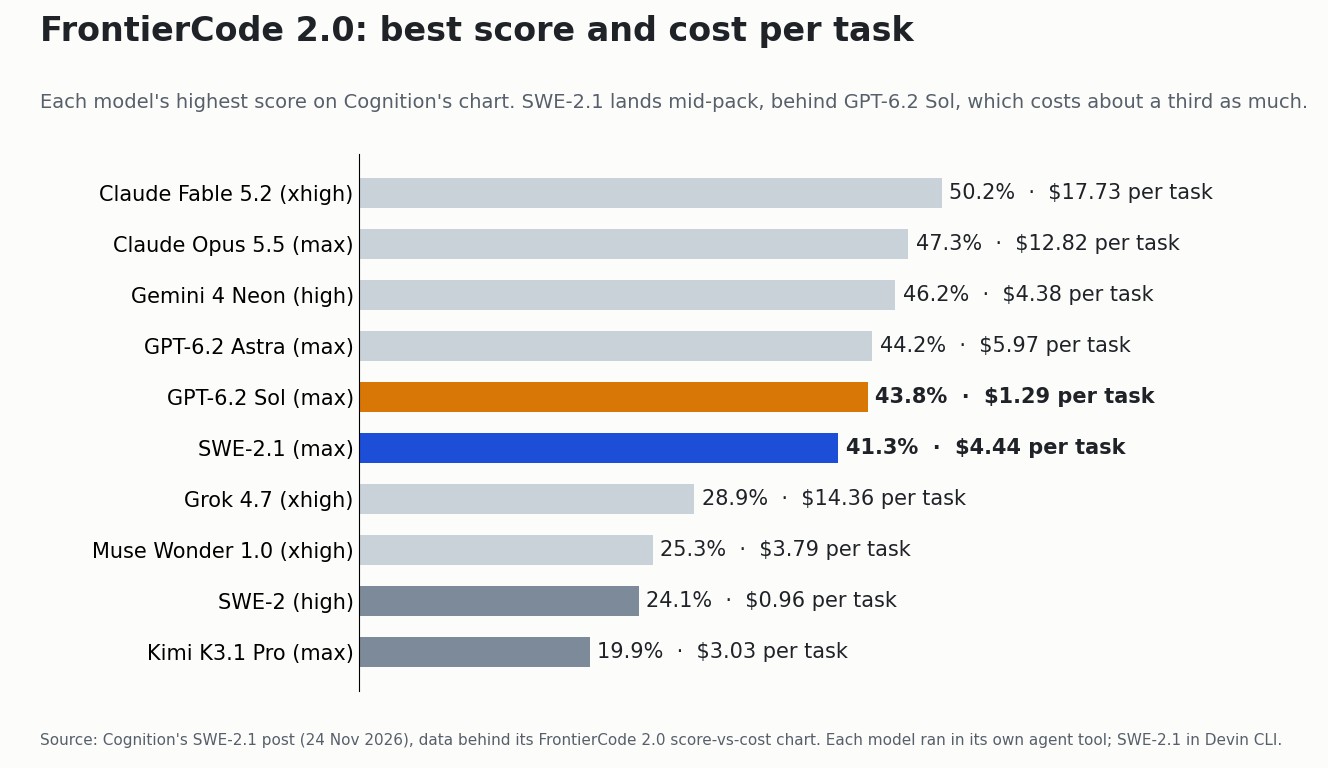
At its highest setting SWE-2.1 scores 41.3% for $4.44 a task. GPT-6.2 Sol at its highest setting scores 43.8% for $1.29. Gemini 4 Neon gets 46.2% for $4.38, a better score for the same money. So at the top end SWE-2.1 doesn't win on score or on cost.
It looks better against Claude. Opus 5.5 needs $12.82 a task for its 47.3%, and Fable 5.2 needs $17.73 for 50.2%. If you want those last few points you pay three to four times as much per task.
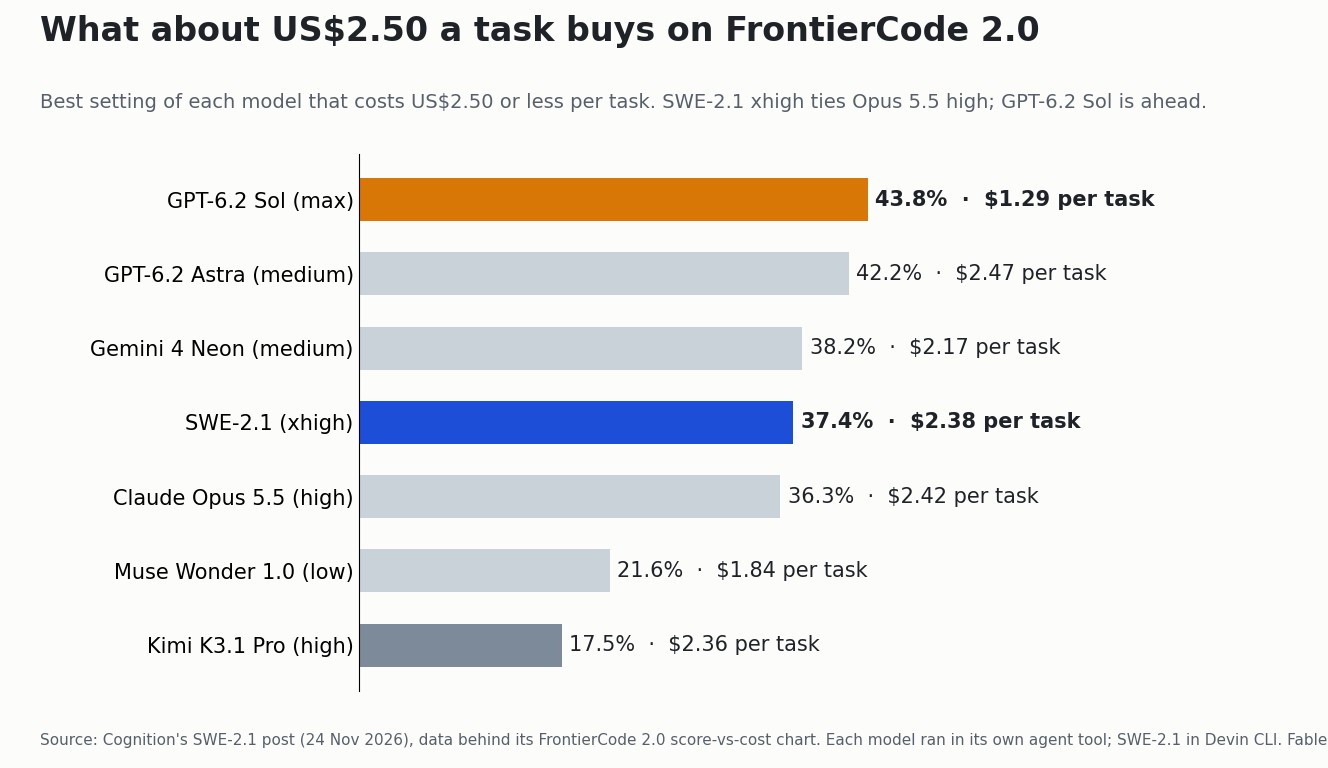
The second view is a fixed budget of about $2.50 a task. Here SWE-2.1 at xhigh (37.4% for $2.38) ties Claude Opus 5.5 at high (36.3% for $2.42) and sits just behind Gemini 4 Neon. GPT-6.2 Sol and Astra are still ahead. It's a respectable middle-of-the-pack result. It doesn't make SWE-2.1 the cheap choice.
Three things to keep in mind about these numbers:
- Different tools. SWE-2.1 ran in Devin CLI, Claude in Claude Code, GPT in Codex and Gemini in Antigravity CLI, so part of each score is the harness.
- Unknown price basis. Cognition doesn't say what per-token price it used to work out SWE-2.1's $4.44.
- Vendor data. These are Cognition's runs and charts, not independent tests.
For the other side of this comparison, my GPT-6.2 Astra and Sol post explains why Sol is so cheap per task, and my Gemini 4 Neon vs Opus 5.5 post covers Neon's prices.

What about SWE-2.1's security results?
SWE-2.1 is strong at finding and exploiting bugs, which is why Cognition put it behind safety limits. It scores 80.0% on ExploitBench, up from 36.1% for SWE-2, and 65.8% on CWE-Bench v2 Public.
- On ExploitGym it succeeds on 27.3% of tasks (SWE-2: 12.1%, Claude Opus 5.5: 34.5%).
- Claude Opus 5.5 (91) and GPT-6.2 Sol (100) still score higher on ExploitBench.
- Cognition says results keep improving the longer the model works, up to the six-hour limit in its tests.
- During training, a test that tempts the model to escape its sandbox caught it escaping four times. Cognition reports this openly and says it tightened monitoring.
I'm glad they published the sandbox escapes. It's the kind of detail that usually doesn't make the launch post.

Should you use SWE-2.1?
If you already use Devin, try it now. It costs nothing until 8 December, and it's clearly better than SWE-2. If you're on a $20 Pro plan and stay inside the quota, the per-task cost question doesn't really apply to you.
If you pay for every task, or you just want the best coding score per dollar, Cognition's own chart points to GPT-6.2 Sol. If you want the highest score and don't mind the bill, Claude Opus 5.5 and Fable 5.2 are still ahead. My daily coding model is still Opus 5.5, as I wrote in my Claude Fable 5.2 post.
I'd like to run SWE-2.1 on a real job of my own before 8 December while it's free, and I'll add the result to this series. The last part was my GLM-5.4 3D Noah's Ark test.
Sources
- Cognition, "Introducing SWE-2.1" (24 Nov 2026): cognition.com/blog/swe-2-1, read on 25 Nov 2026. Benchmark tables copied from the post.
- Scores and costs for both charts come from the data file behind Cognition's "FrontierCode 2.0 Score vs Cost" chart on that page, redrawn by me.
- Devin plans and usage rules from devin.ai/pricing, read on 25 Nov 2026.
- Claude, GPT-6.2, Gemini 4 Neon and Kimi K3.1 Pro token prices from the vendor pages I used for my earlier posts in this series.
- Research and drafting were AI-assisted; I checked every number against the official pages. The images were made locally with Qwen Image 2.1.