Gemini 4 Neon is Google's new middle model in the Gemini 4 family, released on 18 November 2026. In Google's own model card it scores close to Claude Opus 5.5, and ahead of it on most rows, while its API price is 25% lower: US$3 per million input tokens and $15 per million output tokens. On my Google AI Pro plan, Neon has already taken Argon's place in the Gemini app. I think that's a better deal, and the name sounds better too.
This follows my Argon, Carbon and Hydrogen posts. Here is what Neon is, how its numbers compare with Opus 5.5, what it costs, and how I plan to use it.
What is Gemini 4 Neon?
Neon is the balanced Gemini 4 model, sitting between Carbon (the biggest) and Hydrogen (the fastest and cheapest). Google's model card says Neon is "built for complex coding, analytical reasoning, and production-grade enterprise workflows" and is "adapted from Gemini 4 Carbon".
Google's own way of putting it: Carbon "tackles your hardest, long-horizon projects", Hydrogen "handles fast everyday execution", and Neon "balances depth and efficiency".
- Released: 18 November 2026
- Context: up to 1M tokens, shared by input and output
- Output: up to 64K tokens per normal request, or up to 1M with background "long decode"
- Input: text, images, audio and video
- Knowledge cutoff: March 2026
- Where: Gemini app, Gemini API and Google AI Studio, Gemini for business, Google Antigravity and Android Studio
Did Gemini 4 Neon replace Argon on the Pro plan?
On my account, yes. When I opened the Gemini app on my Google AI Pro plan, Neon was in the model menu where Argon used to be. Google hasn't announced that Neon replaces Argon, though. Argon doesn't appear on the Gemini plans page at all now, and it is still listed on the API pricing page with no shutdown date.
According to Google's plans page for Australia, Neon is in Google AI Pro (A$32.99 a month) and Ultra (from A$149.99). The page also tags it under AI Plus (A$7.99), but the Plus feature list itself only names Hydrogen, so I wouldn't count on Neon there yet. Google's announcement only mentions Pro and Ultra.
I mostly use Gemini for writing, and Argon was my writing model. I tested Argon on the Pro plan back in my Argon homepage test. If Neon writes as well as Google's numbers suggest, swapping it in is an upgrade for the same monthly fee.
Is Gemini 4 Neon as good as Claude Opus 5.5?
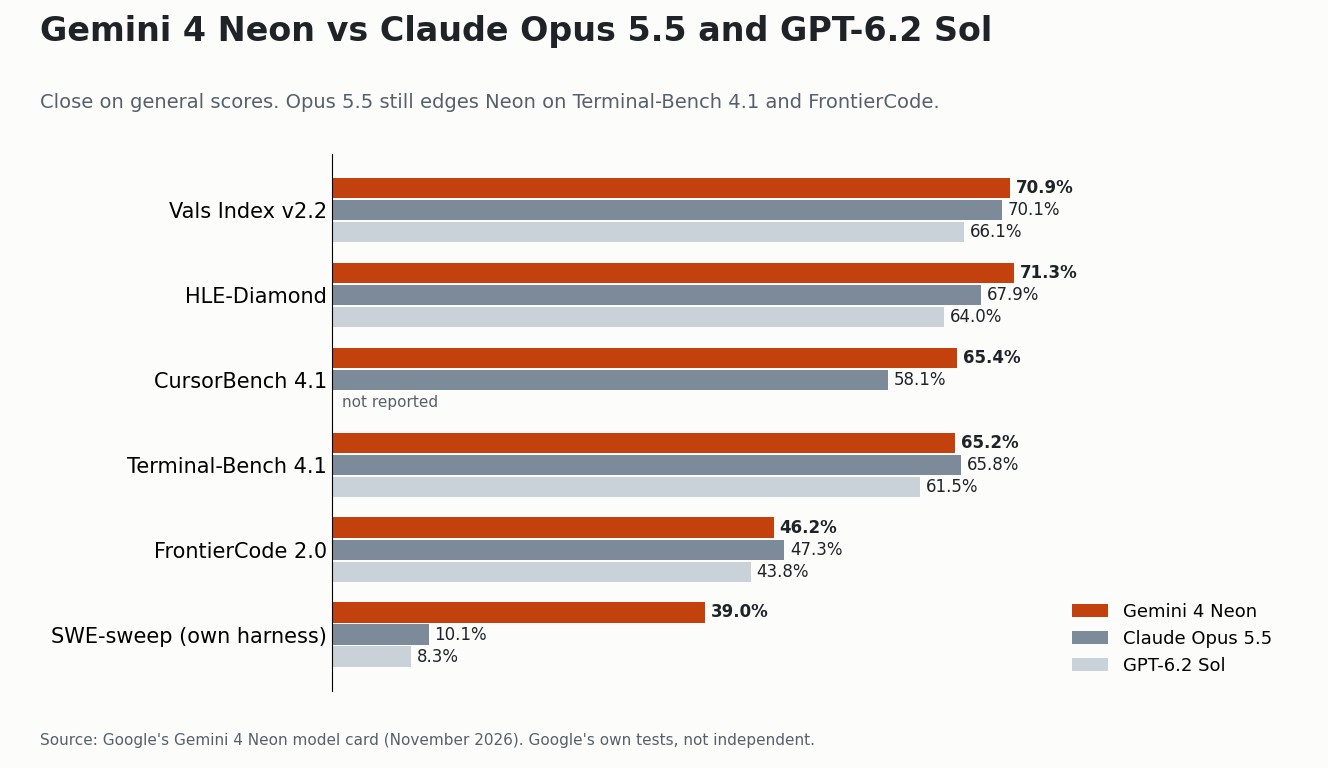
On Google's own tests, Neon is close to Opus 5.5 and ahead on most rows. The model card has 19 rows. Neon beats Opus 5.5 on 16 of them, Opus 5.5 wins 2, and 1 has no Opus score. I redrew six of them:
| Benchmark | Gemini 4 Neon | Claude Opus 5.5 | GPT-6.2 Sol |
|---|---|---|---|
| Artificial Analysis Index v5.0.1 | 61 | 59 | 57 |
| Vals Index v2.2 | 70.9% | 70.1% | 66.1% |
| CursorBench 4.1 (coding) | 65.4% | 58.1% | not reported |
| Terminal-Bench 4.1 (coding) | 65.2% | 65.8% | 61.5% |
| FrontierCode 2.0 (coding) | 46.2% | 47.3% | 43.8% |
| SWE-sweep (each vendor's own harness) | 39.0% | 10.1% | 8.3% |
| HLE-Diamond (reasoning) | 71.3% | 67.9% | 64.0% |
| GraphWalks 256K to 1M (long context) | 95.2% | 66.8% | 80.1% |
| AutomationBench (knowledge work) | 56.3% | 42.5% | 41.3% |
The two general indexes, Artificial Analysis and Vals, are the closest: 61 vs 59 and 70.9% vs 70.1%. That matches what I'd call "very close to Opus 5.5". The biggest gaps are long context (GraphWalks) and knowledge work (AutomationBench), where Neon is well ahead.
Keep in mind these are Google's numbers, run by Google. Anthropic and OpenAI might score their own models differently, and independent tests take a few weeks to show up.
Is Gemini 4 Neon good for coding?
On paper, yes, but coding is where Opus 5.5 holds on best. Opus 5.5 still wins Terminal-Bench 4.1 (65.8% vs 65.2%) and FrontierCode 2.0 (47.3% vs 46.2%). Both gaps are about one point. Neon wins CursorBench 4.1 by more than seven points.

Be careful with the big SWE-sweep number. Neon scored 39.0% in Google's own Antigravity harness, and on the shared mini-SWE harness it drops to 12.8%, against 3.6% for Opus 5.5. It still leads there, but the harness changes the score a lot.
Google's announcement adds a few coding claims I want to check myself:
- It "cuts redundant file reads" and shares progress while it works.
- It handles context compaction in long sessions.
- In Antigravity it can act as an orchestrator that directs parallel Hydrogen sub-agents.
- Its coding "cheating" rate is 2.45% of tasks, the lowest of any Gemini 4 model.
Right now I code with Claude. I'll try Neon on a real project next and write up what happens.
How much does Gemini 4 Neon cost?
On the paid API tier, Neon costs $3 per million input tokens and $15 per million output tokens, with cached input at $0.15. That is 25% cheaper than Claude Opus 5.5 at $4 / $20. Neon has no free tier.
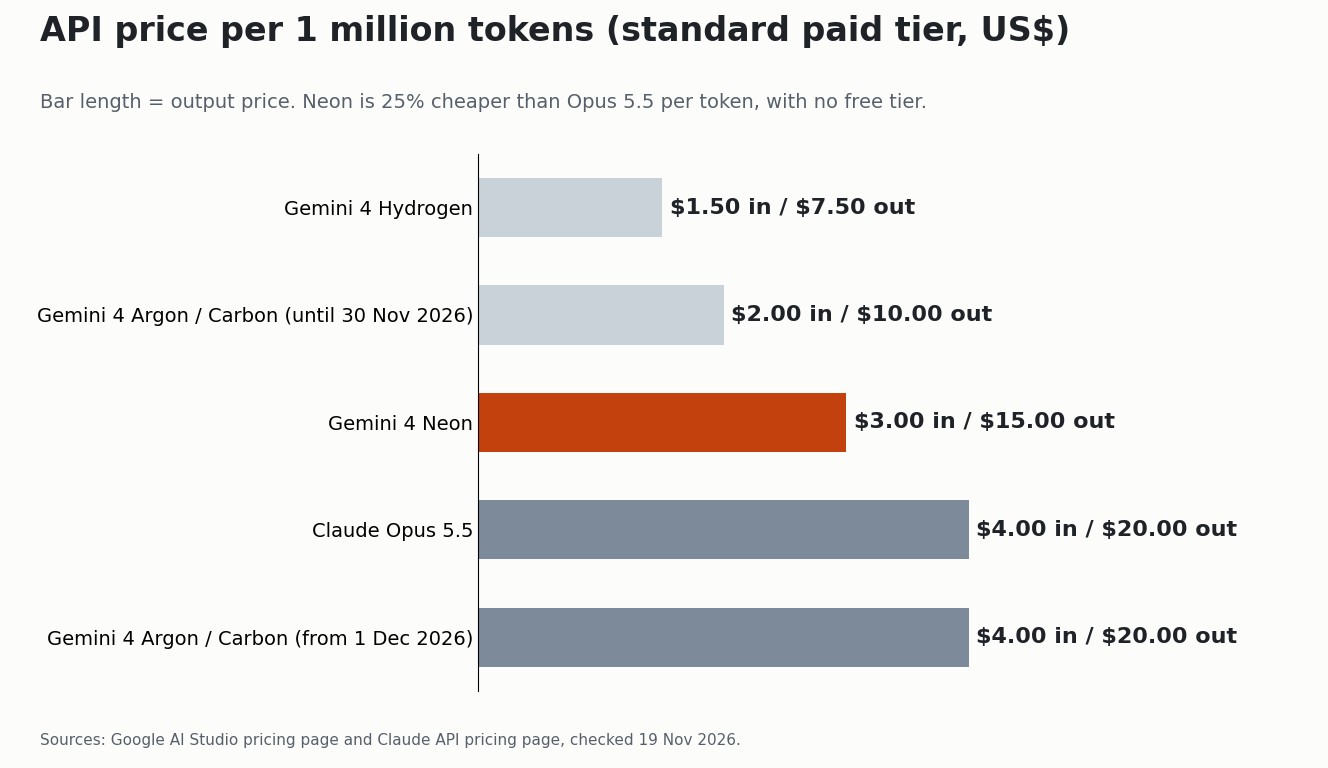
The pricing has one odd detail. Today, Argon and Carbon are on an introductory price of $2 / $10, which is cheaper than Neon. That ends on 30 November 2026. From 1 December they double to $4 / $20, and Neon becomes the cheaper choice. Batch and Flex use costs half for Neon: $1.50 / $7.50.
Google also says that at high thinking, Neon costs 32% less per task than Carbon. A low price per token doesn't always mean a cheap task, because output prices include thinking tokens. So test it on your own work.
Why is it called Neon?
Google hasn't said. Hydrogen is element 1, Carbon is 6, Neon is 10 and Argon is 18, so the names don't line up with model size. I said in my Hydrogen post that element names beat Max, Pro and Flash, and I still think so. "Neon" sounds bright and quick, which suits a model that is meant to be fast but still smart.
What I'll do next
For writing, I'm switching from Argon to Neon on my Pro plan today. For coding, I'll run Neon on a real project in Antigravity and compare it with Opus 5.5 on the same task, then post the results in this series.
If you only read one more post first, try my Qwen4-Max vs Kimi K3.1 Pro vs Opus 5.5 comparison, or my Gemini 4 Carbon benchmarks post for the top model in the family.
Sources
- Google blog: "Introducing Gemini 4 Neon" (18 November 2026)
- Google DeepMind: Gemini 4 Neon model card (November 2026), results table and knowledge cutoff
- Google AI Studio: Gemini API pricing page
- Google: Gemini subscriptions page (Australia, A$ prices)
- Anthropic: Claude API pricing page (Opus 5.5)
Figures checked on 19 November 2026. Benchmarks are Google's own and not independent tests. The illustrations were made locally with Qwen Image 2.1, the charts were redrawn by me from Google's model card, and AI helped with the research and the English.