
Is Claude Fable 5.2 worth using over Opus 5.5? For my everyday work, not really. Anthropic released Fable 5.2 on 9 November 2026, and on its own benchmarks it beats Opus 5.5 on almost everything. I'm on the Claude Pro plan, which gets Fable included for the launch week, so I asked it to review michaelleung.info. The result wasn't much different from what Opus 5.5 gives me: a few suggestions to make the pages a bit cleaner, such as moving the About Us section somewhere else. It also used up my limit much faster than Opus 5.5. When Opus 5.5 came out, it gave my website a big facelift. Fable 5.2 gave it a tidy-up.
What's new in Claude Fable 5.2?
It's Anthropic's most capable public model, built for the hardest, most open-ended technical work. Anthropic's announcement lists these changes from Fable 5.1:
- Better coding, reasoning and vision, with big jumps on robotics and chart reading.
- Up to 30% faster output than Fable 5.1, and testers say it explains things more clearly.
- Cheaper: $8 per million input tokens and $40 per million output tokens, down from $10 and $50 for Fable 5.1.
- Optional fast mode: up to 2.5 times faster for $16 / $80 per million tokens.
- Fewer false blocks: about 55% fewer unnecessary safety blocks than Fable 5.1 (60% fewer in cybersecurity, 40% fewer in biology).
- Medium effort by default in the Claude apps and Claude Code, using fewer tokens than Fable 5.1 for hard tasks.
- Advisor and orchestrator roles: smaller Claude models can consult Fable on hard problems, and Fable can hand simple jobs to smaller models.
The demos are big. Anthropic says a team of 1,000 Fable 5.2 agents formalised the proof of Fermat's Last Theorem in 30 hours. It also says Fable 5.2 solved two open problems about black holes, designed three working electronic devices from a one-paragraph prompt, and built a prototype operating system that boots on a laptop.
What's the difference between Fable 5.2 and Mythos 5.2?
They're the same model. Fable 5.2 has strong cybersecurity and biology safeguards, so it's open to everyone. Mythos 5.2 doesn't have those safeguards, so only vetted organisations can use it, through Anthropic's Cyber Verification and Life Sciences Verification programs. If Fable blocks a request, it answers with an older model instead: Opus 4.8 for cybersecurity, Opus 5 for biology. Anthropic's tests show Mythos 5.2 found 10.2% more known vulnerabilities than Opus 5.5 on its CVE Rediscovery test.
How does Claude Fable 5.2 compare with Opus 5.5?
On Anthropic's own benchmarks, Fable 5.2 is ahead on almost every test. The biggest gaps are in remote work tasks, robotics and science.
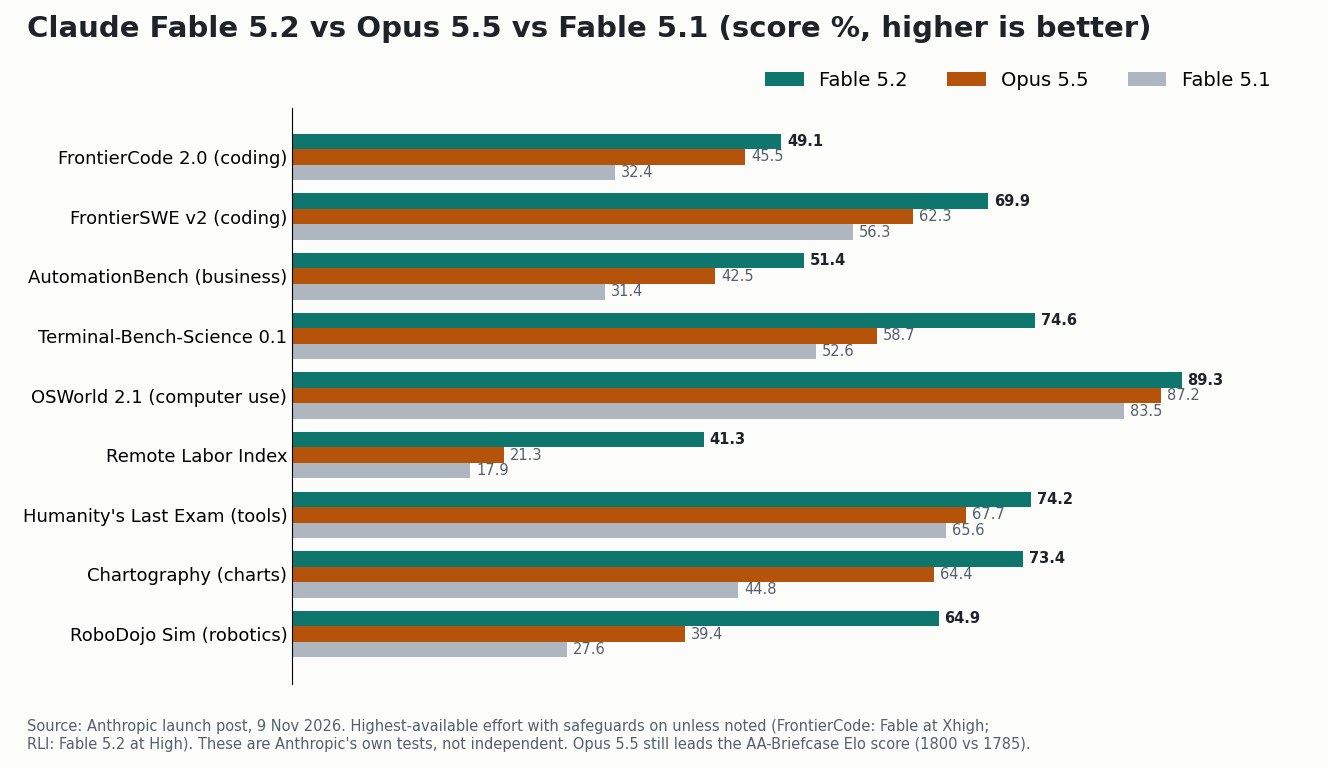
| Test | Fable 5.2 | Opus 5.5 | GPT-6 Astra | Gemini 4 Carbon |
|---|---|---|---|---|
| FrontierCode 2.0 (coding) | 49.1% | 45.5% | 42.8% | 41.1% |
| FrontierSWE v2 (coding) | 69.9% | 62.3% | 65.5% | 61.2% |
| AutomationBench (business) | 51.4% | 42.5% | 41.4% | 53.9% |
| OSWorld 2.1 (computer use) | 89.3% | 87.2% | 79.5% | 81.5% |
| Remote Labor Index | 41.3% | 21.3% | 20.8% | - |
| Humanity's Last Exam (with tools) | 74.2% | 67.7% | 57.2% | - |
| Chartography (no tools) | 73.4% | 64.4% | 71.0% | 72.5% |
| AA-Briefcase (knowledge work, Elo) | 1785 | 1800 | 1569 | 1611 |
Two things stand out. Opus 5.5 still wins one score in the table, the AA-Briefcase Elo for knowledge work, and Gemini 4 Carbon leads AutomationBench. Anthropic also says Fable 5.2 at High effort scores about the same as Opus 5.5 at Max effort on FrontierCode 2.0 (45.3% vs 45.5%), for roughly half the cost per task. These are Anthropic's own tests, run at each model's highest effort unless noted.
Even Anthropic doesn't tell most people to switch. Its advice is to start with Opus 5.5, "our strongest daily driver", and move up to Fable only for the most ambitious technical work.
Is Claude Fable 5.2 free on the Pro plan?
Only for the launch week. Anthropic's launch offer page says Pro plans and standard Team seats get every Fable model included from 9 November until 16 November 2026, 11:59 pm Pacific time, for up to 50% of the weekly usage limit. They also get one Fable limit reset, which expires at the same time. After that week, Fable on Pro goes back to running on paid usage credits.
- Pro and standard Team seats: one week of Fable included (up to 50% of weekly limits) plus one reset.
- Max, Ultra and premium Team seats: one to three Fable resets, depending on how long you've subscribed, valid until 8 March 2027.
- Free plan: not included.
A reset gives back the weekly usage you've spent on Fable and refills your five-hour window. It doesn't raise your limits. To use one, go to Settings, then Usage, then "Reset for free". Fable isn't your default model, so you have to pick it in the model picker.
What happened when I used Fable 5.2 to review my website?

It gave me a sensible clean-up list, not a redesign. I'm on Pro, so I got Fable 5.2 for the launch week plus one reset, and I used it to review michaelleung.info. It suggested a few changes to make the pages a bit cleaner, such as moving the About Us section to another place.
That's useful, but it's about what I'd expect from Opus 5.5 too. I didn't see the kind of step up the benchmark table suggests. When Opus 5.5 was released, it gave my website a big facelift, which changed a lot. Fable 5.2 didn't change much.
For a website review, maybe that's fair. A site that already had a big makeover doesn't need another one, and the benchmarks where Fable pulls ahead are long agent tasks, science and robotics, not web design.
Why does Fable 5.2 use up limits so fast?
Because it costs about twice as much as Opus 5.5 to run. In the API, Fable 5.2 is $8 / $40 per million input and output tokens, and Opus 5.5 is $4 / $20 (see my Claude models price comparison). Anthropic's launch offer page warns that "Fable models use your usage limits faster than other Claude models" and suggests watching Settings, then Usage.
That matched what I saw. My limit went down much faster than it does on Opus 5.5. On Pro, with Fable capped at 50% of the weekly limit, a couple of big tasks can use up a good part of the week.
Should you use Fable 5.2 or Opus 5.5?
Use Opus 5.5 for everyday work and save Fable 5.2 for jobs that really need it. For my website review, Fable 5.2's advice wasn't much different from Opus 5.5's, and Opus uses far less of my limit. Fable 5.2 makes sense for long, hard technical jobs: big migrations, research-style problems, or work where Opus keeps getting stuck.
If you're on Pro, the launch week is a free chance to try it. Pick one hard task you care about, not a quick question, and keep an eye on the usage meter. For how other models handled my homepage, see Gemini 4 Argon building my homepage and Meta Muse Wonder vs Claude Opus 5.5.
Sources
- Anthropic, "Introducing Claude Fable 5.2 and Claude Mythos 5.2", 9 November 2026: features, prices, benchmarks, safeguards, availability and the API model ID
claude-fable-5-2. - Claude Help Center, "Claude Fable 5.2 launch offers": what each plan gets, dates and how resets work.
- Claude Fable 5.2 and Mythos 5.2 System Card: full testing details.
- Fable 5.1 and Opus 5.5 prices: my earlier comparison, from Anthropic's pricing.
- The website review and usage observations: my own Claude Pro account, November 2026.
Checked 10 November 2026. Prices are in US dollars and can change. The benchmark chart was redrawn from Anthropic's table, the illustrations were made locally with Qwen Image 2.1, and AI (Claude, made by Anthropic) helped me research and edit this post.