Qwen4-Max is finally out. Alibaba's Qwen team has released it officially, after about a week of preview on the Token Plan. My short answer after using the preview: it is better than Kimi K3.1 Pro, it feels very close to Claude Opus 5.5 in daily work, and it costs a lot less. Qwen's own launch chart backs up the first part strongly. The second part is closer than it feels. Opus 5.5 still leads on 10 of the 14 scored tests Qwen published, and it leads by a lot on the hardest coding ones.
One honest caveat up front. Everything I have run so far was on the discounted qwen4-max-preview, not the model Alibaba is now selling. I will come back to what that means for the price.
What is Qwen4-Max?
Qwen4-Max is the first model in Alibaba's Qwen4 series, with 2.4 trillion parameters, 71 billion active per token and a 1-million-token context window. It can see images natively, and it runs in thinking and non-thinking modes.
From the official launch post:
- New architecture. Three out of every four layers use Gated DeltaNet, which squeezes history into a fixed-size state. The fourth uses a new "Qwen Sparse Attention" that picks relevant blocks of the context. There are also four parallel residual branches and 328B extra "N-gram embedding" parameters.
- Fewer tokens per job. Compared with Qwen3.8-Max, it uses about 24% fewer tokens on Qwen's Work360 test at Xhigh effort, and about 48% fewer on Terminal-Bench 4.0.
- Cheaper per task. Qwen says the average cost of one Work360 task fell from 26.58 yuan to 11.16 yuan, down 58%.
- Weights. Max is not open. Qwen says smaller Qwen4 models will be open-sourced later. Those are the ones I care about for my 8GB GPU tests.
Qwen's post is mostly about work: Blender scenes, Unreal and Godot games, car-part machining, legal due diligence, medical records and a 48-hour lab run that designed a new coolant molecule. It reads like a pitch for "a new teammate", and that is literally the title.
Is Qwen4-Max better than Kimi K3.1 Pro?
Yes, on Qwen's numbers and in my own use. On Qwen's launch chart, Qwen4-Max beats Kimi on 14 of 16 tests. Kimi only wins Terminal-Bench 4.0 (67.2 vs 48.5) and AutomationBench (73.3 vs 72.5).
That matches what I saw. I gave both models the same kind of job, a full 3D Noah's Ark in one HTML page. Qwen4-Max's ark was the best any model has built for me, with animals, live weather and sound. Kimi K3.1 Pro's ark worked, but had no "wow". Both left the same hole in the bow, which tells you 3D geometry is still hard for all of them. You can try the Qwen4-Max ark yourself.
The one place I'd still pick Kimi is long terminal work. A 19-point gap on Terminal-Bench is big, and Kimi's own table gave it 65.7 there too.
Is Qwen4-Max as good as Claude Opus 5.5?
Close on agent and office work, behind on hard coding and vision. On Qwen's own chart, Opus 5.5 is ahead on 10 of 16 tests and Qwen4-Max on 6.
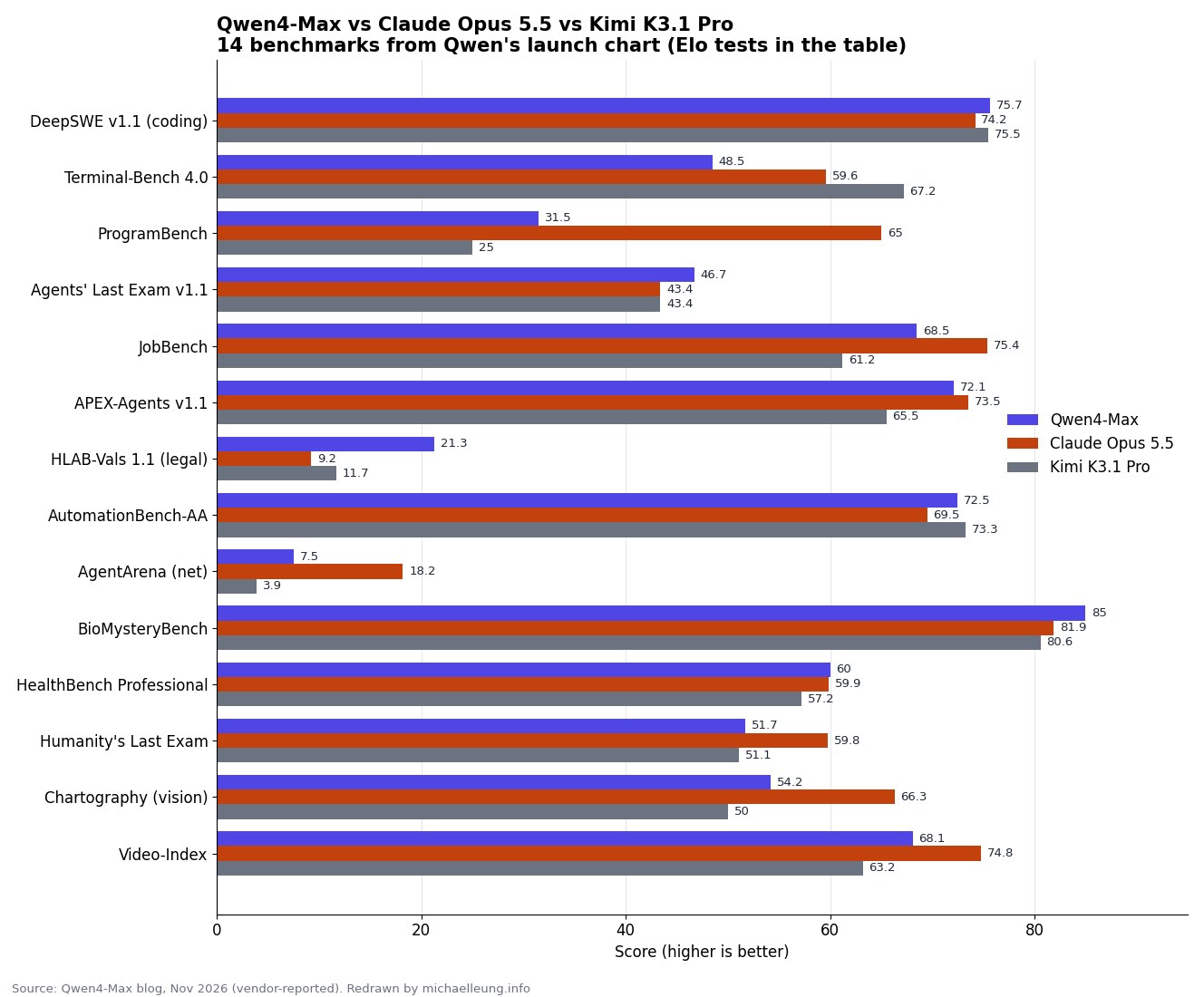
Many of those gaps are small. Qwen4-Max wins DeepSWE (75.7 vs 74.2), Agents' Last Exam (46.7 vs 43.4) and HealthBench (60.0 vs 59.9), and it is only 1.4 points behind on APEX-Agents. The legal test HLAB-Vals is its biggest win: 21.3 against Opus's 9.2.
The big gaps all go to Opus:
- ProgramBench (rebuild a whole program from its behaviour): Opus 65.0, Qwen4-Max 31.5.
- Terminal-Bench 4.0: Opus 59.6, Qwen4-Max 48.5.
- Chart reading and video: Opus is 12 and 7 points ahead.
- AgentArena, where people vote on real agent tasks: Opus 18.2, Qwen4-Max 7.5.
So why does it feel so close? I think it's because most of my day is the middle of that chart: building pages, fixing scripts, writing and checking. On that kind of work I honestly can't tell the two apart most of the time. If your work is "write a whole program from a spec" or long terminal sessions, the chart says you will notice.
| Benchmark (Qwen's chart) | Qwen4-Max | Claude Opus 5.5 | Kimi K3.1 Pro |
|---|---|---|---|
| DeepSWE v1.1 (agent coding) | 75.7 | 74.2 | 75.5 |
| CodeArena (web dev, Elo) | 1750 | 1816 | 1686 |
| Terminal-Bench 4.0 | 48.5 | 59.6 | 67.2 |
| ProgramBench | 31.5 | 65.0 | 25.0 |
| AA-Briefcase v1.1 (knowledge work, Elo) | 1686 | 1801 | 1674 |
| Agents' Last Exam v1.1 | 46.7 | 43.4 | 43.4 |
| JobBench | 68.5 | 75.4 | 61.2 |
| APEX-Agents v1.1 | 72.1 | 73.5 | 65.5 |
| HLAB-Vals 1.1 (legal) | 21.3 | 9.2 | 11.7 |
| AutomationBench-AA | 72.5 | 69.5 | 73.3 |
| AgentArena (net improvement) | 7.5 | 18.2 | 3.9 |
| BioMysteryBench | 85.0 | 81.9 | 80.6 |
| HealthBench Professional | 60.0 | 59.9 | 57.2 |
| Humanity's Last Exam | 51.7 | 59.8 | 51.1 |
| Chartography (chart reading) | 54.2 | 66.3 | 50.0 |
| Video-Index | 68.1 | 74.8 | 63.2 |
Bold = best of these three. Numbers read from Qwen's launch chart; higher is better. Qwen's chart also includes Qwen3.8-Max, GPT-6.1 Sol and GPT-6 Astra, and labels Kimi's model "Kimi K3.1".
Why don't Qwen's and Kimi's charts agree?
Because each lab runs or picks the numbers for its rivals, and they don't always match. I compared Qwen's chart with the table in my Kimi K3.1 Pro benchmarks article:
- Terminal-Bench 4.0: Kimi's table had Kimi 65.7 and Opus 66.4. Qwen's chart has Kimi 67.2 and Opus only 59.6.
- ProgramBench: Kimi gave itself 31.5. Qwen's chart gives Kimi 25.0.
- Some rows do agree: DeepSWE (Kimi 75.5, Opus 74.2) and Humanity's Last Exam without tools (Kimi 51.1, Opus 59.8) are the same in both.
Neither is lying, as far as I can tell. They use different harnesses, effort settings and leaderboard snapshots. It does mean a 2-point win on any launch chart is noise. Look for the big gaps, then try the model on your own work.
How much does Qwen4-Max cost compared with Kimi and Opus?
Qwen4-Max lists at US$1.50 per million input tokens and US$4.50 per million output tokens on Alibaba Cloud's international region. That is less than half of Kimi K3.1 Pro's output price and under a quarter of Opus 5.5's.
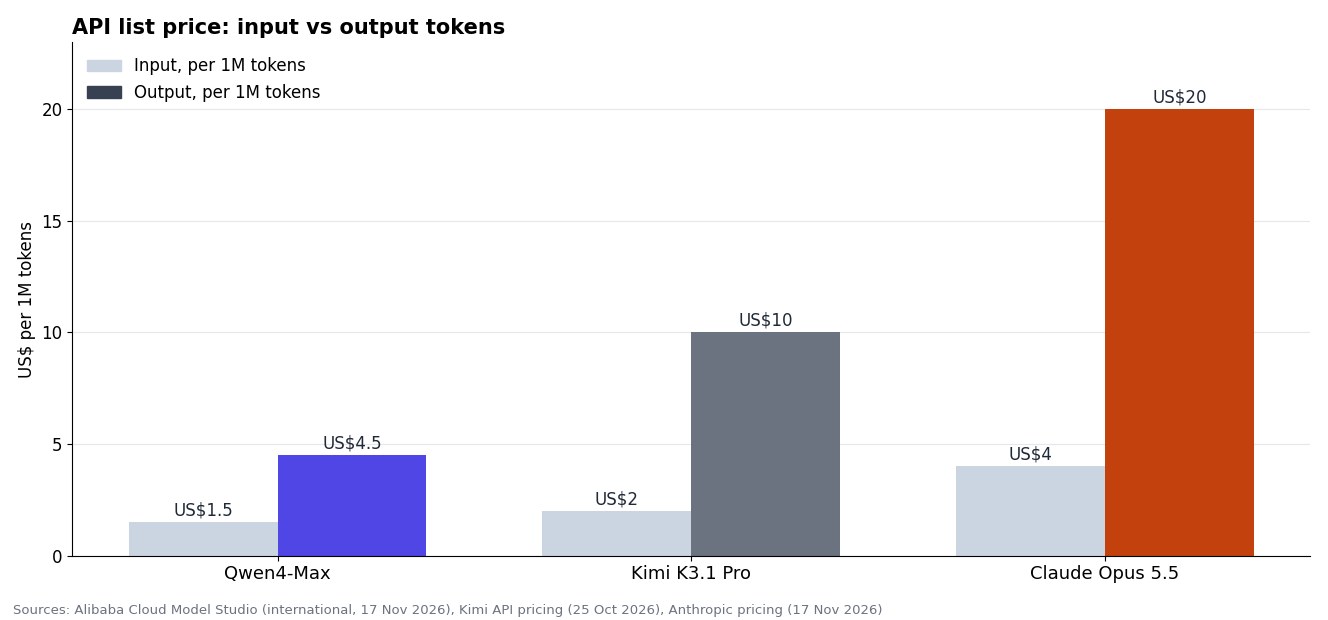
| US$ per 1M tokens | Input | Output | Cache read | Example job* |
|---|---|---|---|---|
| Qwen4-Max (international) | $1.50 | $4.50 | $0.075 | $2.40 |
| Kimi K3.1 Pro | $2.00 | $10.00 | $0.20 | $4.00 |
| Claude Opus 5.5 | $4.00 | $20.00 | $0.20 | $8.00 |
*Example job: 1 million input tokens and 200,000 output tokens, no caching. Qwen's China and other-region prices are slightly lower (US$1.413 / $4.24). The international region also gives 1 million free tokens for 90 days. Prices exclude tax.
So on list price, a job that costs US$8 on Opus 5.5 costs about $2.40 on Qwen4-Max. Coding agents re-read the same files a lot, and Qwen's cache-read price is also the lowest of the three, so the real gap can be wider.
What about the discounted preview I've been using?
The preview was even cheaper, and that is the part to be careful about. On the Token Plan, qwen4-max-preview uses credits at as little as 20% of the standard rate, and 8% between 10pm and 8am China time. That deal runs until 25 November 2026, and the preview model is retired after that.

So my "it's so cheap" feeling comes partly from a launch discount. At full list price it is still far cheaper than Opus 5.5, about a quarter on output. I also don't know yet whether the released qwen4-max behaves exactly like the preview I tested. I'll switch to it after 25 November and say so if anything changes.
Should you switch to Qwen4-Max?
If you pay per token and your work is agent tasks, office documents or building web pages, I think it's worth trying now. It beats Kimi K3.1 Pro almost everywhere on Qwen's chart and costs less, and for a lot of daily work it gets close enough to Opus 5.5 that the price difference wins.
I'd stay with Opus 5.5 for big "write the whole program" jobs, long terminal sessions and anything that depends on reading charts or video. The gaps there are not small. For how Opus fits against the rest of Anthropic's line-up, see my Claude models comparison.

Next, I'll run the released qwen4-max on the same ark prompt and a real coding job, and compare the cost with the preview. If you've tried Qwen4-Max already, tell me how it went on the contact page. The story so far is in my Qwen 4 teaser article.
Sources
- Qwen: Qwen4-Max: Your New Teammate Has Arrived (Nov 2026), including the benchmark chart, token-efficiency chart, architecture and Work360 cost figures.
- Alibaba Cloud Model Studio: Model pricing, qwen4-max rows.
- Anthropic: Claude pricing, Claude Opus 5.5.
- Kimi API pricing for K3.1 Pro, as recorded in my Kimi K3.1 Pro article (25 Oct 2026).
- Token Plan preview terms for qwen4-max-preview, from Alibaba's Token Plan overview page, as recorded in my Qwen4-Max Preview ark test.
Checked 17 November 2026. Prices are in US dollars. All benchmark figures are Qwen's own launch numbers, read from its chart, and the Kimi comparison uses Kimi's launch table. My own impressions come from the discounted preview model. I redrew both charts from the published numbers; the other images were made locally with Qwen Image 2.1. AI helped me research and edit this article.