
Claude Haiku 5.5 is Anthropic's new small model, released on 7 October 2026. It costs $0.10 per million input tokens and $0.50 per million output tokens for normal-sized prompts, about 90% less than Haiku 4.5, and it is much smarter. It is built for high-volume jobs and for working as a "subagent" under Opus or Sonnet. For my own coding I will keep using the bigger models, but this release means almost the whole Claude family is now on version 5.5.
New Models Keep Arriving, Even as People Ask AI to Slow Down
For a few years now, researchers, public figures and even some people inside AI companies have asked the industry to slow down, pause, or at least move more carefully. You would not guess it from the release calendar. In the last three weeks alone I have written about Claude Opus 5.5, Claude Sonnet 5.5, Gemini 4 Argon, Microsoft's FrogNano and EmbeddingGemma 2. Now Anthropic has added a third member to its 5.5 line.
The speed is not slowing down. If anything, the releases are getting closer together, and the price of each step is dropping fast.
What Is Claude Haiku 5.5?
Haiku is the smallest and fastest of the Claude models. Anthropic calls Haiku 5.5 "the cheapest, fastest, and most capable small model" it has released. The API model ID is claude-haiku-5-5, and it is available on the Claude Platform, Amazon Web Services, Google Cloud and Microsoft Azure.
Two things stand out:
- It is the first Haiku with an effort setting. Like Opus and Sonnet, you can choose how hard it thinks, from Low up to Max. Easy jobs stay cheap, and harder jobs can get more thinking.
- It is the fastest model Anthropic has released at standard speed (only the Opus models in Fast Mode are quicker).
How Much Does Claude Haiku 5.5 Cost?
This is the headline. For prompts up to 100,000 tokens, Haiku 5.5 is ten times cheaper than Haiku 4.5 and twenty times cheaper than Sonnet 5.5.
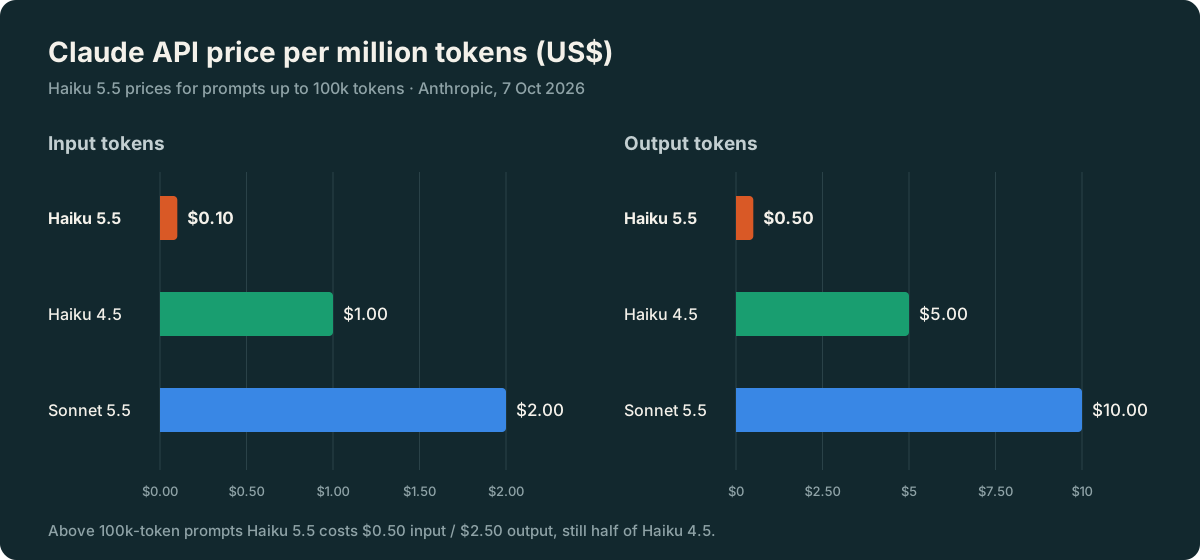
| Price per 1M tokens (US$) | Haiku 5.5 (prompts up to 100k) | Haiku 5.5 (over 100k) | Haiku 4.5 | Sonnet 5.5 |
|---|---|---|---|---|
| Input | $0.10 | $0.50 | $1.00 | $2.00 |
| Output | $0.50 | $2.50 | $5.00 | $10.00 |
| Cache reads | $0.01 | $0.05 | $0.10 | $0.10 |
| Cache writes | $0.125 | $0.625 | $1.25 | $2.50 |
A quick example: summarising 1,000 documents of about 5,000 tokens each, with a 500-token summary for each one, would cost roughly $0.75 on Haiku 5.5, $7.50 on Haiku 4.5 and $15 on Sonnet 5.5. One small catch: Haiku 5.5 uses an updated tokenizer, so the same text turns into slightly more tokens. Anthropic says the average saving across real requests is still about 75%.
Anthropic also cut Sonnet 5.5's cache-read price in half on the same day, from $0.20 to $0.10 per million tokens. It says this lowers the cost of most Sonnet agent tasks by about 20%.

How Good Is Haiku 5.5 Compared With Haiku 4.5 and Sonnet 5.5?
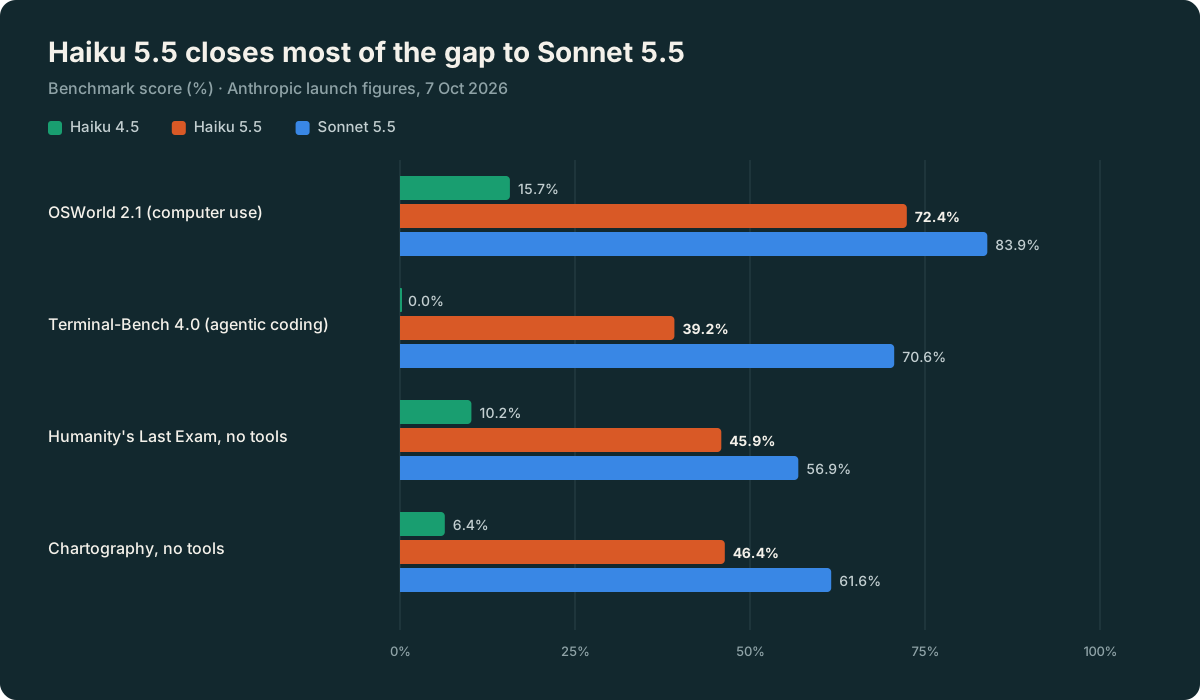
It is a huge jump from Haiku 4.5, and on several tests it gets surprisingly close to Sonnet 5.5. On OSWorld 2.1, a test of using a computer like a person does, it scored 72.4%, up from 15.7%.
| Benchmark | Haiku 4.5 | Haiku 5.5 | Sonnet 5.5 |
|---|---|---|---|
| GDPval-AA v2.1 (office work, Elo) | 735 | 1620 | 1840 |
| OSWorld 2.1 (computer use) | 15.7% | 72.4% | 83.9% |
| Terminal-Bench 4.0 (agentic coding) | 0.0% | 39.2% | 70.6% |
| Humanity's Last Exam (no tools / with tools) | 10.2% / 18.7% | 45.9% / 57.4% | 56.9% / 64.5% |
| Chartography (reading charts, no tools) | 6.4% | 46.4% | 61.6% |
The one place the gap stays wide is coding. On Terminal-Bench 4.0, Haiku 5.5 scores 39.2% against Sonnet 5.5's 70.6%. Anthropic says so itself: for complex agentic coding, Sonnet 5.5 and Opus 5.5 are still the better choice.
What Is Haiku 5.5 Good For?
Haiku 5.5 is made for narrow, repeated jobs where speed and cost matter more than deep thinking:
- High-volume work: summaries, sorting and classifying, database queries, and "compaction" (shrinking a long conversation so an agent can keep going).
- Subagents: a big model such as Opus 5.5 plans the job and hands small pieces to many quick Haiku workers.
- Speed-sensitive work: live customer support and browser automation, where a slow answer feels broken.

The early customer results Anthropic shared point the same way. Asana saw over 30% lower latency on task completions. HubSpot got 92.8% on its CRM test suite, the best score it has seen there. AlphaSense measured 0.84 against 0.76 for Haiku 4.5 over 400 queries, for a feature that makes about 8 million calls a week. At that volume, a 90% price cut is real money.
Do I Use Haiku for My Own Coding?
Honestly, not much. Haiku is the smaller model, and for the code tasks I do every day it has not been very useful to me. My workflow is still the one I described in my Sonnet 5.5 post: I plan with Opus 5.5 and build with Sonnet 5.5. When a task touches many files or needs careful design, a smaller model saves a few cents and then costs me an hour fixing its mistakes.
Where Haiku 5.5 makes sense for me is behind the scenes, as a subagent that reads logs, summarises long files or sorts data while the bigger model does the thinking. That is exactly the job Anthropic designed it for. If you are building a product that makes thousands of small AI calls a day, though, Haiku 5.5 is probably the most important release of the three. For the cost side of that choice, see my local hardware vs cloud API guide.
Is Haiku 5.5 Safe to Use?
Anthropic says Haiku 5.5 shows far fewer misaligned behaviours than Haiku 4.5 and is less willing to help with misuse. Its cybersecurity safeguards sit between Haiku 4.5 and Sonnet 5.5: it allows more defensive security work, but still blocks penetration testing and other attacker-style techniques. Its biology safeguards match Sonnet 5.5 and Opus 5. Organisations that need more can apply to Anthropic's Cyber and Life Sciences verification programs.
Anything Else Announced With Haiku 5.5?
- Monthly API credits for subscribers: Max 5x gets $100, Max 20x gets $200, and Team plans get up to $500 shared across users. The credits work on any model.
- Computer use and browser use are now in beta in the Python and TypeScript SDKs.
The Claude 5.5 Family Is Almost Complete
With Haiku 5.5 out, three of Anthropic's model lines are now on 5.5 within about two weeks. Opus 5.5 arrived on 22 September, Sonnet 5.5 on 28 September, and Haiku 5.5 on 7 October.
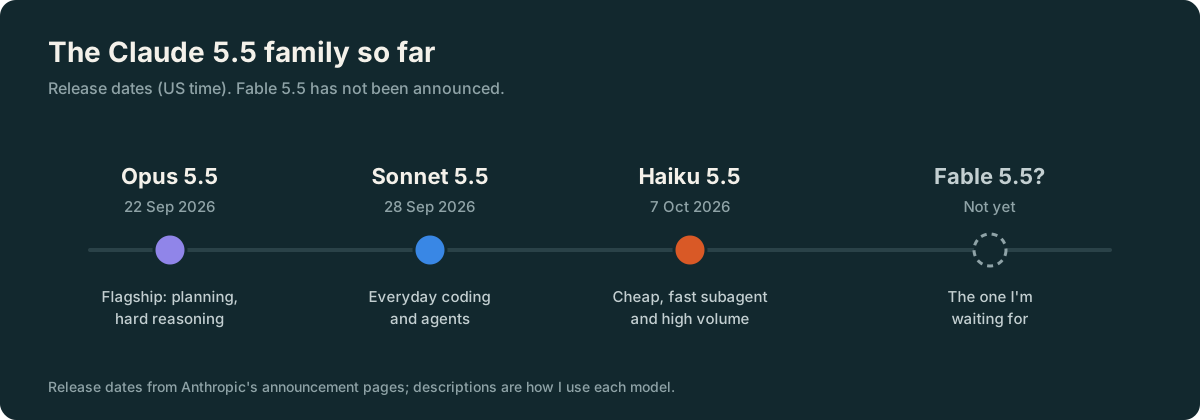

That is good news. Every model in the family is now faster and cheaper than the one before it. The one I am really waiting for is Fable 5.5. Anthropic has not announced it yet, but Fable is the top of the range, and if it follows the same pattern as Opus, Sonnet and Haiku, it should be another big step. I will write it up here as soon as it lands.
Related reading: Claude Opus 5.5 explained · Claude Sonnet 5.5 · Why you should avoid annual AI subscriptions in 2026
Sources
- Anthropic, "Claude Haiku 5.5" announcement, anthropic.com/claude-haiku-5-5 (7 October 2026): prices, benchmarks, customer results, safety notes.
- Release dates for Opus 5.5 and Sonnet 5.5 from Anthropic's announcements, as covered in my earlier posts.
Figures checked on 8 October 2026. This article was researched and drafted with AI assistance and reviewed by me. The images were made locally with Qwen Image 2.1 on an 8 GB RTX 4060 Ti, and the charts were drawn from Anthropic's published numbers.