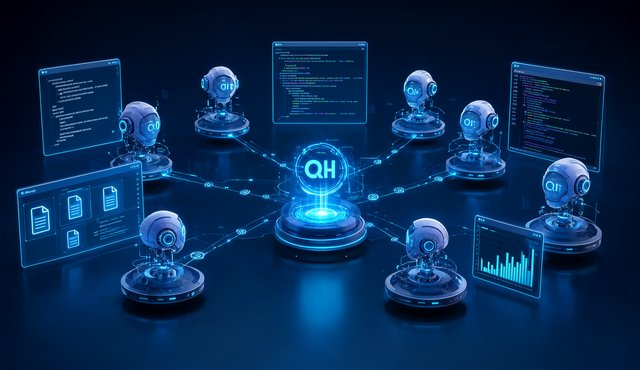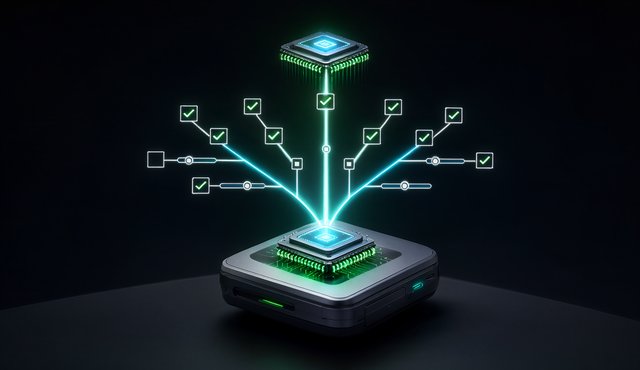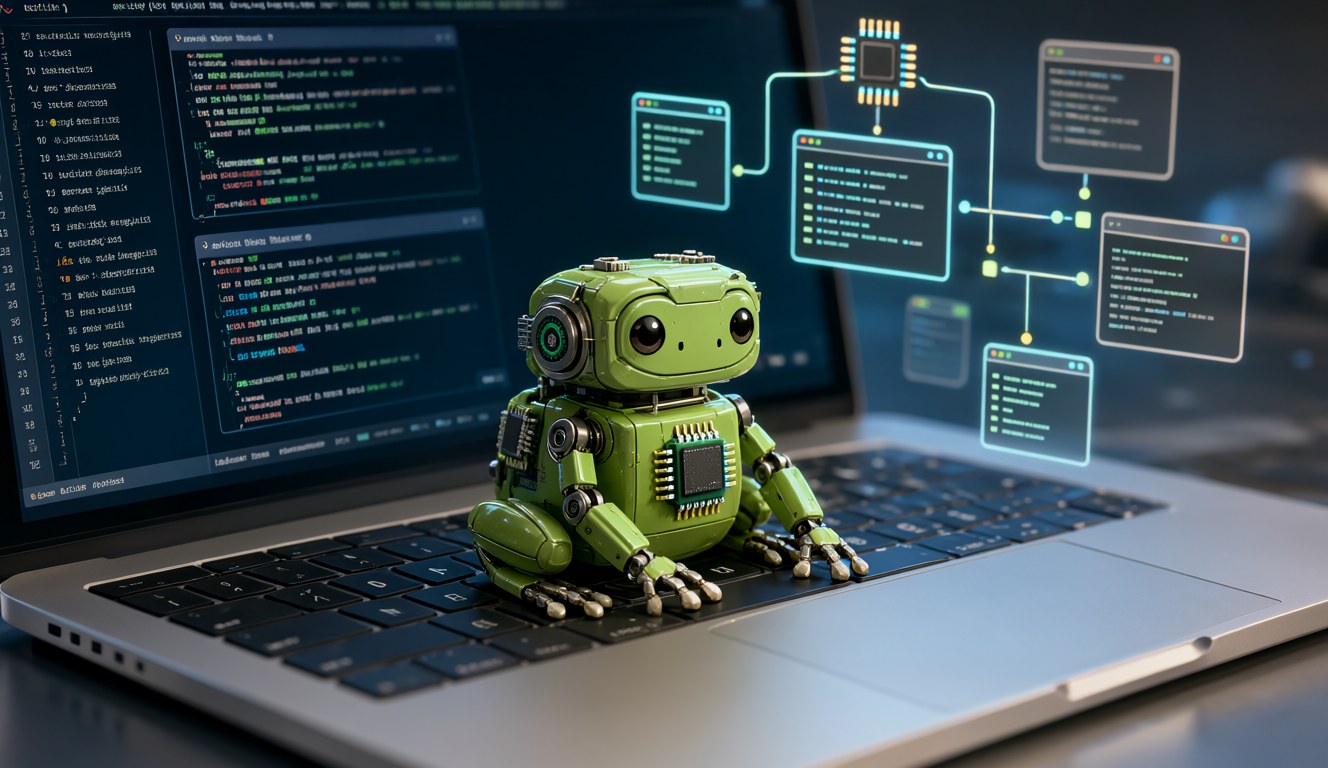
With more people looking for AI tools to help with software development, there is a push to create smaller, more efficient models that still deliver strong performance. FrogNano-4B-2609 is Microsoft's new coding agent designed for working at the repository level. Based on the Qwen3.5-4B architecture, FrogNano is both compact and powerful, making it a great fit for complex software engineering tasks.
Let's look at what sets FrogNano apart and how it handles development across entire repositories.
A Pure Reinforcement Learning Approach
Many recent coding models rely on behavioral distillation, meaning they learn from the solutions, reasoning steps, and patch targets of larger, more advanced models. FrogNano, however, uses a different approach. Rather than copying larger models, FrogNano was trained only with reinforcement learning. Microsoft used TaskPilot to create, check, and fine-tune about 1,500 synthetic software engineering tasks. By using test-based rewards over full coding sessions, FrogNano learned to move through repositories and fix bugs by trial and error, ensuring its solutions work and don't cause new problems.
The Leaf Harness: 5 Tools for Full Autonomy
FrogNano does more than just generate code snippets. It works as an autonomous agent inside a secure, sandboxed environment. Using the Leaf harness, a simple interaction loop, the model gets five key tools for working with a repository:
- Reading files
- Writing files
- Editing code
- Glob-based searching
- Shell execution
Given an English natural-language issue and an authorized repository snapshot, FrogNano iterates through these tools to diagnose bugs, search across multiple files, run tests, and propose a candidate patch.
Big Context in a Compact Package
Despite its highly efficient size of just 4.66 billion parameters, FrogNano doesn't skimp on context. Software repositories can be huge, and solving real problems means keeping a lot of information in memory. FrogNano can handle about 131,000 tokens at once. This lets it read lots of documentation, take in large parts of a codebase, and keep track of up to 150 tool interactions in a session to find a solution.
Why FrogNano is a Win for Local Deployment
For developers and organizations that don't want to send their code to outside APIs, FrogNano is built to run locally and efficiently. Here's why it works well on your own hardware:
- Accessible Hardware Requirements: Thanks to its small size, the model needs about 9.3 GB of VRAM in BF16 for its weights. You can run it easily on common consumer GPUs, such as an NVIDIA RTX 3060 or 4070 (12GB VRAM), without needing a big server setup.
- Privacy-Preserving Code Assistance: FrogNano doesn't use cloud APIs, so your whole software repository stays on your own systems. This air-gapped feature is important for strict enterprise rules, financial companies, or anyone working with closed-source code.
- Broad Framework Support: Built on the standard Qwen3.5 architecture, it is highly interoperable out of the box. It natively supports deployment via frameworks like vLLM, SGLang (which Microsoft used for their rollout), KTransformers, and standard Hugging Face Transformers.
Human-in-the-Loop Design
Although FrogNano is very capable, Microsoft points out that it is meant for development and research with human supervision. The model creates candidate patches, which are suggestions that need to be reviewed, tested, and checked for security by qualified people before being used in production. Since it can run shell commands and change files, it should always work in secure, limited sandboxes to keep systems safe.
The Future of Compact Agents
FrogNano shows you don't always need a huge model to handle complex software engineering tasks. By using a dense hybrid architecture, pure test-based reinforcement learning, and easy hardware requirements, Microsoft has created a strong tool for the next wave of AI-assisted, privacy-focused coding.