Learn — the five lessons
Short chapters from the Unit 6 casebook. Read a lesson, then play the case that practises it.
1 · Repeating patterns and the unit of repeat
Look at a necklace: red, red, blue, red, red, blue. The whole string is one small block copied over and over — red, red, blue. Detectives call that block the unit of repeat. The necklace has no new ideas after bead 3; it only has the unit, again and again. The same trick works with sounds: clap, clap, stomp — clap, clap, stomp. That pattern's unit is clap-clap-stomp, and its 11th beat is already decided by the rule.
 Key Idea: a repeating pattern copies one block — find the unit, and any bead's colour is decided.
2 · Growing patterns and skip counting
Build a staircase from blocks: step 1 is 2 blocks tall, step 2 is 4, step 3 is 6. Each new step adds 2: 2, 4, 6, 8, 10… That is a growing pattern — it does not copy a block, it climbs by the same steady amount every time. Coins grow too: rows of 3, 6, 9, 12. Each row adds 3 — and here is the detective's secret: the rule "add 3 each row" is the three-times facts wearing a costume.
Key Idea: a growing pattern climbs by the same steady amount every time.3 · The pattern rule — what changes, what stays the same
A pattern rule is the sentence that tells the pattern what to do. Ask two questions of every pattern: what changes, and what stays the same? Shade the multiples of 3 on this hundred chart and a column shape appears — the rule made visible. Switch to the 4s: a different shape, a different rule. The rule also earns its keep far from the start: the staircase grows 2, 4, 6, 8… so step 10 must be 20 blocks tall, decided without building. And 30 lives in the 3s pattern, but no row of the 4s pattern ever holds 30.
"You keep going" is not a rule. A real rule can be said, tested, and used by someone else.
Key Idea: the pattern rule says what changes and what stays the same.4 · The equals sign as balance
Picture a see-saw with coins on each side. It sits level when both sides hold the same amount. That is exactly what the equals sign means: not "the answer comes next", but "the same amount as". Is 5 + 3 = 6 + 3 true? The left side makes 8; the right side makes 9; the see-saw tips — false. Is 30 − 12 = 26 − 8 true? Both sides make 18 — level, true. And watch for the chain-of-answers trap: 5 + 3 = 8 + 1 = 9 chains answers together instead of keeping both sides of the equals sign equal.
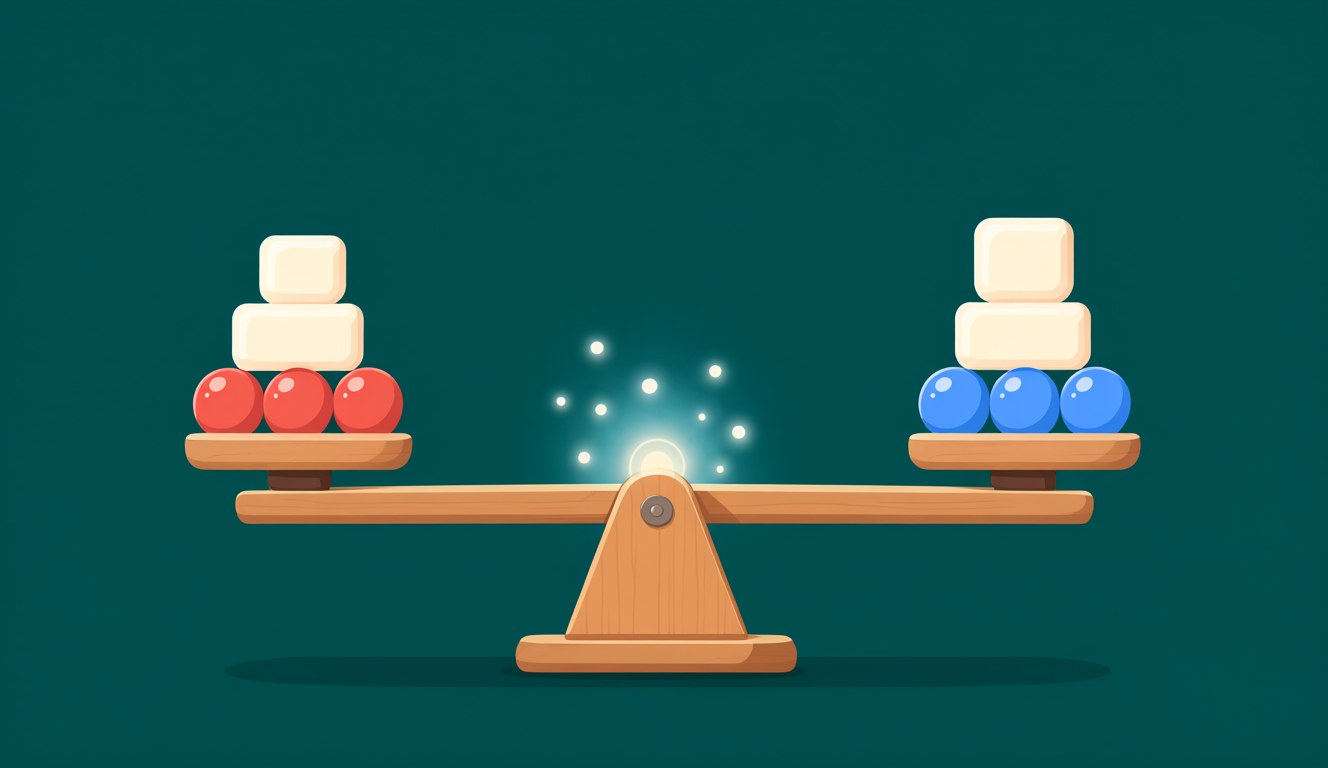 Key Idea: the equals sign means "the same amount as" — check both sides before you answer.
5 · Finding the unknown
Every case file ends with a mystery number: the unknown, the box (□). Sometimes it hides on the right: 6 + □ = 10 — count on from 6 to 10, the box holds 4. Sometimes it hides on the left: 8 = □ + 3 — the whole makes 8, so the box holds 5. When the numbers grow too big to count, compare sides: in 5 + 7 = □ + 10, the left makes 12, so the right must make 12 too — ten plus what makes 12? The box holds 2. And a note for your future case files: one day the box gets a letter name, like n — same mystery, new costume.
Key Idea: ask "what does the balance need?" — then count on, use known facts, or compare sides.Word Power — the detective's casebook glossary
| Term | What it means |
|---|---|
| Pattern | A design that repeats or grows in a way you can predict. |
| Term | One member of a pattern — term 1, term 2, term 3. |
| Pattern rule | The hidden instruction that tells you how a pattern moves from one term to the next. |
| Repeating pattern | A pattern where the same block of terms comes round again and again. |
| Growing pattern | A pattern where each term grows by the same steady amount — like 2, 4, 6, 8. |
| Number sentence | A maths sentence built from numbers and signs, like 8 + 4 = 12 or 6 + □ = 10. |
| Balance | What the equals sign really means: both sides hold the same amount, like a see-saw sitting level. |
| Unknown | The mystery number you're hunting, shown by a box (□) — like the □ in 6 + □ = 10. |
Try it yourself — two home missions
🔴🔵 Bead-String Patterns
Thread a 1-metre string with a repeating unit — red, red, blue — using beads, buttons or dry pasta. Thread at least four units, then predict bead 12 and bead 20 before checking by counting. Extension: lay rows of 3 coins (3, 6, 9, 12 …) and find which row totals can never appear.
⚖️ The Coin Balance Mission
Rule a giant equals sign down the centre of a sheet of paper. Place 7 coins on the left; on the right place 4 coins and a gap: 7 = 4 + □. Find the unknown that makes it level. Then the mission: one coin vanishes from the left side overnight — find the new unknown that restores the balance, and write the number sentence to prove it.
- Equipment: about 20 coins · two-colour beads, buttons or pasta · 2 sheets of paper · pencil and ruler · a 1-metre string.
For grown-ups
What your explorer will be able to do: explain a pattern rule in their own words and name a far-off term (bead 20, step 10); read the equals sign as "is the same as" and check both sides; hunt an unknown by asking what the balance needs; name repeating and growing patterns on sight; and say "wrong turn = new clue" when a case gets messy.
Curriculum: supports the Australian Curriculum: Mathematics Version 9.0, Year 4 — AC9M4N09 (pattern rules) and AC9M4A01 (finding unknown values), building toward AC9M4A02 (multiplication-facts fluency). The content description codes are quoted from the Australian Curriculum: Mathematics Version 9.0, © ACARA; ACARA does not endorse, sponsor, or affiliate with Pattern Detective or Maths Explorers Club.
Answers: full worked answers for all ten Case Files questions are printed in the Unit 6 book's Answer Key — including the misconception notes on the equals-sign trap and the rule-versus-continuation trap.