Learn at basecamp
Five short Year 4 place value lessons: big numbers, decimals with tenths and hundredths, sliding digits, the odd/even clue and clever strategies. Read one, then play its game.
Your mission: close the camp ledger
Every long trail starts at basecamp, where explorers check their gear and stock their packs. The camp ledger on the ranger's desk has one unfinished line: 25 boxes were carried by two teams. One team carried 17. How many did the other team carry?
By the end of these five lessons you will have the tools to close it, and the answer is waiting in lesson 5.
Word Power
| Word | What it means |
|---|---|
| place value | the value a digit gets from its position in a number |
| digit | a single symbol from 0 to 9 |
| decimal point | the dot that separates whole numbers from parts of a whole |
| tenth | one of ten equal parts; the first place after the decimal point |
| hundredth | one of a hundred equal parts; the second place after the decimal point |
| even number | a whole number that shares equally into two groups; its last digit is 0, 2, 4, 6 or 8 |
| odd number | a whole number that does not share equally into two groups; its last digit is 1, 3, 5, 7 or 9 |
| strategy | a plan for working something out; a missing number in a number sentence is written as a box (□) |
1 · Big numbers, big places
Numbers grow by the place, not by the digit. The 7 in 47.25 means seven ones, but the 7 in 75 means seven tens. Move a digit one place to the left and its value becomes ten times bigger. Ten thousands, thousands, hundreds, tens, ones: each place is worth ten times the place on its right.
Read 34 500 by naming the places: 3 ten thousands, 4 thousands, 5 hundreds. The 5 looks small until you notice which house it lives in.
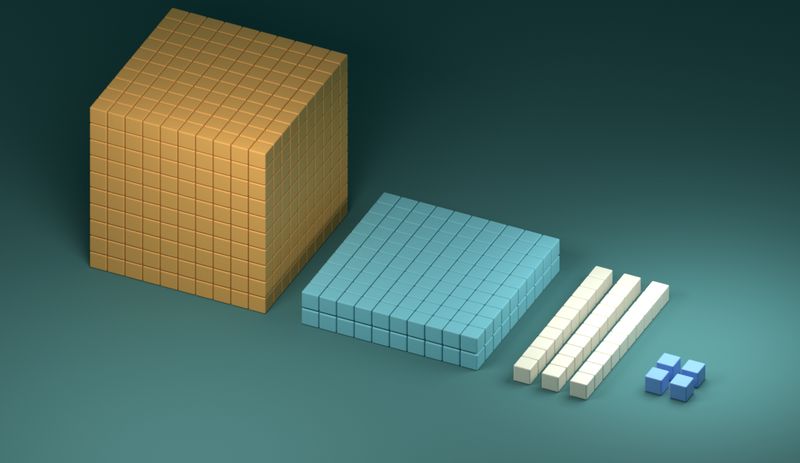
1 234 in blocks: 1 thousand cube, 2 hundred flats, 3 ten rods and 4 ones. Ten of any block make one of the next block up.
2 · The decimal point: tenths and hundredths
The decimal point opens the places that live between whole numbers. To its right the houses shrink: the first place counts tenths (one of ten equal parts) and the second counts hundredths (one of a hundred). So 47.25 reads as 4 tens, 7 ones, 2 tenths and 5 hundredths.
Money speaks decimal every day: $6.30 is 6 dollars and 30 hundredths of a dollar, which is 30 cents. And length is longer than it looks: 0.9 is bigger than 0.15, because 9 tenths beats 1 tenth. Compare by place, not by how many digits there are.
Try the place-value reader
3 · Slide the digits
Multiplying by 10 or 100 slides every digit to a bigger place. 23 becomes 230 (× 10) and 2 300 (× 100): the same digits in bigger houses. Nothing is "added on". The digits slide, and zeros fill the empty places to hold them.
Dividing slides the other way: 3 400 ÷ 100 = 34, because every digit moves two places right and the placeholder zeros drop away. For a multiple of 10, use a fact you already own and then slide: 6 × 30 = 6 × 3 × 10 = 18 × 10 = 180.
The slide works across the decimal point too: 4.5 × 10 = 45, because the 5 slides from tenths into ones. That is why "just add a zero" is a trap: it would give 4.50, which is still 4.5.
4 · Odd or even? The last-digit clue
Every whole number shows whether it is odd or even in its last digit. Last digit 0, 2, 4, 6 or 8: even. Last digit 1, 3, 5, 7 or 9: odd. 3 468 is even (it ends in 8) and 75 931 is odd (it ends in 1). Why only the last digit? Every ten, hundred and thousand shares into pairs already, so only the ones can leave a lonely leftover.
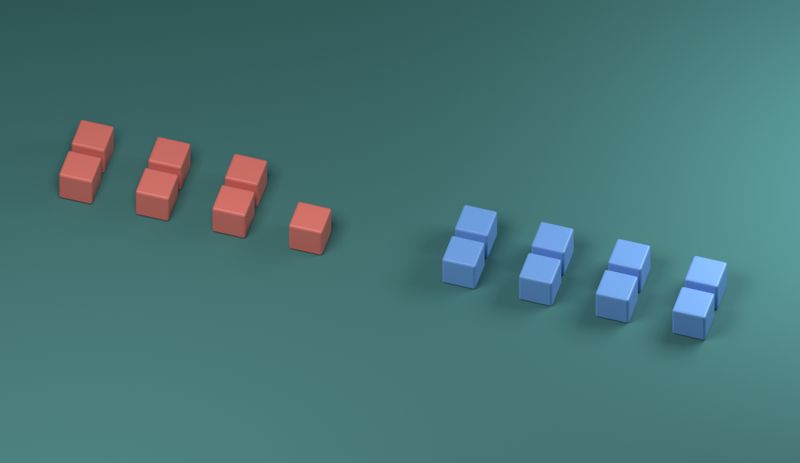
7 is odd: three pairs and one left over. 8 is even: four pairs and none left over.
The leftovers also predict answers. Odd + odd = even (the two leftovers pair up), even + even = even, odd + even = odd. For multiplying, odd × odd = odd, and anything × an even number = even. Test each rule with small numbers: because it holds every time, it is a rule and not a lucky guess.
5 · Clever strategies
Strategies are an explorer's shortcuts: plans that turn clumsy sums into friendly ones.
- Bridge to a friendly number. 199 + 56 is awkward, but 200 + 56 = 256 is easy. Then give back the 1 you borrowed: 255.
- Use facts you own. 6 × 8 is 5 × 8 plus one more 8: 40 + 8 = 48. And 48 ÷ 6 is the same fact read backwards: 8.
- Double and halve. × 4 is double, double again (25 → 50 → 100). ÷ 4 is half, then half again (72 → 36 → 18).
- Pick the right tool. Adding four 4-digit amounts is a calculator job, but estimate first so you notice a mistyped key.
And the ledger? Write the story as a number sentence: 17 + □ = 25. Count up from 17 to 20 (3) and on to 25 (5 more): the box holds 8. Check by adding back: 17 + 8 = 25. Ledger closed!
Worked examples
1 · The value of the 7 in 47.25. Find the 7 and read its house: ones. The 2 lives in tenths and the 5 in hundredths. The 7 is worth 7 ones. Checkpoint: what does the 2 mean? (2 tenths.)
2 · 34 × 100. × 100 slides every digit two places left: the 3 moves from tens to thousands and the 4 from ones to hundreds. 34 × 100 = 3 400. Checkpoint: what is 34 × 10? (340, one slide.)
3 · 199 + 56. 199 is one step from 200. 200 + 56 = 256, then take back the borrowed 1: 255. Checkpoint: how would you bridge 198 + 47? (200 + 47 = 247, then 247 − 2 = 245.)
Try it at home
The place-value slider
Write 4, 7, 2 and 5 on four paper scraps, plus one scrap for the decimal point. Draw four houses on a sheet (tens, ones, tenths, hundredths) and lay out 47.25. Slide every digit one house left, keeping the point where it is, and write the new number. Slide again. Then write one sentence about what stayed the same and what changed.
The last-digit sorting race
Ask someone to call out ten numbers of any size (the bigger the better). Shout "odd" or "even" using only the last digit. Prove two of them by drawing dots in pairs. Finish by finding an odd + odd pair and an even + even pair in your list and checking the last digits of their sums.