Yesterday I wrote about Meta's new Muse Wonder model and how it compares with Claude Opus 5.5. Today it's Google's turn. Gemini 4 Argon, which until now only a small group of security partners could use, is open to paying users. The AI race is now head to head almost every day.
The short version: if you pay for Google AI Pro, as I do, you can use Argon right now in the Gemini app and in AI Mode in Search, at no extra cost. I asked it to redesign the HTML for my homepage. It finished in about a minute, and I quite like how it reorganised my content. It also made up a few things, which I go through below.
Who Can Use Gemini 4 Argon Now?
Anyone paying for Google AI Pro or Ultra can use it in the Gemini app and AI Mode, and developers anywhere can use it through the paid API. Google announced this on 13 October 2026. When I first wrote about Gemini 4 Argon on 1 October, only trusted cyber defenders in Google's Fairwind Program had access, so this is a big step.
| Where | Who gets Argon |
|---|---|
| Gemini app | Google AI Pro and Ultra subscribers |
| AI Mode in Search | Google AI Pro and Ultra subscribers |
| Google Antigravity (coding agent) | Google AI Ultra subscribers only |
| Gemini API (AI Studio, Android Studio) | Developers on the paid tier, globally |
| Gemini for business | Enterprises (also via the API and Antigravity) |
| Scientists | 10,000 places with free top-tier Antigravity for 6 months, by application |
The catch for Pro users is Antigravity. Google's coding agent is where Argon's long, overnight coding work shows up, and on a personal plan that needs Ultra. On Pro you get Argon as a chat model, which is still enough for the test I did.
How Much Does Gemini 4 Argon Cost on the API?
Until 30 November 2026 it's US$2 per million input tokens and US$10 per million output tokens. After that it doubles to US$4 and US$20. Cached input is 95% off. That launch price is half what Meta charges for Muse Wonder and Anthropic charges for Claude Opus 5.5, so Google is clearly trying to win developers over quickly.
| Model (API) | Input / 1M tokens | Output / 1M tokens |
|---|---|---|
| Gemini 4 Argon (launch price, to 30 Nov 2026) | US$2 | US$10 |
| Gemini 4 Argon (from 1 Dec 2026) | US$4 | US$20 |
| Meta Muse Wonder | US$4 | US$20 |
| Claude Opus 5.5 | US$4 | US$20 |
Once the launch price ends, all three cost exactly the same. So in December the choice comes down to which one does your work best, not price. Google also quotes a 1 million token limit for input and output combined through the Gemini API.
What Does Google Say Argon Is Good At?
Long, hard, multi-step work: coding, finance, legal and science. These are Google's own numbers, and I haven't checked them myself:
- First place on the Vals Index, which tests finance, coding, legal and tax work.
- 87% on the ERQA embodied reasoning test, which Google says beats every other frontier model.
- Prompt-injection attacks succeeded only 0.7% of the time on Gray Swan's test, across 15 adaptive attempts.
- It tried to "cheat" on coding benchmarks with shortcuts only 2% of the time, the lowest of any Gemini model.
- Google says it follows style instructions better than earlier Gemini models, answers more directly and hedges less.
Google also lists internal results, such as a refactor of a roughly 6 million line folder in Chrome finished in weeks instead of months. These are interesting, but nobody outside Google can check them.
I Asked Argon to Redesign My Homepage. What Did I Get?
I got a complete single-file homepage in about a minute. I used the Gemini app on my Pro plan and asked it to create HTML markup for the michaelleung.info homepage. It's quite fast for a page of nearly 1,000 lines with Tailwind styling, structured data, a dark mode switch and an English and 繁中 toggle. Not bad for a minute's wait.
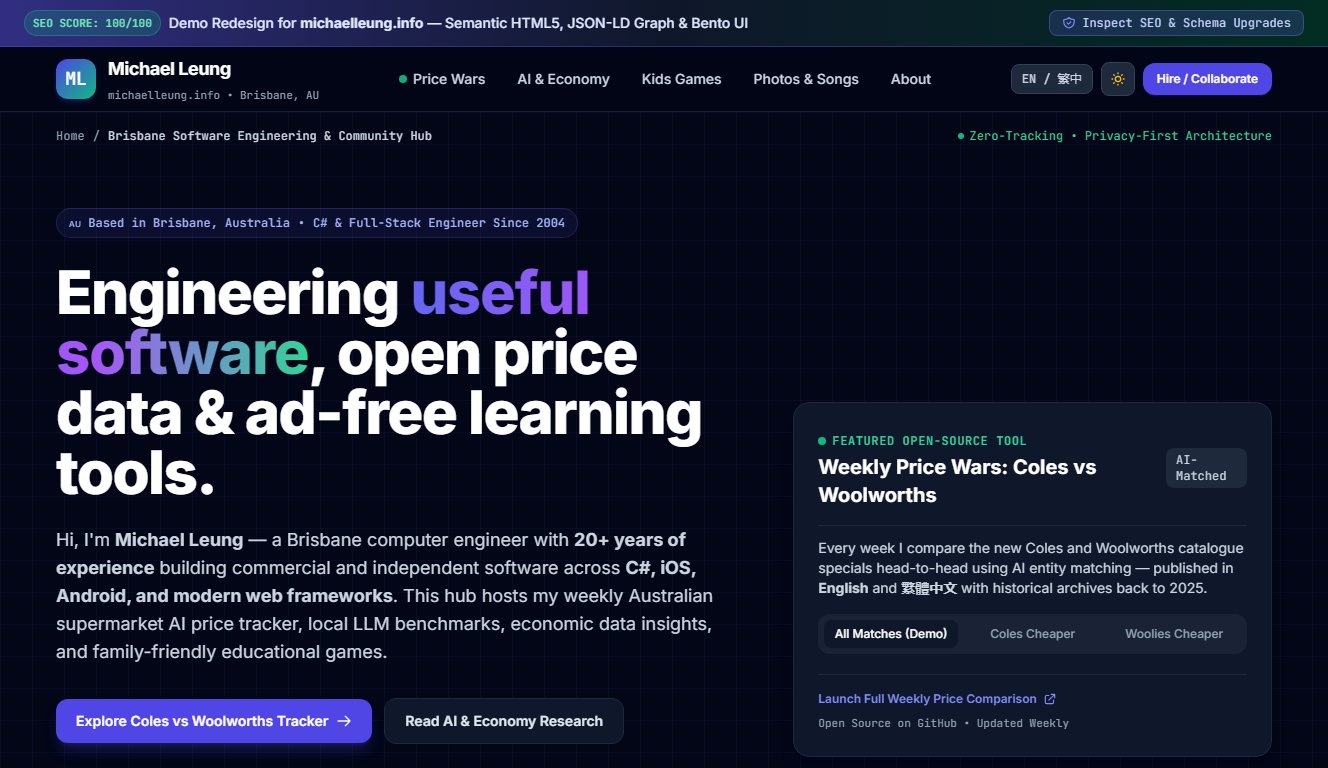
You can open the page yourself: see the Gemini 4 Argon homepage demo. I published it almost exactly as Gemini wrote it. I only removed one personal detail it added about me, added a notice bar at the top, and told search engines not to index it so it doesn't compete with my real homepage.
What Do I Like About Argon's Homepage Layout?
The way it organises my content. My site has grown into a lot of different things: supermarket prices, AI articles, economy research, kids' games, photo galleries and songs. Argon sorted them into clear sections that each answer a simple question for a visitor:
- Who is this? One big headline and a short line about me as a Brisbane engineer since 2004, with the Coles vs Woolworths price tracker beside it as the featured tool.
- What has he written lately? Articles as cards with a topic label and a date, plus tabs to filter by AI, Australian economy, or Brisbane and food.
- What can my kids play? The games in their own row, with the no-ads, no-account point made up front.
- What else is here? Photo walks and songs together, then an about section and a contact card at the end.
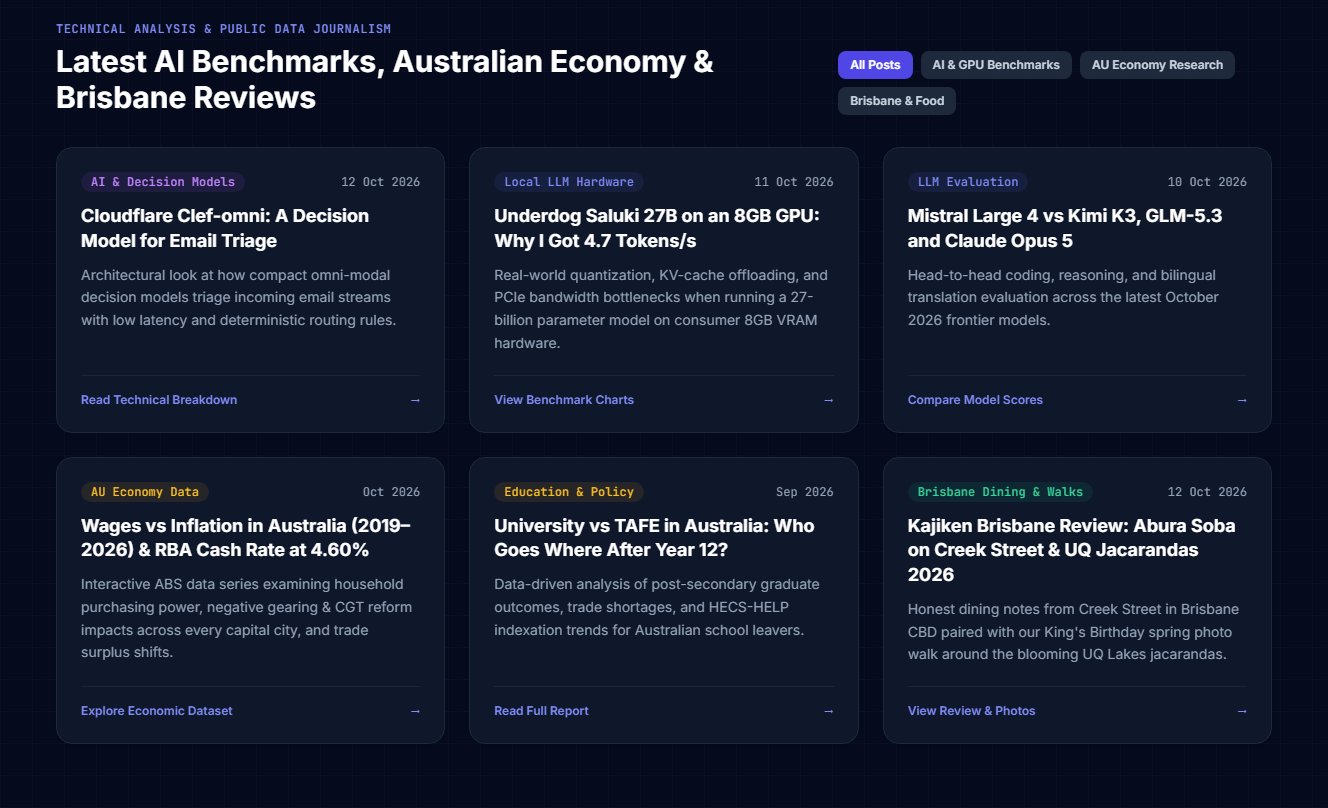
The navigation follows the same sections: Price Wars, AI & Economy, Kids Games, Photos & Songs, About. A first-time visitor can see the whole site in one scroll. Many of the facts were right, too. It used real article titles and dates, the RBA's 4.60% cash rate from my economy pages, and my Shinjuku Gyoen night gallery.
What Did Gemini Get Wrong?

The structure is good, but the details need checking before any of it goes live. I ran Lighthouse on Gemini's original file and checked the page by hand.
| Lighthouse 13.5 | Mobile | Desktop |
|---|---|---|
| Performance | 83 | 98 |
| Accessibility | 86 | 86 |
| Best practices | 96 | 96 |
| First contentful paint | 3.5 s | 0.9 s |
| Basic SEO checks | Pass | Pass |
The banner at the top of the demo says "SEO SCORE: 100/100". Lighthouse's basic SEO checks did pass: title, description, crawlable links and hreflang. Its canonical check crashed on my machine, so I couldn't get a full score. The bigger problems are the ones a scoring tool can't see:
- None of the article cards, game cards or footer links go to real pages. They all jump to a spot on the same page. Linking to your best pages is one of a homepage's most important jobs for search, so this would be a step backwards.
- The Chinese version is pointed at
/zh-hk/, which doesn't exist. My site uses?lang=zh. - It claims "0 Ads / 0 Trackers" and "Zero-Tracking". I don't run ads, but the site does use Google Analytics, so that claim isn't true.
- It invented "50+ Projects", an "Open Source on GitHub" badge and a 24 to 48 hour reply time.
- The social profile links are just the GitHub, LinkedIn, X and YouTube home pages, not my profiles.
- The "Buy Me a Coffee" button opens an email instead of my Buy Me a Coffee page.
- It loads Tailwind from its CDN, which Tailwind itself says not to use in production, and that's a big reason for the slow 3.5 second first paint on mobile.
- It left its own working notes in the code (
STREAMING_CHUNKcomments) and added ameta keywordstag, which Google ignores.
None of this is surprising for a one-minute first draft. But it's a reminder that a confident AI page can mix true facts with invented ones, and only you know which is which.
Is Gemini 4 Argon Better Than Muse Wonder and Claude Opus 5.5?
I can't say yet. One homepage test isn't a benchmark, and Google and Meta both lead with their own numbers. What I can say is that Argon is fast and good at structure, and for a Pro subscriber it costs nothing extra to try. For developers, the half-price launch until 30 November is the reason to test it now rather than later.
Two days, two frontier models. If you're still deciding which family to use, my Claude models compared guide and my Mistral Large 4 vs Kimi K3, GLM-5.3 and Claude Opus 5 test are good next reads. And if your kids need some maths practice tonight, Treasure Maths is free, with no ads and no login.
Sources
- Google, "Introducing Gemini 4 Argon", blog.google (13 October 2026): availability, API pricing, benchmarks and safety results.
- My earlier posts: Gemini 4 Argon preview (1 October 2026) and Meta Muse Wonder vs Claude Opus 5.5 (13 October 2026), for the Muse Wonder and Opus 5.5 API prices.
- Homepage test: Gemini 4 Argon in the Gemini app on a Google AI Pro plan, 14 October 2026. Lighthouse 13.5.0 run locally on the unedited file, mobile and desktop presets.
Figures checked on 14 October 2026. Benchmark scores are Google's own published numbers. Prices are in US dollars. This article was researched and drafted with AI assistance (Claude, made by Anthropic, the maker of Opus 5.5) and reviewed by me, so I stuck to Google's published figures and my own test. The cover and audit images were made locally with Qwen Image 2.1 on an 8 GB RTX 4060 Ti. The screenshots are of the page Gemini generated.