
Meta released Muse Wonder and Muse Wonder Full on 12 October 2026, and says they are its most capable models yet. Is it better than Claude Opus 5.5? Partly. On Meta's own 14-test table, Muse Wonder Full beats Opus 5.5 on 8 tests and loses 6. The API version, plain Muse Wonder, beats it on only 5 and loses 9. It costs exactly the same as Opus 5.5 per token. The interesting part for me is the price of the coding plan: Muse Code starts at US$5 a month (A$6.60 was the price shown to me in Australia). The catch is that the model that beats Opus, Wonder Full, is only in the US$50 and US$200 plans.
Below I go through what Meta actually released, the full benchmark table, what each plan gets you, and who I think should try it. All the scores are Meta's own published numbers. I have not run my own tests yet.
What Is Meta Muse Wonder?
Muse Wonder is Meta's new frontier model family, built on its earlier Muse Spark models and trained at Meta's Prometheus data centre. There are two versions:
- Muse Wonder: available now through the Meta Model API and the Muse Code coding agent. API price US$4 per million input tokens and US$20 per million output tokens, with cached input at US$0.20.
- Muse Wonder Full: the stronger version. There is no API. You can only use it through a Muse Code subscription on the Power or Maximum plan.
Both take text, images, video and audio as input, give text back, and have a 1 million token context window. Meta highlights two features: Active Memory, which carries useful details across conversations, and Active Focus, which keeps working on a hard goal, tries other approaches when something fails and asks you a question when it is stuck. Meta says it is strongest at agent work in law, finance and health, and at long coding jobs.
Meta has not published the model size or whether the weights will ever be released. For now it is a closed model, like Claude.
Is Muse Wonder Better Than Claude Opus 5.5?
Muse Wonder Full beats Opus 5.5 on just over half of Meta's tests. Plain Muse Wonder loses most of them. "Better than Opus 5.5" is true for some jobs, not overall.

This is the full table Meta published, with GPT-6 Astra and Claude Fable 5.1 included. The best score in each row is in bold.
| Benchmark | Muse Wonder Full | Muse Wonder | Claude Opus 5.5 | GPT-6 Astra | Claude Fable 5.1 |
|---|---|---|---|---|---|
| Personal Superintelligence Index (Meta internal) | 59.1 | 54.3 | 55.2 | 54.5 | 49.9 |
| Harvey LAB-AA (legal work) | 13.1 | 10.0 | 4.2 | 8.6 | 6.4 |
| Vals Finance Agent V2 | 59.1 | 56.6 | 58.6 | 53.5 | 58.9 |
| HealthBench Pro | 62.3 | 60.5 | 65.6 | 65.3 | 62.1 |
| AutomationBench-AA | 45.4 | 39.1 | 41.2 | 41.6 | 32.1 |
| GDP.pdf (work from PDF sources) | 33.2 | 30.8 | 30.6 | 34.2 | 27.6 |
| JobBench | 75.3 | 70.5 | 75.4 | 66.1 | 73.1 |
| OSWorld V2.1 (computer use) | 78.4 | 72.6 | 81.8 | 75.8 | 80.7 |
| MemoryBench (Meta internal) | 85.5 | 85.6 | 81.5 | 81.4 | 79.0 |
| Terminal-Bench 4.0 | 57.1 | 52.0 | 59.6 | 59.1 | 52.0 |
| DeepSWE 1.1 | 79.0 | 78.8 | 74.2 | 74.1 | 67.4 |
| SWE-Marathon | 57.5* | 53.1 | 46.3 | 42.5 | 45.6 |
| ProgramBench | 59.0 | 50.0 | 70.5 | 52.5 | 55.5 |
| Artificial Analysis Intelligence Index | 56 | 52 | 58 | 53 | 53 |
* Muse Wonder Full ran SWE-Marathon at "xhigh" effort. The GPT-6 Astra and Fable 5.1 SWE-Marathon results came from Codex and Claude Code, so that row is not a like-for-like test.
A few things stand out to me:
- Legal work is Meta's biggest win. Wonder Full scored 13.1 on Harvey's legal test, against 4.2 for Opus 5.5. These are low scores for every model, because a task only counts if every criterion passes with no made-up facts.
- Two of Meta's wins are on Meta's own tests. The Personal Superintelligence Index and MemoryBench are internal. Nobody outside Meta can rerun them. Leave those two out and Wonder Full wins 6 of the remaining 12 against Opus 5.5, and plain Muse Wonder wins 4.
- Opus 5.5 still has the best overall score on the independent Artificial Analysis Intelligence Index: 58, against 56 for Wonder Full and 52 for Muse Wonder.
- Meta says its runs of competitor models were "best-effort", meaning prompts and tools may not have suited those models. That is normal for a launch table, and it usually favours the company that made it.
Is Muse Wonder Better at Coding?
At long software projects, yes, on these numbers. At terminal work and rebuilding a program from scratch, Opus 5.5 is still clearly ahead.

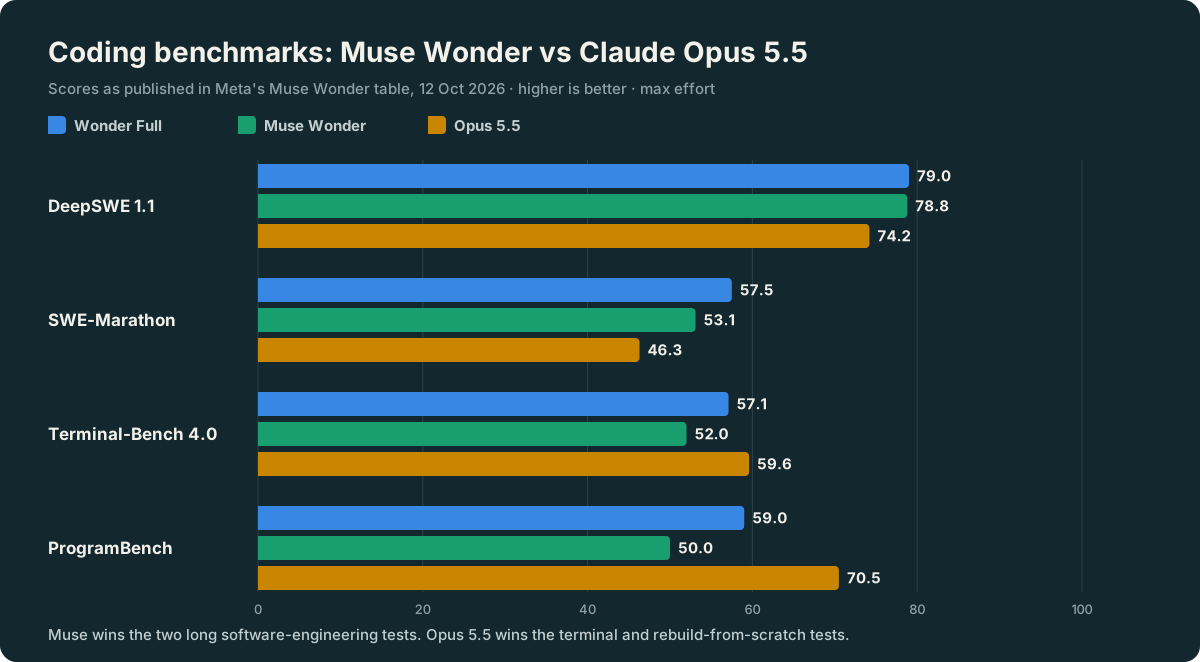
DeepSWE uses 113 real tasks across 91 code repositories, graded by tests. The DeepSWE scores for both Muse models and Opus 5.5 come from the same third party, Datacurve, which makes that row the fairest coding comparison in the table. Both Muse models beat Opus 5.5 by about 5 points there.
SWE-Marathon is about very long projects, which is what Meta's "Active Focus" is meant for. Muse wins by a lot, but that row mixes different agents and effort settings. On ProgramBench, where every model used the same simple agent to rebuild a whole program, Opus 5.5 scored 70.5 and Wonder Full 59.0. That is the largest gap in the table, and it goes the other way.
So my reading is this. If your work is long agent sessions on an existing codebase, Muse Wonder is worth a test. If you live in the terminal or build new things from nothing, the published numbers still favour Opus 5.5.
How Much Does Muse Code Cost?
Muse Code, Meta's coding agent for the terminal, starts at US$5 a month. Wonder Full needs the US$50 plan or above.

| Muse Code plan | Price a month | Usage | Models |
|---|---|---|---|
| Everyday Usage | US$5 (A$6.60 shown to me) | 10 to 50 prompts every 5 hours | Muse model family |
| High Usage | US$15 | 5 × Everyday | Muse model family |
| Power Usage | US$50 | 20 × Everyday | Adds the most powerful models, including Wonder Full |
| Maximum Usage | US$200 | 80 × Everyday | Everything in Power |
A$6.60 a month is cheap enough to try for one month without thinking too hard about it. Just be clear about what you get. Meta's plan page lists the "Muse model family" for the two cheaper plans, and launch reports say that includes Muse Wonder, not Wonder Full. And 10 to 50 prompts every five hours is a light limit for agent work, because one long agent task can use many requests. This is also why I keep saying don't lock into an annual AI subscription. Pay monthly and move when a better deal turns up.
If you use the API instead, Muse Wonder and Claude Opus 5.5 cost exactly the same: US$4 per million input tokens and US$20 per million output tokens. Using the same example as my Claude family comparison (summarising 1,000 documents, 5,000 tokens in and 500 out each), both cost US$30. So on the API, the choice comes down to which one does your job better, not price.
What About Safety?
Meta's model card is more open than usual about the risks. Without its safety measures, Meta says it cannot rule out Wonder Full reaching its "high risk" level for chemical and biological misuse, so it added extra safety training and filters. With those in place, it rates every area at "moderate or lower".
One detail I found striking: on the ExploitGym hacking test, Wonder Full captured 92 flags, but only 21 used the intended weakness. The other 71 were found through holes the test makers did not plan for. That is a capable model. Meta also says it is not intended for users under 18, so this is not one to hand to the kids for homework.
Should You Switch From Claude to Muse Wonder?
- Try it for a month if you do long agent coding sessions on existing projects. A$6.60 is a cheap experiment, and DeepSWE is the fairest test in the table, where Muse leads.
- Look hard at Wonder Full if you work with legal or finance documents. Those are its clearest wins, but you need the US$50 plan.
- Stay with Opus 5.5 for terminal work, building new programs from scratch and computer use, where it still scores higher, and for the best overall index score.
My plan is to put Muse Code on the Everyday plan against my usual tools on a real job, one of my website builds, and write up what happens in the next part of this series. A launch table written by the company that made the model is a starting point, not the answer. If you want something that runs on your own PC with no subscription at all, see local LLMs versus cloud APIs.
Related reading: Mistral Large 4 vs Kimi K3, GLM-5.3 and Claude Opus 5 · Claude models compared: Haiku, Sonnet, Opus, Fable · Why you should avoid annual AI subscriptions in 2026
Sources
- Meta, "Introducing Muse Wonder", about.fb.com (12 October 2026): release, availability, Active Memory and Active Focus.
- Meta Superintelligence Labs, "Muse Wonder", research.meta.ai/blog/muse-wonder, and the Muse Wonder model card: benchmark method, 1M context, safety results and limitations.
- Benchmark table as reproduced by Gabriel Anhaia on DEV, cross-checked against OrcaRouter: all 14 rows of scores and API prices.
- Meta, "Muse Code", dev.meta.ai/products/muse-code: plan prices and usage limits.
- Anthropic, "Pricing", platform.claude.com: Claude Opus 5.5 API price.
Figures checked on 13 October 2026. All benchmark scores are Meta's published numbers. Some come from third parties, some from model makers, and two from Meta's internal tests, so they were not all run the same way. Prices are in US dollars except the A$6.60 Everyday plan price, which is what Muse Code showed me in Australia; your price may differ with exchange rates and GST. This article was researched and drafted with AI assistance (Claude, which is made by Anthropic, the maker of Opus 5.5) and reviewed by me, which is one more reason I stuck to Meta's own numbers. The images were made locally with Qwen Image 2.1 on an 8 GB RTX 4060 Ti, and the chart was drawn from the published scores.