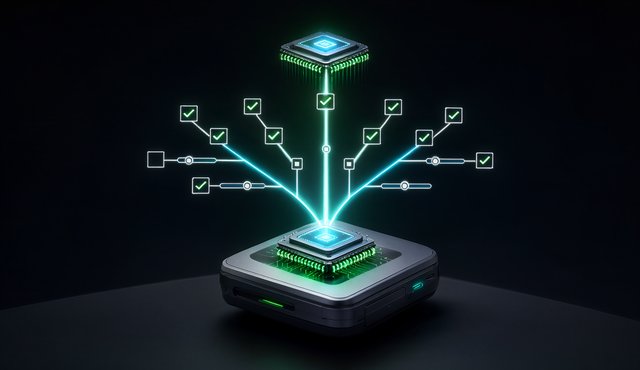
Most of the AI news this year has been about bigger chatbots and longer answers. The release I keep thinking about goes the other way. On 9 October 2026 Cloudflare added Clef-omni to Workers AI. It doesn't write anything. You give it a situation and a few typed questions, and it hands back probabilities. That sounds dull, and it's exactly what I want for email triage and the other small, repeating jobs that eat my week.
My short verdict: if you have a job where the answer is always one of a few known options (urgent or not, which team, spam or not), a decision model is a better fit than an LLM. Clef-omni is the version that can also look at the photo, listen to the voicemail or watch the clip that came with the message.
What is a decision model?
A decision model picks from answers you define in advance and tells you how sure it is. It doesn't generate free text, so there's no JSON to parse and no rambling to clean up.
The idea came from TypeSafe AI, a San Francisco start-up that opened early access to its model Jev on 15 September 2026. TypeSafe calls these "System One" models, after Daniel Kahneman's fast, intuitive System 1 thinking. The request has two parts: a state (the email, ticket or log you want judged) and a set of questions. There are three question types:
- noul: a yes/no question. You get back the probability of "yes".
- choice: pick one option from a list, such as billing, technical or sales.
- score: a ranked scale from lowest to highest, such as severity 1 to 4.
Jev is closed and hosted only by TypeSafe. Cloudflare answered on 1 October with Clef and Clef-flash. They use the same API, but the weights are open on Hugging Face under Apache 2.0. Clef-omni is the third model in that family, and the first that takes sound and video.
I wrote about the local side of this when Ollama added Jev-style decision models. Clef-omni is the hosted, multimodal version of the same idea.

What can Clef-omni read?
Text, images, audio and video, all in one request. Cloudflare's docs list these limits:
| Input | Limit per request | Token cost |
|---|---|---|
| Text state | 64,000-token context, long text is truncated | Normal text tokens |
| Questions | 1 to 64 | Count toward context |
| Images | Up to 4 (PNG, JPEG, WebP), 4 MiB each | 64 to 1,024 tokens each |
| Audio | Up to 4 clips, 300 seconds each | About 780 tokens per minute |
| Video | Up to 2 clips, 60 seconds each | About 8,600 tokens per minute at 480p |
One catch: media has to be uploaded as data in the request. Clef-omni won't fetch a remote URL for you.
Under the hood it's built on Qwen3-Omni-30B-A3B, a mixture-of-experts model with 30 billion parameters, of which about 3 billion are active per request. Cloudflare kept the part that understands input and threw away the speech output.
How would I use it for email triage?
This is the job I have in mind. Every morning there's a pile of messages: customer questions, invoices, newsletters, the odd phishing attempt, and a voicemail transcript or two. Most need one of four actions. I don't need an AI to write me an essay about each one. I need a label and a confidence number so a script can move it.
A request for one email looks roughly like this:
{
  "state": "From: [email protected]\nSubject: Overdue invoice #4471\n\nHi, our records show invoice #4471 ($1,240) is 30 days overdue...",
  "questions": {
    "urgent":   { "type": "noul",   "instructions": "Does this need a reply today?" },
    "team":     { "type": "choice", "instructions": "Who should handle it?",
                  "criteria": { "billing": "Payments and invoices",
                                "support": "Product problems",
                                "sales": "New business",
                                "ignore": "Newsletters and notifications" } },
    "phishing": { "type": "noul",   "instructions": "Is this likely a phishing attempt?" },
    "severity": { "type": "score",  "instructions": "How serious is it?",
                  "criteria": ["low", "medium", "high", "critical"] }
  }
}
You get one answer per question, keyed by the same ids. My script would then do the boring part:
- If
phishingis above 0.8, move the email to quarantine and stop. - If
urgentis above 0.7, flag it and notify me. - Route by
team, but only when the top choice is above 0.6. Anything less sure goes to a "check by hand" folder.
That last rule is what I like about this approach. An LLM will happily give you a confident answer in a clean JSON block even when it's guessing. A decision model gives you a number you can set a threshold on. When it isn't sure, a person looks.
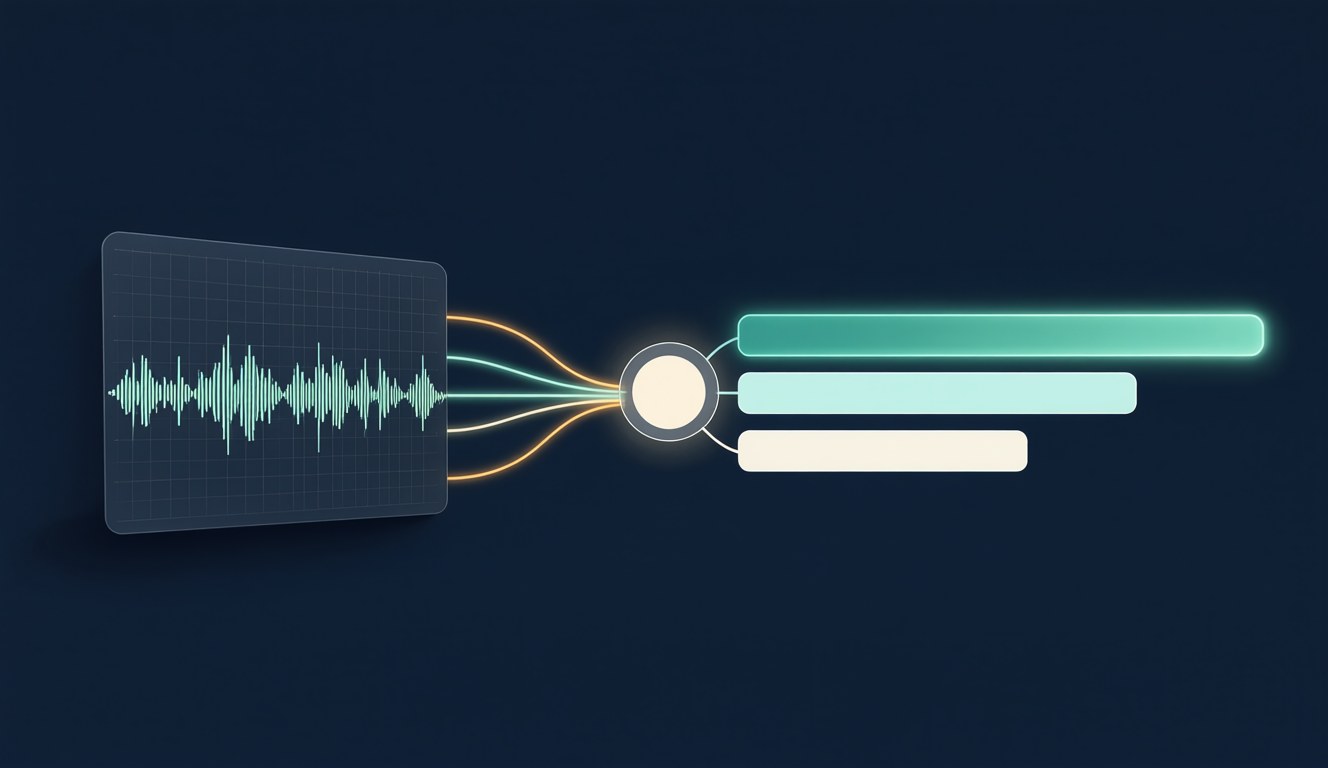
Clef-omni adds one more trick. If the email has a photo of a damaged parcel attached, or a voicemail, you can send that in the same call and ask the same questions. Cloudflare's own example checks an air-conditioner install from a photo, a sound recording and a video of the fan in one request.
Beyond email, the same pattern fits a lot of repeating work: tagging support tickets, sorting receipts into tax categories, flagging comments for moderation, or deciding which model to send a prompt to. Cloudflare says its own GitHub docs repo already uses Clef to close spam issues, and its threat team uses it to classify suspicious domains.
How much does it cost?
Clef-omni costs $0.15 per million input tokens on Workers AI, and Clef models don't charge for output tokens. Here's the whole Clef family next to each other:
| Model | US$ per M input tokens | Hosted context | Audio and video |
|---|---|---|---|
| Clef-flash | $0.038 | 24K | No |
| Clef-omni | $0.15 | 64K | Yes |
| Clef | $0.24 | 64K | No |
My rough sum for a small business inbox (an estimate, not a measured bill): call it 700 tokens per email including the questions, and 1,000 emails a day. That's 21 million tokens a month, or about US$3.15 a month on Clef-omni and about US$0.80 on Clef-flash. A one-minute voicemail adds roughly 780 tokens, which is about a hundredth of a cent.
For a text-only inbox, I'd start with Clef-flash. I'd only pay for Clef-omni when the attachments matter.
Is it accurate enough to trust?
On Cloudflare's own benchmarks, mostly yes, with gaps. These are Cloudflare's numbers and nobody has checked them independently yet.
| Benchmark | Clef-omni | Clef | Clef-flash | Jev |
|---|---|---|---|---|
| BANKING77 (intent), F1 | 94.8 | 94.2 | 90.9 | 79.7 |
| CLINC150+OOS (intent), F1 | 97.7 | 97.4 | 66.8 | 89.3 |
| PhishNChips (phishing), accuracy | 73.2 | 79.6 | 75.1 | 62.6 |
| Customer service workflow | 71.6 | 76.3 | 77.0 | 76.0 |
| When2Call (when to use a tool) | 63.3 | 72.4 | 65.6 | 81.0 |
Two things stand out for email. Clef-omni is the best of the four at working out what a message is about (the two intent tests), which is most of triage. But on phishing it trails plain Clef by six points. So if spotting scams is the main job, the cheaper text model is actually the better one. And about a quarter of customer-service cases still came out wrong for every model, which is why I'd keep the "not sure, a human checks" folder.
Speed is good but Cloudflare quotes different figures in different places. Its launch post measured about 130 ms median for a text decision and about 1.5 seconds for a 21-second video with sound. Either way it's far quicker than waiting for an LLM to write a reply.
What are the catches?
- Questions are answered in parallel. If question B depends on the answer to question A, you need two calls.
- It only decides. If you want a draft reply, you still pair it with an LLM. Cloudflare suggests exactly that: Clef in the fast path, an LLM only for the messages that need words. If you're choosing that LLM, my Claude Haiku 5.5 post covers a cheap option.
- Your email goes to Cloudflare. Cloudflare says it doesn't store or train on requests unless you opt into fine-tuning. If that's still too much, the Clef weights are open, and the local vs cloud trade-offs are the same as for any other model. A 30B model won't fit on my 8GB card, though.
- The benchmarks are Cloudflare's. I'd test it on a week of my own mail before letting it move anything without me.
So is this a new stream of AI?
I think so. For two years "AI" has mostly meant a chatbot that writes. Decision models are a different tool. They're closer to a very smart sorting machine: fast, cheap, and honest about how sure they are. Most of the AI work in a normal office isn't writing. It's sorting, routing and deciding whether something needs a person. That's the part these models are built for.
I don't think they replace LLMs. I think they sit in front of them, quietly handling the 80% of messages that only need a label, so the expensive model only sees the ones that matter. My next step is to point Clef-flash at a copy of my own inbox and see how often I disagree with it. I'll write that up as the next part of this series.
Sources (checked 12 October 2026)
- Cloudflare Workers AI docs: clef-omni (inputs, limits, pricing, token costs)
- Cloudflare blog: Introducing Clef-omni, 9 October 2026 (base model, benchmarks, latency)
- Workers AI changelog, 9 October 2026 (Clef-flash price cut, context sizes)
- Cloudflare blog: Introducing Clef, 1 October 2026 (Apache 2.0 weights, Jev compatibility, privacy)
- Wikipedia: Jev (AI model) (TypeSafe AI, System One API, release date)
Research for this article was AI-assisted. The cost figures are my own estimates. Benchmarks are as published by Cloudflare and have not been independently verified.