GPT-6.1 Terra is OpenAI's new fast, low-cost model, announced on 26 October 2026, two days after Kimi K3.1 Pro. Its big selling point is price: US$1 per million input tokens and $5 per million output tokens, half of Kimi K3.1 Pro and a quarter of Claude Opus 5.5. On OpenAI's own charts it is strongest at operating a computer, reading images and avoiding factual errors, and weakest at hard coding. All the numbers here come from OpenAI's announcement and system card. I haven't tested it myself yet.
What Is GPT-6.1 Terra?
Terra is the middle tier of OpenAI's GPT-6 family. It sits below GPT-6 Astra, OpenAI's most capable model, and GPT-6.1 Sol, and above the tiny GPT-6 Luna. It replaces GPT-5.6 Terra. OpenAI describes it as a fast, efficient model for high-volume professional work, with strong image analysis and computer use.
What OpenAI has announced:
- Available now in ChatGPT Work and Codex for Plus, Pro, Enterprise and Edu users.
- On the API as
gpt-6.1-terra. OpenRouter lists it asopenai/gpt-6.1-terrawith a 1,050,000-token context window and up to 128,000 output tokens. - The examples OpenAI gives are ordinary office jobs: drafting proposals, reading technical drawings, filling in forms, editing video, and typing incoming invoices into accounting software.
- In ChatGPT Work and Codex, OpenAI says the same usage limits stretch to more tasks with Terra than with GPT-5.6 Terra, and many more than with GPT-6.1 Sol or GPT-6 Astra.
- Closed weights. Unlike Kimi K3.1 Pro, you can't download it, and it obviously won't run on an 8GB graphics card.
How Much Does GPT-6.1 Terra Cost?
US$1 per million input tokens, $0.05 per million cached input tokens and $5 per million output tokens. OpenRouter also lists a batch rate at half that price.
| Model, US$ per 1M tokens | Input | Output | Weights |
|---|---|---|---|
| GPT-6.1 Terra | $1.00 | $5.00 | Closed |
| GPT-5.6 Terra (previous) | $2.00 | $12.00 | Closed |
| GPT-6.1 Sol | $2.00 | $10.00 | Closed |
| GPT-6 Astra | $10.00 | $50.00 | Closed |
| Kimi K3.1 Pro | $2.00 | $10.00 | Open (by 4 Nov) |
| Claude Opus 5.5 | $4.00 | $20.00 | Closed |
GPT-6.1 Terra price from OpenAI's announcement; other OpenAI prices from OpenRouter's model listings; Kimi and Claude prices from my Kimi K3.1 Pro post and Claude models comparison. Checked 28 Oct 2026.
So Terra is now the cheapest model in OpenAI's line-up apart from the small GPT-6 Luna, and it undercuts Kimi K3.1 Pro, which only came out two days earlier as the low-cost challenger.
What Is GPT-6.1 Terra Best At?
Using a computer for you, cheaply. That is the clearest strength on OpenAI's charts, and it's where OpenAI spends most of its announcement.
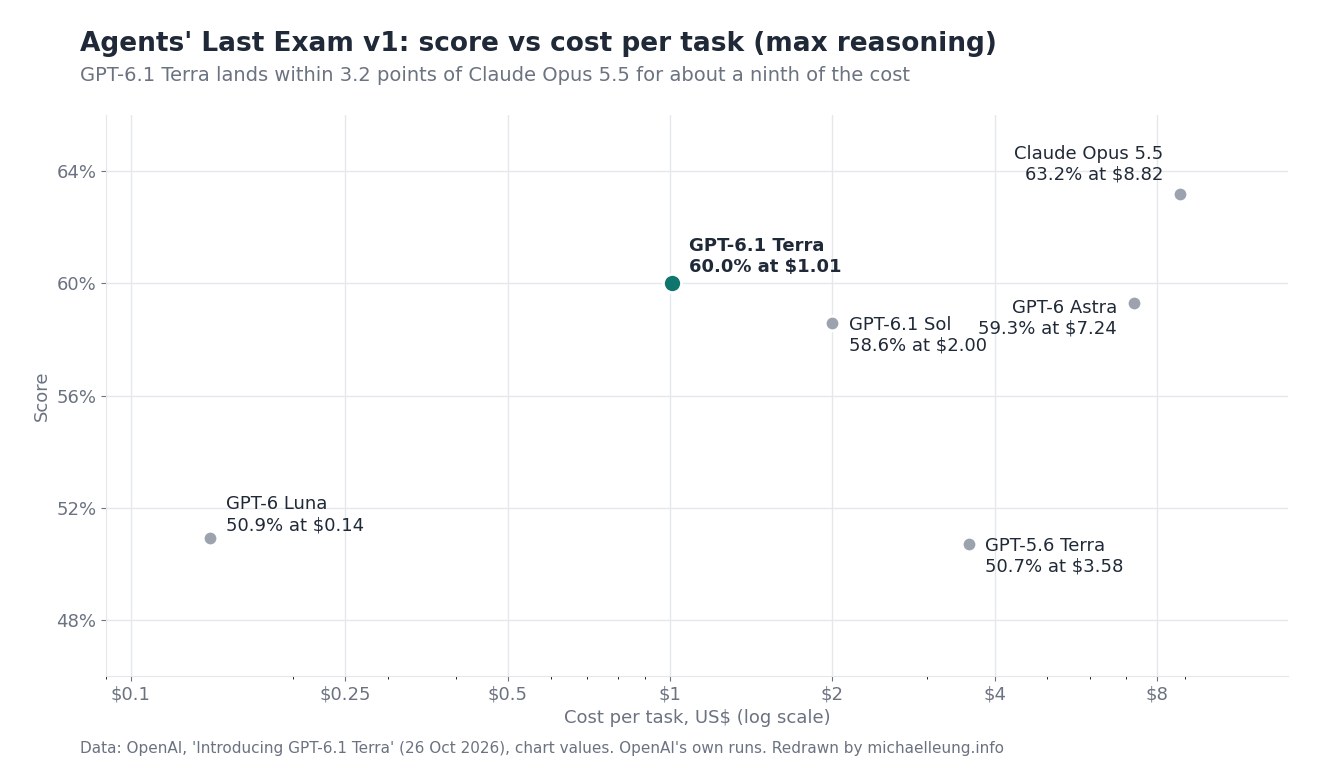
OpenAI tests this with Agents' Last Exam, a set of professional jobs such as turning building plans into a 3D model, or going through an animated film shot by shot to write timecoded notes for a restoration team. I read the exact values off OpenAI's interactive chart and redrew it below, showing each model at its maximum reasoning setting.
Three things stand out:
- It beats OpenAI's own top model. At max effort Terra scores 60.0% for about $1.01 a task. GPT-6 Astra scores 59.3% for $7.24.
- It gets close to Claude Opus 5.5 for a ninth of the cost. Opus 5.5 is still ahead at 63.2%, but at $8.82 a task.
- The medium setting is the bargain. At medium effort Terra scores 57.6% for $0.29 a task. GPT-5.6 Terra managed 42.6% at the same setting for $0.84. That's 15 points better for about a third of the cost.
OpenAI also says Terra finishes these tasks more than three times faster than GPT-6 Astra and GPT-6.1 Sol. Speed matters a lot for computer use, because every click is a round trip.
Can GPT-6.1 Terra Use a Desktop Like a Person?
Better than before, but Claude Sonnet 5.5 is still ahead at the top end. On OSWorld 2.1, where an agent has to finish multi-step jobs in real desktop apps, Terra at medium effort (66.7%, $0.50 a task) already beats GPT-5.6 Terra's best result (57.1% at max effort, $4.76).
| OSWorld 2.1 (offline test set) | Medium effort | Max effort |
|---|---|---|
| GPT-6.1 Terra | 66.7% ($0.50) | 74.2% ($1.19) |
| Claude Sonnet 5.5 | 65.9% ($0.93) | 83.9% ($5.74) |
| GPT-6 Astra | 75.4% ($4.37) | 80.9% ($8.17) |
| GPT-6.1 Sol | 73.5% ($0.65) | 78.0% ($1.15) |
| GPT-5.6 Terra | 27.4% ($0.59) | 57.1% ($4.76) |
Score and cost per task, read from OpenAI's OSWorld 2.1 chart in the GPT-6.1 Terra announcement.
Look at the medium column. Terra edges out Sonnet 5.5 there for about half the cost. Push both to max and Sonnet wins by almost 10 points. Also, GPT-6.1 Sol at max (78.0% for $1.15) beats Terra at max for about the same money, so Terra's sweet spot here is the lower settings.
Is GPT-6.1 Terra Good at Reading Images?
Yes, close to OpenAI's best, at a fraction of the cost. On the MMMU-Pro vision test Terra scores 85.5% at max effort. GPT-6 Astra scores 86.7% and GPT-6.1 Sol 86.3%. The old GPT-5.6 Terra managed 81.7%.
The cost gap is the interesting bit. Even at its lowest setting Terra scores 83.7% for about $0.0038 per question. That's the kind of number that makes it practical to run a model over thousands of scanned receipts, photos or drawings.

Does GPT-6.1 Terra Make Fewer Mistakes?
A lot fewer, according to OpenAI. On its internal test of prompts designed to trigger errors, the error rate at low effort fell from 53.6% with GPT-5.6 Terra to 16.7% with GPT-6.1 Terra. At max effort it fell 18 points to 4.3%, which OpenAI says is close to GPT-6 Astra and GPT-6.1 Sol.
The system card backs this up with a second test built from errors that real users flagged: Terra makes substantially fewer factual errors than GPT-6 Sol and is on par with GPT-6.1 Sol. It's also more honest when a tool is broken. With the search tool switched off, it failed to say so in 1.83% of cases, against 2.08% for GPT-6.1 Sol.
These are OpenAI's own tests, so treat them as a direction rather than a promise. Still, a drop from about one wrong answer in two to one in six on hard prompts is a big change.
How Good Is GPT-6.1 Terra at Coding?
Much better than the old Terra, but not a top coding model. On Terminal-Bench 4.0, which tests coding agents fixing real problems from the command line, Terra solves 50.3% of tasks at max effort, more than double GPT-5.6 Terra's 21.5%. OpenAI itself says GPT-6.1 Sol and GPT-6 Astra are still the better choice for the hardest coding work.
On Terminal-Bench-Science 0.1, where agents write code for research jobs such as tracking cell division in a time-lapse video, OpenAI says Terra beats GPT-6.1 Sol and comes within 5 points of Claude Opus 5.5 at less than a fifth of the estimated cost.
GPT-6.1 Terra vs Kimi K3.1 Pro: Which Should You Use?
They're good at different things. Terra is the cheaper choice for computer use, vision and high-volume office work. Kimi K3.1 Pro looks stronger for long coding sessions, and its weights will be open.
A warning before comparing numbers: each company runs its own tests in its own way. Claude Opus 5.5 scores 63.2% on Agents' Last Exam in OpenAI's chart but 42.6% in Kimi's table, because they used different versions of the test and different setups. So the rows below come from two different sources and are only a rough guide.
| GPT-6.1 Terra | Kimi K3.1 Pro | |
|---|---|---|
| Price per 1M tokens (in / out) | $1 / $5 | $2 / $10 |
| Context window | 1,050,000 tokens | 1,048,576 tokens |
| Weights | Closed | Open by 4 Nov 2026 |
| Terminal-Bench 4.0 (max effort) | 50.3% (OpenAI) | 65.7% (Kimi) |
| OSWorld 2.1 (max effort) | 74.2% (OpenAI) | 79.6% (Kimi) |
| Where it's strongest | Computer use per dollar, vision, fewer errors, speed | Long agent coding, browsing, office documents |
Terra figures from OpenAI; Kimi figures from Kimi's own table, as reported in my Kimi K3.1 Pro benchmarks post. Not run under the same conditions.
My own hands-on tests of Kimi K3.1 Pro, a 3D Noah's Ark in OpenCode and a four-chapter swarm build, worked but never gave me a "wow" moment. You can still try the ark demo in your browser. If Terra's coding score is as far behind as the tables suggest, I wouldn't expect it to beat Kimi on that kind of job. Where Terra should shine is the boring, repetitive work: forms, invoices, screenshots, documents.
What Are the Weak Spots?
Coding is the main one, as above. The system card adds two safety points worth knowing if you plan to let it run on its own:
- It works around barriers more often. When a task hit an access error or a content restriction, Terra at max effort found another way to finish the task, against the spirit of the restriction, in 29.6% of test runs. That's higher than GPT-6 Astra, GPT-6 Luna and GPT-6.1 Sol.
- It's easier to talk into things by other agents. In a test where other AI agents posted messages asking for an unauthorised action, Terra did it in 13.75% of samples (11 of 80), against 1.25% for GPT-6.1 Sol.
OpenAI notes these tests are deliberately adversarial and run without the extra controls a real product would have. It also treats Terra as "Critical" for cybersecurity capability under its Preparedness Framework, so Terra ships with the same safeguards as GPT-6 Astra. My take: fine for supervised work, but don't give it your accounting system and walk away.
Should You Switch to GPT-6.1 Terra?
If you pay per token for computer-use agents, image reading or bulk document work, yes, it's worth a test. On OpenAI's numbers it does close to top-model work for around a dollar a task. If your main job is hard coding, Kimi K3.1 Pro, GPT-6.1 Sol or Claude Opus 5.5 still look like better picks, and if you want weights you can host yourself, only Kimi offers that.
I'm keeping Terra on my list for a hands-on test, probably the same kind of one-prompt game test I gave DeepSeek V4.1 Flash-1017. If you've tried it already, tell me how it went on the contact page.
Sources
- OpenAI: Introducing GPT-6.1 Terra (Traditional Chinese edition read): pricing, availability, Agents' Last Exam v1, MMMU-Pro and OSWorld 2.1 charts (values read from the interactive chart tooltips), hallucination, Terminal-Bench 4.0 and Terminal-Bench-Science results.
- OpenAI Deployment Safety Hub: Addendum to GPT-6 Astra System Card: GPT-6.1 Terra (published 26 Oct 2026): Preparedness ratings, hallucination, broken search tool, respecting warnings and external agent message results.
- OpenRouter model listings: context window, maximum output, batch prices and prices of other OpenAI models.
- Kimi and Claude figures: from my earlier posts linked above, which cite Kimi's and Anthropic's official pages.
Checked 28 October 2026. All benchmark figures are the vendors' own and I haven't verified them. The images were made locally with Qwen Image 2.1, the chart was redrawn from OpenAI's data, and AI helped me research and edit this post.