Kimi K3.1 Pro is Moonshot AI's new flagship model, released on 24 October 2026. Kimi calls it its most capable "3T-class" open-weight model so far, with a 1-million-token context window, and says the full weights will be out by 4 November. On Kimi's own benchmark table it trades blows with Claude Opus 5.5: ahead on 21 tests, behind on 20. The API is cheaper than the old Kimi K3, at US$2 per million input tokens and $10 per million output tokens. Everything in this post comes from Kimi's announcement and API docs. I haven't tested it myself yet. That comes tomorrow.
What Is Kimi K3.1 Pro?
It is a post-trained version of Kimi K3, the first model in a new K3.1 series. Kimi says it spent "substantially larger post-training compute" on it, mostly reinforcement learning across hundreds of task types, and focused on coding, 3D creation and finance work.
What Kimi has announced:
- Two versions: Kimi K3.1 Pro and K3.1 Pro Highspeed, which Kimi says runs 2–3× faster with the same abilities.
- A 1,048,576-token context window. Thinking is always on, and you choose the reasoning effort:
low,highormax(the default). - Available now on kimi.ai and the Kimi apps, the Kimi Work desktop app (version 3.1.0 or later, Windows and Apple silicon Macs), Kimi Code (pick it with the
/modelcommand) and the Kimi API askimi-k3.1-proandkimi-k3.1-pro-highspeed. - The API speaks the OpenAI and Anthropic formats, so it plugs into Claude Code, Codex and OpenCode. Zero Data Retention is available for API customers.
- Full model weights "will be released by Nov 4, 2026". Kimi hasn't published an exact parameter count beyond "3T-class".
One catch for new API users: Kimi treats K3.1 Pro as a flagship model, so it only unlocks after you top up your account (minimum US$1).
How Much Does Kimi K3.1 Pro Cost?
US$2 per million input tokens and $10 per million output tokens, flat across the whole 1M context. That is a third cheaper than Kimi K3. The Highspeed version costs double.
| Model, US$ per 1M tokens | Input | Output | Cached input | Cache write (5 min / 1 h) |
|---|---|---|---|---|
| Kimi K3.1 Pro | $2.00 | $10.00 | $0.20 | $2.00 / $4.00 |
| Kimi K3.1 Pro Highspeed | $4.00 | $20.00 | $0.20 | $4.00 / $8.00 |
| Kimi K3 (previous model) | $3.00 | $15.00 | $0.30 | $3.00 / $6.00 |
From Kimi's API pricing page, 25 Oct 2026. Prices exclude tax. Caching switches on automatically with a 5-minute lifetime; you can pay more for a 1-hour one.
OpenRouter already lists it as moonshotai/kimi-k3.1-pro at the same $2 / $10. For how that compares with Anthropic's line-up, see my Claude models comparison.
Is Kimi K3.1 Pro Better Than Claude Opus 5.5?
On Kimi's own numbers, it's roughly a draw. Across the 41 tests in Kimi's table where both models have a score, K3.1 Pro is ahead on 21 and behind on 20. K3.1 Pro has the top score among all six models on 16 of the 47 rows; Opus 5.5 has it on 14.
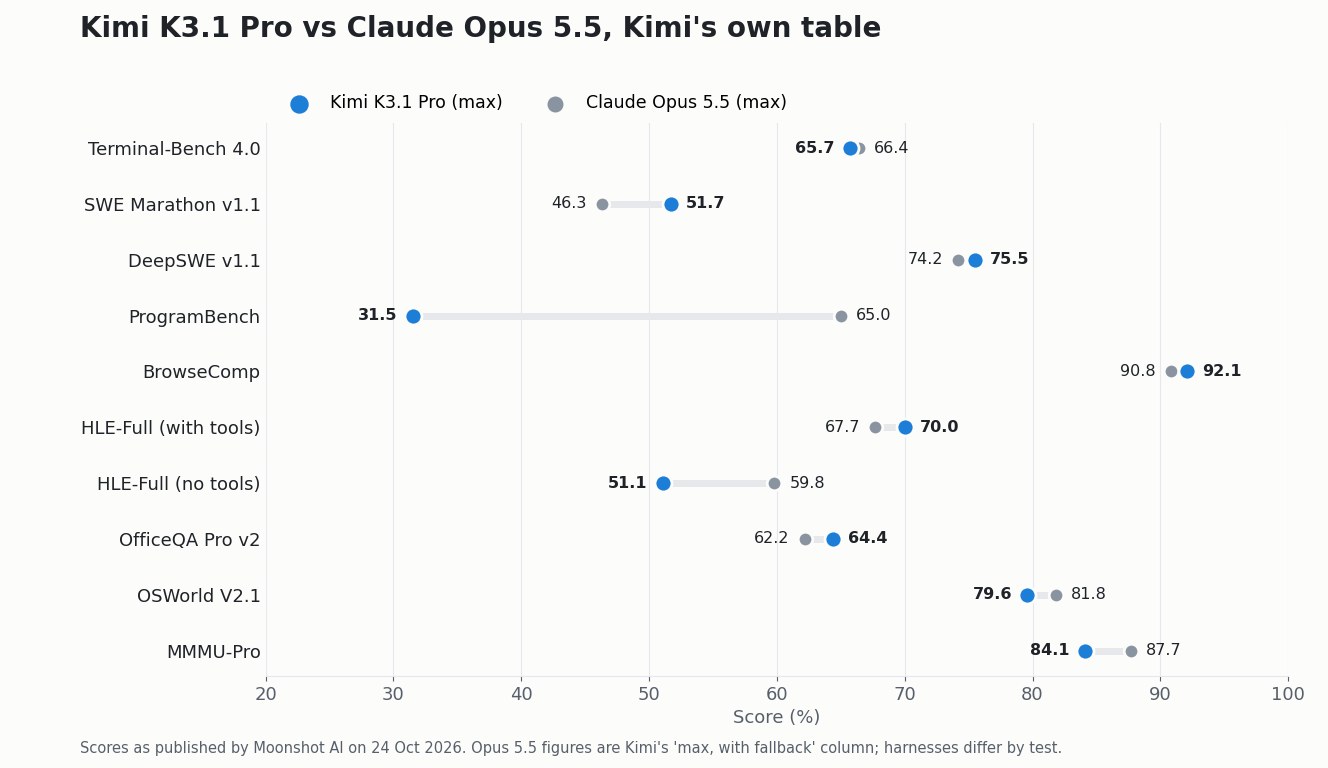
The pattern is fairly clear. K3.1 Pro does best on long agent jobs with tools: browsing, searching, long coding sessions, office documents. It falls behind where the model has to know or see things on its own. The biggest gap is ProgramBench (31.5 vs 65.0), and on the harder HLE-Diamond set it scores 39.4 against Opus 5.5's 60.9.
| Benchmark (Kimi's table) | Kimi K3.1 Pro | Claude Opus 5.5 | GPT-6 Astra | DeepSeek V4.1 Flash-1017 |
|---|---|---|---|---|
| Terminal-Bench 4.0 | 65.7 | 66.4 | 58.2 | 42.3 |
| SWE Marathon v1.1 | 51.7 | 46.3 | 42.5 | 40.0 |
| DeepSWE v1.1 | 75.5 | 74.2 | 74.1 | 77.0 |
| ProgramBench | 31.5 | 65.0 | 50.0 | 29.1 |
| BrowseComp | 92.1 | 90.8 | 91.5 | – |
| HLE-Full, with tools | 70.0 | 67.7 | 57.2 | 58.8 |
| HLE-Full, no tools | 51.1 | 59.8 | 53.6 | 42.6 |
| Agents' Last Exam (all) | 43.2 | 42.6 | 41.8 | 37.7 |
| OSWorld V2.1 (computer use) | 79.6 | 81.8 | 75.8 | 69.3 |
| GPQA-Diamond | 94.2 | 93.9 | 96.1 | 92.2 |
Bold = best of these four. All at maximum reasoning effort. Kimi ran K3.1 Pro mostly in the Claude Code harness; many rival scores come from their own reports or public leaderboards, and Kimi marks the Claude and GPT columns "with fallback". Kimi's table also includes Claude Fable 5.1 and GLM-5.3.
Keep in mind who made this table. It's Kimi's choice of tests, Kimi's settings and, for its own model, Kimi's runs. That's normal for a launch post, but it's a vendor's view until other people test it.
Is Kimi K3.1 Pro Cheaper Per Coding Task?
On Kimi's Terminal-Bench 4.0 chart, yes, by a lot. At max effort it scores 65.7% for about US$5.25 per task. Claude Opus 5.5 scores 64.8% on the same chart for about $14.30, and GPT-6 Astra 58.2% for about $9.90.
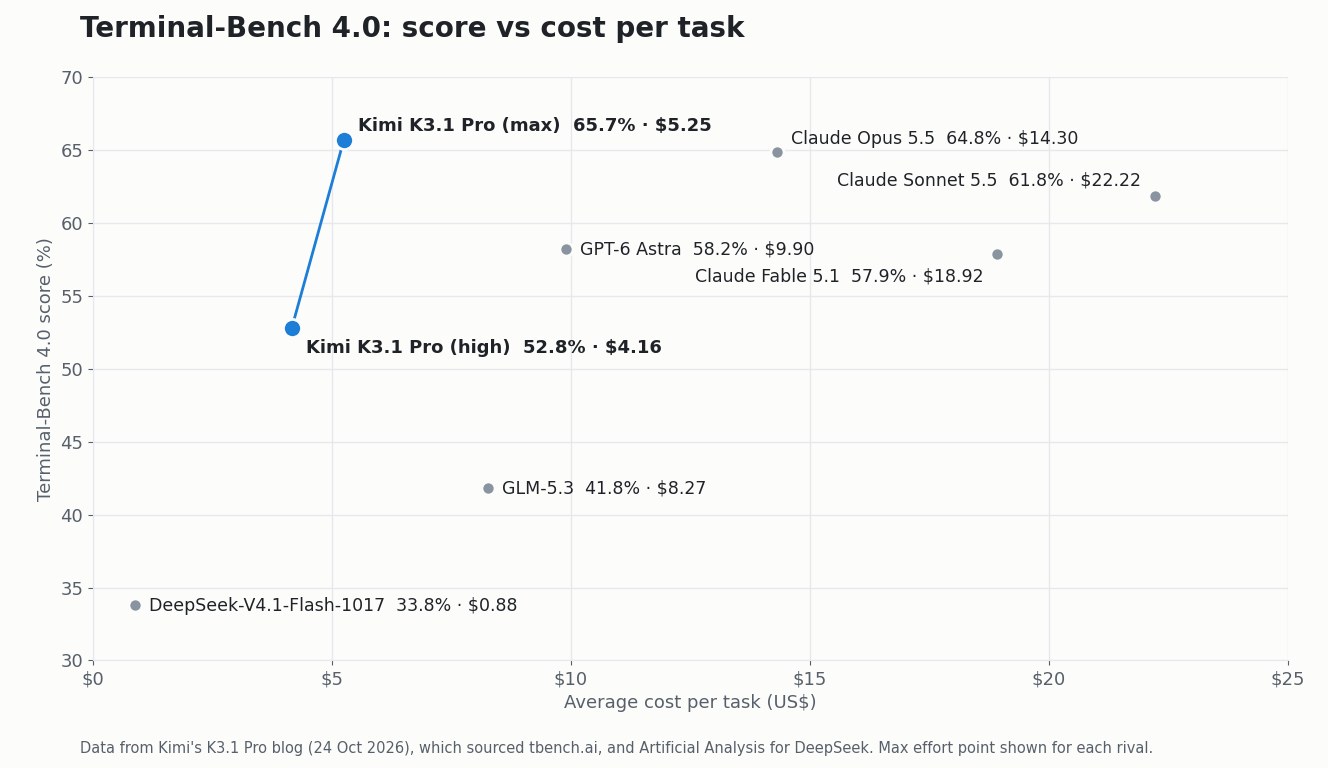
Two things to notice. First, max effort matters here: on high effort K3.1 Pro drops to 52.8% while only saving about a dollar a task. Second, the Opus 5.5 score on this chart (64.8%) is a little lower than in Kimi's table (66.4%), because the table takes the higher of the blog and leaderboard numbers. Either way, the gap that matters is cost, not score.
The cheapest model on the chart is still DeepSeek V4.1 Flash-1017 at 88 cents a task, but at 33.8% it is far behind. I wrote about that model in DeepSeek V4.1 Flash-1017: Same Price, Big Coding Gains.
What Else Is New: 3D, Finance and Fewer Made-Up Facts?
Kimi spends most of its post on three areas outside plain coding.
3D. On BenchCAD, which asks the model to rebuild a 3D object from pictures by writing CAD code, K3.1 Pro scores 92.7% with tools, close to Opus 5.5 (96.2%) and GPT-6 Astra (95.9%). Kimi says it can write and run scripts for Blender and CAD tools without an MCP connector, and shows game scenes made in Unity, Unreal Engine and Godot. There's also a new "3D Make" feature on kimi.ai that exports models for 3D printing. I build Blender models by script for my own Godot game, so this is the claim I most want to check.
Finance. K3.1 Pro tops Kimi's table on OfficeQA Pro v2 (64.4, ahead of Opus 5.5 at 62.2), a test of answering questions from real financial documents given only as page images. On Kimi's internal tests it beats K3 by 7.2 points on financial modelling and 11.6 points on financial research, and scores about 4.2 times K3 on a long business-management simulation.
Hallucination. On Kimi's hardest internal fact-checking test, the share of false claims fell from 23.4% with K3 to 8.3%. That beats Opus 5.5 (15.0%) but not GPT-6 Astra (5.5%). Kimi is careful to say this is a stress test built to trip models up, so it is not the error rate you'd see day to day.
Why Did Kimi Hold Back Its Hacking Skills?
Because the weights will be public, Kimi removed cyber-security training data on purpose. It found that its models got steadily better at finding and exploiting security bugs as training went on, and traced that to security content mixed into the general training data.
On Kimi's in-house exploit test, xdev-bench-hard, a version trained without the clean-up solved 90.5% of tasks. The released K3.1 Pro solves 81.0%. Kimi says its cyber ability stays behind closed models that have been public for at least three months, and that it wants to raise the cyber level of open weights slowly rather than all at once. On the public ExploitBench, K3.1 Pro scores 74.7 against Opus 5.5's 91.0 and GPT-6 Astra's 100.
I think this is the most interesting section of the post. It's rare for a lab to show the score it chose not to ship.
Can You Run Kimi K3.1 Pro Locally?
Not at home. A "3T-class" model has about 3 trillion parameters, so even squeezed to 4 bits per parameter the weights would need roughly 1.5 TB of memory. My RTX 4060 Ti has 8 GB. The weights still matter: companies and cloud hosts can run it themselves once they're out by 4 November. Meta's 816B Muse Spark Open was already too big for home GPUs, and this is several times larger. For when the cloud is the better deal, see my Local LLM vs Cloud API guide.
Should You Try Kimi K3.1 Pro?
If you run long coding or research agents and pay per token, it's worth a look. On Kimi's numbers it gets close to Claude Opus 5.5 on agent work for half the list price and a bit over a third of the cost per Terminal-Bench task. If your work leans on knowledge and reasoning without tools, or on writing whole programs from a spec, the table says Opus 5.5 is still clearly ahead.
I used Kimi K3 as one of four "director" models in my Claude video workflow test, where Opus 5.5 came out on top. Tomorrow I'll put K3.1 Pro through my own hands-on test and post the results as the next part of this series. If you've tried it already, tell me how it went on the contact page.
Sources
- Kimi: Kimi K3.1 Pro Tech Blog: Advancing Open Intelligence (24 Oct 2026), including the full benchmark table, the Terminal-Bench 4.0 cost chart, BenchCAD, finance, hallucination and xdev-bench-hard results, and availability.
- Kimi API: Model Inference Pricing: K3.1 Pro, K3.1 Pro Highspeed and K3 prices.
- Kimi API: Kimi K3.1 Pro quickstart: reasoning effort, minimum top-up, API formats.
- OpenRouter: Kimi K3.1 Pro: model ID, context length and price.
Checked 25 October 2026. Prices are in US dollars. All benchmark figures are Moonshot AI's own; I haven't run my own tests yet. I redrew both charts from the numbers published in Kimi's blog, and the cover image was made locally with Qwen Image 2.1. AI helped me research and edit this article.