
Ripple-65B Preview is a new open-weight AI model from Ricursive Intelligence, released on 4 November 2026 under the Apache 2.0 licence. Its headline number is 80.52 on Terminal-Bench 2.1, a test of how well an AI agent can get real jobs done in a command-line terminal. That's the best score yet for an open model from a US lab, and it beats rivals up to 15 times its size. The lab says the whole project cost about US$32 million. My verdict: it's an impressive coding model for its size and very cheap to use through the cloud, but it isn't the best open model at everything, and it's still too big for a normal home PC.
What Is Ripple-65B Preview?
It's a 65-billion-parameter language model built mainly for agentic coding: an AI that runs commands, reads the output, fixes its mistakes and keeps going until the task is done. According to the model card:
- Dense, not mixture-of-experts. Most big open models now only switch on part of their parameters for each word they write. Ripple uses all 65 billion every time. The team chose that because it's simpler to train and serve.
- Trained from scratch on 12 trillion tokens of mostly English text and code, starting from the training recipe of AI2's open Olmo 3 model.
- Up to 1 million tokens of context, enough to hold a large codebase in one go.
- Three downloads: the instruction-tuned model in BF16, a smaller NVFP4 version, and a base model with no fine-tuning.
One thing I want to clear up, because I've seen it reported differently: the public model is not a chip-design model. Ricursive is a lab that uses AI to design chips. Its launch blog says a private variant powers its chip-design platform, and Ripple-65B Preview is "a general-purpose variant" of it.
How Good Is Ripple-65B at Coding?

Very good at terminal work, and decent but not top on bug-fixing tests. I redrew the chart below from the model card's table. It compares Ripple only with open-weight models from US labs, so Chinese open models like DeepSeek, Qwen and Kimi aren't in it.
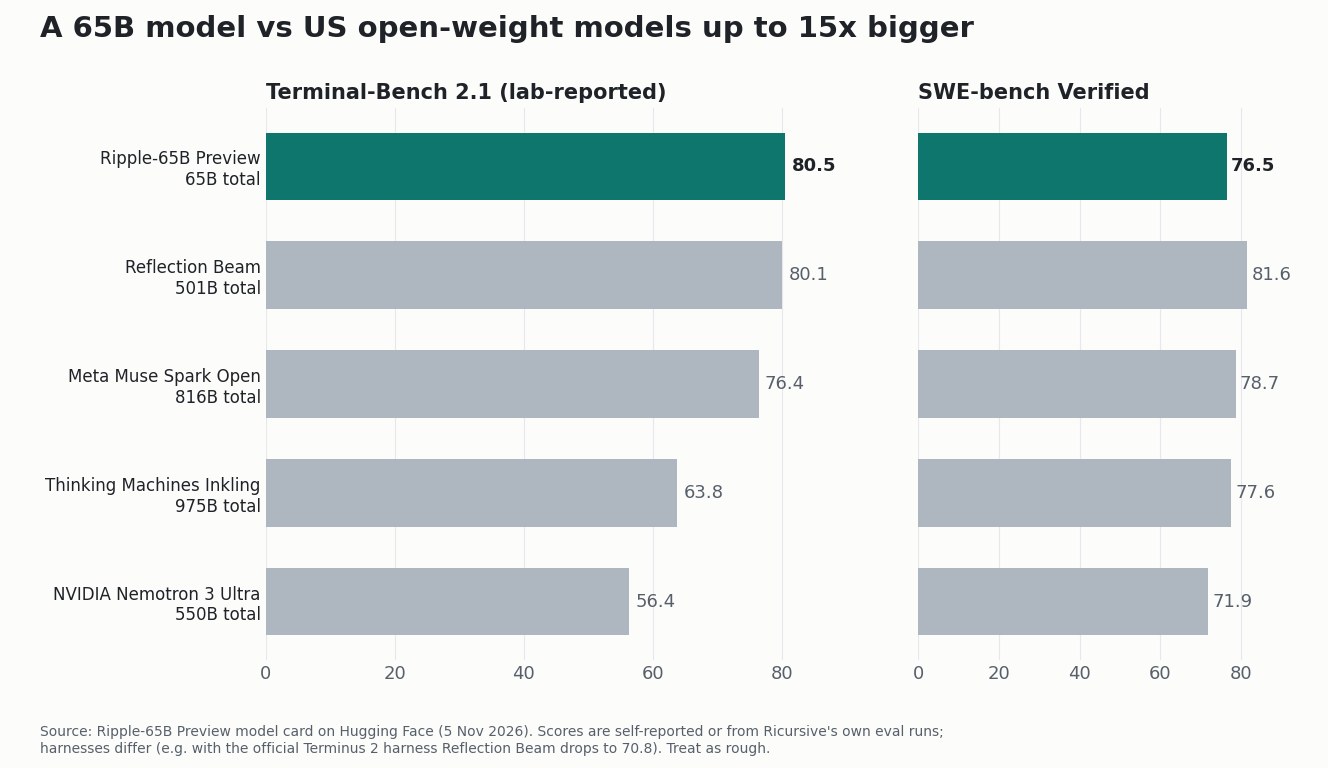
| Test (higher is better) | Ripple-65B | Reflection Beam 501B | Muse Spark Open 816B | Inkling 975B | Nemotron 3 Ultra 550B |
|---|---|---|---|---|---|
| Terminal-Bench 2.1 | 80.5 | 80.1 | 76.4 | 63.8 | 56.4 |
| SWE-bench Verified | 76.5 | 81.6 | 78.7 | 77.6 | 71.9 |
| SWE-bench Pro v2.0 Hard | 79.1 | 76.5 | 52.3 | 2.0 | 30.7 |
| MCP Atlas (tool use) | 71.7 | 80.8 | 89.2 | 76.0 | 62.2 |
| GPQA Diamond (science) | 85.2 | 90.6 | 89.0 | 87.2 | 87.0 |
| AIME 2026 (maths) | 95.0 | 97.7 | 98.3 | 97.1 | 95.4 |
So the honest summary is: Ripple wins the terminal test by a hair (80.5 vs 80.1) and wins one hard bug-fixing test clearly. On everyday bug-fixing (SWE-bench Verified), tool use, science and maths, bigger models are still ahead. For a model a tenth of their size, that's still a strong result.
The lab itself warns that these scores are hard to compare. Some rival numbers come from each lab's own model card and some from Ricursive's own test runs, with different test harnesses. With the official Terminus 2 harness, for example, Reflection Beam's Terminal-Bench score drops from 80.1 to 70.8, while Ripple's stays at 80.5. I'd treat the table as a rough guide until independent results come in.
Did Ripple-65B Really Cost Only $32 Million?

That's what the lab says, and it counts more than most labs would. According to the launch blog, US$32 million is the full research and development cost from scratch: the small test models, data work, evaluations, debugging, synthetic data, and the final training runs. Ricursive estimates that's about one-tenth of what the previous top open coding model cost, though it adds "to the best of our knowledge", since rival labs don't publish their costs.
A few other details stood out to me:
- A tiny team. The model card says the team grew from 1 to 5 people during development.
- Far less reinforcement learning. Ripple reached its Terminal-Bench score with about 1.4 million practice runs, which the lab says is roughly 70 times fewer than Reflection Beam.
- No bought training data. The team made its own synthetic data for fine-tuning instead.
- Simple engineering. No custom GPU kernels and no quantisation during training, yet the GPUs stayed about 40% busy throughout, which is a solid figure.
It reminds me of Axion 1.0, which I wrote about yesterday: another case where a small, careful recipe gets close to the big labs. For anyone worried that only trillion-dollar companies can build good AI, that's encouraging.
How Much Does Ripple-65B Cost to Use?
Very little through the cloud. On OpenRouter it costs US$0.20 per million input tokens and US$0.60 per million output tokens, with cached input at US$0.05 per million. It supports tool calling, the full 1-million-token context, and up to about 131,000 tokens of output per reply. The launch blog says it's also on Together AI and GMI Cloud, with Fireworks to follow.
At those prices, even an input-heavy agentic coding session should cost well under a few dollars, much like the cheap model in my night of agentic coding for under $1. One caution: when I checked, OpenRouter listed only one provider (GMI Cloud), and its uptime over the past day was about 85%. That's normal for a launch week, but I wouldn't put it in a work pipeline just yet.
Can You Run Ripple-65B on Your Own PC?

Not comfortably on a normal gaming PC. Here are the download sizes I checked on Hugging Face:
| Version | Files | Who made it |
|---|---|---|
| BF16 (full) | about 130 GB | Ricursive (official) |
| NVFP4 | about 57 GB | Ricursive (official) |
| GGUF Q4_K_M | about 39 GB | Community upload (unofficial) |
The lab's target is a machine like the NVIDIA DGX Spark, a compact AI computer with 128GB of memory. My own PC has an RTX 4060 Ti with 8GB and 64GB of RAM (I described it in my PC-for-AI-agents post). A 39 GB file would fit in RAM, but because Ripple is dense, the computer has to read all 65 billion parameters for every word it writes. By my rough maths, that means only one or two words per second on my machine. That's far too slow for an agent that has to read and write thousands of lines.
Two more catches. Ripple uses a new architecture with custom code, so check that your app (llama.cpp, Ollama, LM Studio and so on) actually supports it before you download 39 GB. And community quantised copies aren't checked by the lab. I haven't run it locally yet, so I'll test it and write it up when the tools catch up.
Should You Try Ripple-65B Now?
If you use AI coding agents through an API, yes, it's worth a test. At US$0.60 per million output tokens, testing it costs very little, and its terminal score is the best of any US open model. Run it on a real task from your own work before you trust the benchmark table.
If you want a model that runs on your own gaming PC, no. Something much smaller or a mixture-of-experts model will be faster on 8GB of VRAM. If you have a 128GB machine like a DGX Spark or a big Mac, Ripple is one of the most interesting open coding models to try this month.
My honest take: the benchmark win is narrow and self-reported, but the story behind it is the real news. Five people and US$32 million produced an open model that keeps up with models more than ten times bigger, and anyone can download it under Apache 2.0.
Sources
- Ripple-65B Preview model card on Hugging Face: architecture, training stages, team size, instruct benchmark table, harness notes, Apache 2.0 licence.
- Ricursive launch blog: Introducing Ripple-65B Preview: US$32M R&D cost and what it includes, 1.4M RL rollouts, chip-design platform, availability.
- OpenRouter model listing: prices, 1M context, max output, providers and uptime.
- Hugging Face file listings for the NVFP4 repo and community GGUF uploads: download sizes.
Checked 5 November 2026. Benchmark figures and the US$32 million cost are Ricursive's own and I haven't verified them. I haven't run Ripple-65B myself; the speed on my PC is my own rough estimate. The images were made locally with Qwen Image 2.1, the chart was redrawn from the model card's table, and AI helped me research and edit this post.