Mistral Large 4's open weights are out. On 29 October 2026 (late that night in Brisbane), the French lab Mistral AI published the full 1-trillion-parameter model on Hugging Face, with a 1M-token context window, a licence that lets you use it commercially, and an API price half what it charged for the preview three weeks ago. That matters more than any single benchmark: for the first time this year, a frontier-size model you can download and run yourself comes from somewhere other than the US or China. I ran my own quick tests on OpenRouter: about 170 tokens per second, a good Cantonese translation, and one odd habit worth knowing about. It is not the best coder in the world (Claude still wins clearly), but it is a real third option.
What Did Mistral Release on 29 October?
The full weights of the finished Mistral Large 4, which Mistral nicknames "Le Chonk". When I wrote about the Mistral Large 4 preview on 10 October, the weights were only a promise for "the end of the month". Mistral kept that promise, and the model got better in between.
- Size: 1 trillion parameters in total, mixture-of-experts, with 49 billion active per token (52 billion counting embeddings). It uses 128 experts, picks 4 per token, plus 1 shared expert.
- Context: 1M tokens. The preview announcement didn't say; the model card now does.
- Input: text and images (a Pixtral-style vision encoder), with three reasoning levels: low, medium and high (the default).
- Languages: Mistral says it is "natively fluent in 160+ languages", including every official EU language.
- Where: Hugging Face (FP8, plus an NVFP4 version for Blackwell GPUs), Mistral's API, OpenRouter, NVIDIA endpoints and Microsoft Foundry.
A full technical report is "coming soon", so some details, like the number of layers, aren't public yet.
Why Does an Open Model From Europe Matter?

Because until now, nearly every frontier-size AI model has come from one of two countries. The closed leaders, Claude, GPT and Gemini, are American. The big open-weight models you can download, Kimi, GLM, DeepSeek and MiniMax, are Chinese. Meta's Muse Spark Open gave the US an open model in mid-October, but that still left two choices on the map.
For a lot of people that's fine. But if you work for a government, a bank, a hospital, or any company that has to answer the question "where does our data go, and whose law applies?", a third option changes the conversation. You can now run a model of this size on your own servers or in your own region's cloud, and it was made by a company in a third jurisdiction. Nobody can switch it off for you, raise its price, or change how it behaves overnight, because the weights are yours.
In a recent essay I argued that client data shouldn't go into any third-party AI, cheap or famous, until you've checked whether it may leave your hands at all. An open-weight model doesn't settle that for you, but it is the only kind that lets you keep the data in-house and still use a model this strong. And I still think locking into one vendor for a year is a bad idea in 2026. More choice from more places makes that easier to avoid.
Can You Use It for Free, Even Commercially?
Mostly, yes. The licence is the "Mistral Ecosystem Open-Weight License", which Mistral describes as a modified MIT licence. In Mistral's words, the model is "free to use, modify, fine-tune, and commercialize, with a single condition": if your business sells access to the model itself as a service (Model-as-a-Service), you need a separate commercial licence from Mistral.
So a company running it internally, a startup building it into its own app, or a researcher fine-tuning it are all fine. A cloud provider reselling "Mistral Large 4 by the token" needs to talk to Mistral first. That's stricter than plain MIT or Apache 2.0, so read the licence on Hugging Face before you build a business on it.
How Does It Compare With Kimi, GLM and DeepSeek?
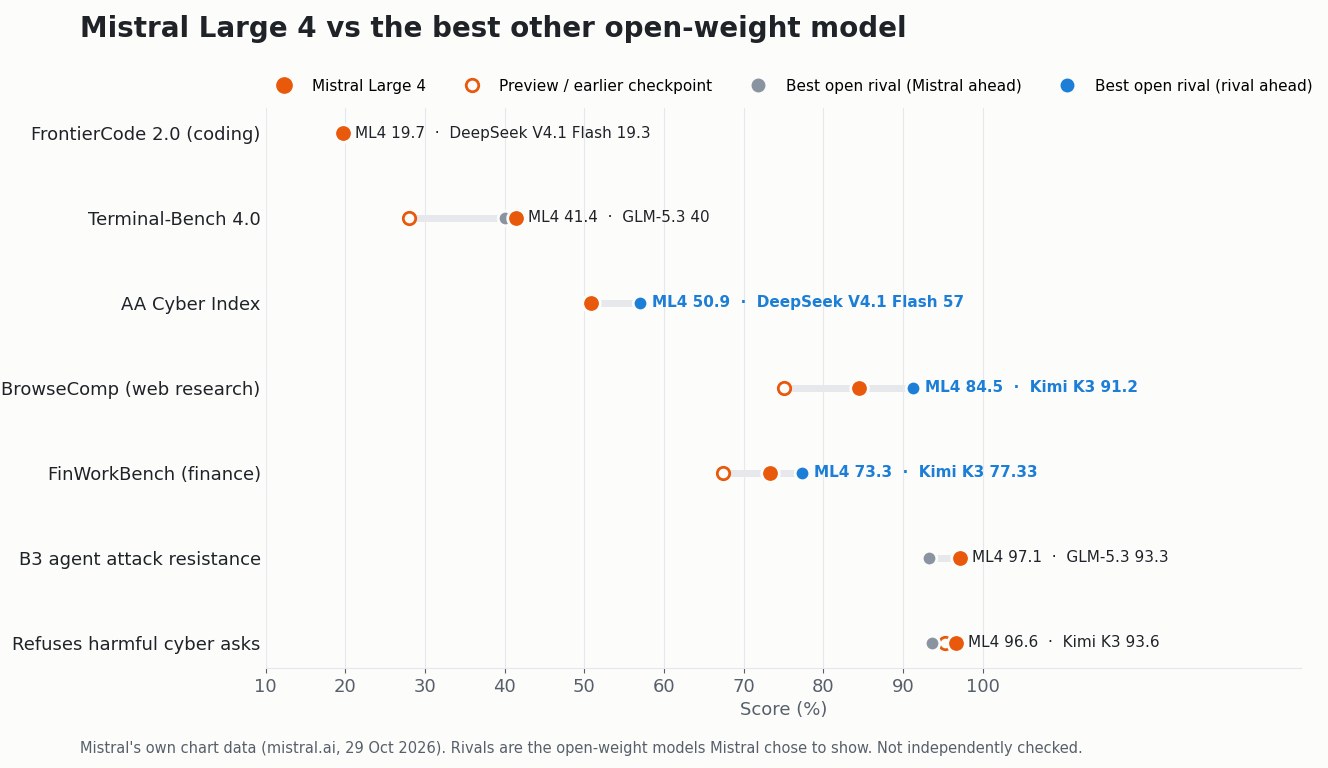
It leads on coding and safety, and trails on web research, finance and the cyber index. I redrew the chart above from the data on Mistral's own announcement page, so these are Mistral's numbers against the open models Mistral chose to show:
- Coding: 19.7% on Cognition's private FrontierCode 2.0, just ahead of DeepSeek V4.1 Flash (19.3%). On Terminal-Bench 4.0 it scores 41.4%, up from 28% in the preview, narrowly ahead of GLM-5.3 (40%), and Mistral says it uses 30% fewer output tokens than the preview.
- Safety: it resists 97.1% of attacks on the B3 agent-security benchmark (GLM-5.3: 93.3%, DeepSeek-V4-Pro: 58.6%) and refuses 96.6% of harmful cyber requests. If you host your own model, that matters, because nobody else is filtering for you.
- Where it trails: Kimi K3 is ahead on BrowseComp (91.2% vs 84.5%) and FinWorkBench (77.3% vs 73.3%). On the Artificial Analysis Cyber Index, Mistral Large 4 scores 50.9%, behind DeepSeek V4.1 Flash 1017 (57%) and MiMo-V2.6-Pro (56%). That last one surprised me, given how much of the announcement is about cybersecurity.
On the Hugging Face model card, Mistral also says it scores 26 on the Artificial Analysis Intelligence Index v5, "the highest among western open-weight models". That's a careful claim. "Western" leaves out the Chinese open models, and the closed frontier models score much higher on that index.
Is Mistral Large 4 as Good as Claude at Coding?
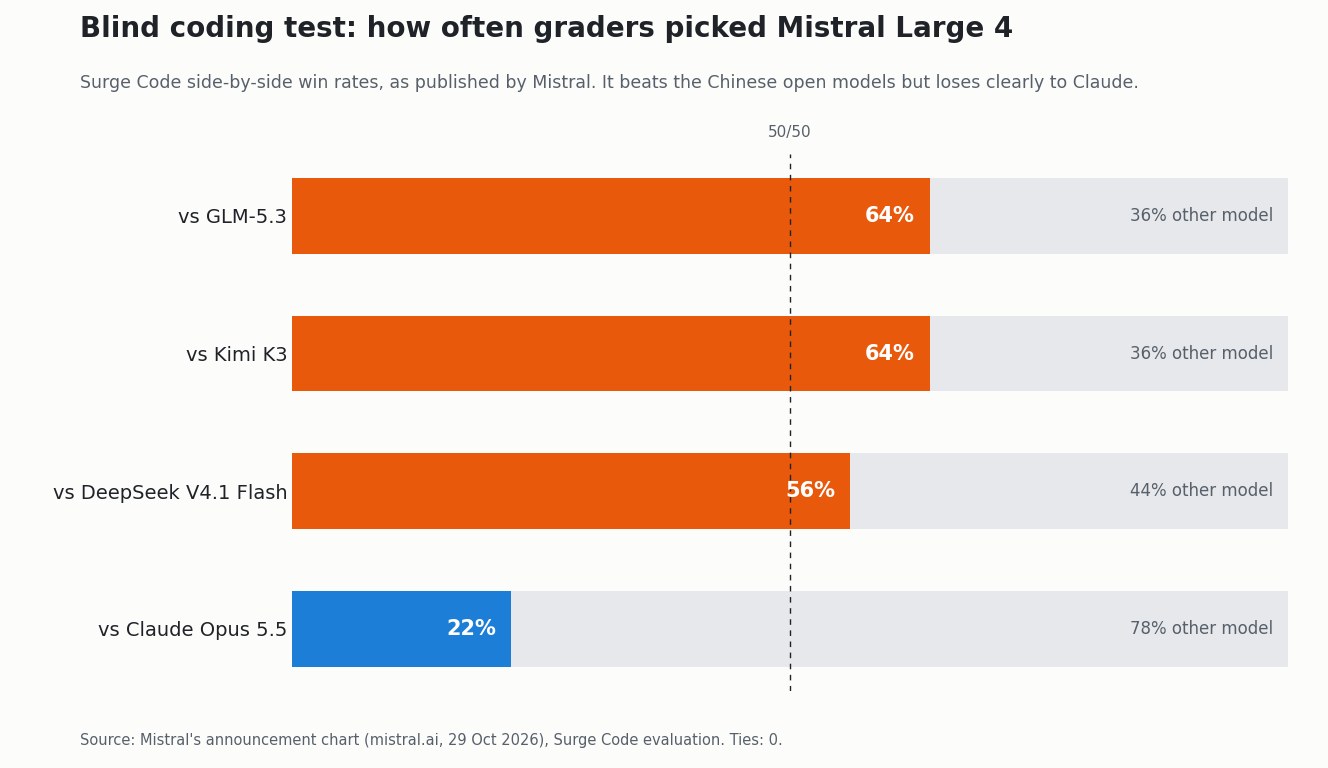
No. In Surge Code's blind side-by-side test, which Mistral published itself, graders preferred Mistral Large 4's code over GLM-5.3 and Kimi K3 64% of the time, and over DeepSeek V4.1 Flash 56% of the time. Against Claude Opus 5.5 they picked Mistral only 22% of the time.
Credit to Mistral for publishing that bar at all. It tells you where the model sits: the best open model for code in this test, clearly behind the best closed one. If you want the strongest coder and your data can go to Anthropic, Claude still wins (my Claude models comparison covers which one). If you need an open model, Mistral Large 4 now has a good case.
How Fast and How Cheap Is It? My Test
Fast, cheap, and a heavy thinker. On 30 October I sent three coding prompts through OpenRouter (model mistralai/mistral-large-4-0, reasoning set to low, 2,000-token limit). All three were served by Mistral itself:
| Prompt | First token | Total time | Speed |
|---|---|---|---|
| Python ISO date parser + 5 tests | 1.60 s | 13.8 s | 164 tokens/s |
| A* on a hex grid, in C# | 0.92 s | 12.7 s | 170 tokens/s |
| Kids' times tables quiz in one HTML file | 0.99 s | 12.0 s | 181 tokens/s |
That averages about 172 tokens per second, with the first token in about a second. That's quick for a model this size. With the same three prompts, the free MiniMax M3.1 Flash I tested earlier this month averaged about 124 tokens per second.
The price is the bigger news: US$0.70 per million input tokens and US$2.10 per million output tokens, with cached input at US$0.07. The preview cost US$1.36 and US$4.18, so Mistral has roughly halved it. Muse Spark Open costs US$1.25 and US$4.25 on OpenRouter. All my tests together cost under 3 US cents.
The odd habit: it thinks a lot, even on "low"
For my second test I asked it to translate a two-sentence paragraph about the RBA and a Brisbane mortgage into Hong Kong Cantonese and into formal Traditional Chinese for Taiwan. With a 3,000-token limit, it spent all 3,000 tokens reasoning and returned nothing. With more room it finished in 36 seconds, but it used 4,489 reasoning tokens to write about 200 tokens of answer.
The answer itself was good. The Cantonese read naturally (係, 唔, 買餸錢, 叫外賣), and it even used the Hong Kong spelling of Brisbane (布里斯班) in one version and the Taiwan spelling (布里斯本) in the other, which many models get wrong. But if you call it through the API, set a generous token limit, or you may pay for thinking and get no answer.
Can You Run Mistral Large 4 at Home?

Not on a home PC. The FP8 weights for 1 trillion parameters come to roughly 1 TB by my maths (one byte per parameter), and Mistral's own vLLM and SGLang examples use 8 GPUs with tensor parallelism. My RTX 4060 Ti with 8GB, which runs Qwen3.8-Flash-Next fine, is nowhere close.
"Open weights" here means a company, a university or a cloud in your own country can host it. That's the point for sovereignty. For most individuals, the API or OpenRouter is the realistic way in, and you can switch hosts later without changing models.
Should You Use Mistral Large 4?

Use it if you need an open model you can host yourself, if you'd rather not depend only on US or Chinese providers, or if you want a cheap, fast general model with strong safety numbers. Skip it if you just want the best code (Claude) or the best web-research agent among open models (Kimi K3 on these numbers).
My honest feeling: I'm glad this exists. In 2026 it's easy to assume AI is a two-country race and the rest of us just pick a side. Mistral shipped a trillion-parameter model, published the weights on the date it promised, cut the price in half, and showed a chart where it loses to Claude. That's a good way to earn trust. The real test is a hands-on build, like the DeepSeek game test that produced the 3D runner you can still play, and that's where any model has to prove itself.
Sources
- Mistral AI: Le Chonk: Built for Coders, Trusted by Defenders, published 29 Oct 2026: licence, pricing, reasoning modes, and all benchmark chart data (values read from the page's chart data).
- Mistral AI on Hugging Face: Mistral-Large-4-1T-A52B model card: active parameters, experts, 1M context, vision encoder, serving examples, sampling settings, AA Intelligence Index claim.
- OpenRouter: model
mistralai/mistral-large-4-0listing (1,048,576-token context, US$0.70/US$2.10) and my own speed and translation tests through the OpenRouter API on 30 Oct 2026. - Preview price and Muse Spark Open price: from my earlier posts linked above, which cite the vendors' own pages.
Checked 30 October 2026. Benchmark figures are Mistral's own and I haven't verified them. The speed and translation results are my own small test, not a benchmark. The images were made locally with Qwen Image 2.1, the charts were redrawn from Mistral's data, and AI helped me research and edit this post.