
Axion 1.0 is a new open AI model built for one job: research. You give it a hard question, and it searches the web, reads pages, looks up academic papers and runs Python until it has an answer. The paper's numbers are strong. The 35B version beats GPT-5.5 and Gemini 3.1 Pro on three research-agent tests, and the bigger 122B version comes close to Claude on the hardest one. The code is out under ByteDance's GitHub account with an Apache 2.0 licence. But can you run it on your own PC today? Not yet, in practice. Here's what it's good for, and why I'm waiting before I try it at home.
What Is Axion 1.0?
Axion 1.0 is an "agent foundation model": a language model trained to think, call tools, read what comes back, and keep going over many steps. It was published on arXiv as 2611.03233, with the code at github.com/bytedance/axion1_0.
It isn't a brand-new model trained from scratch. The team took two Qwen models and fine-tuned them:
- Axion 1.0-35B, built on Qwen3.6-35B-A3B. It's a mixture-of-experts model: 35 billion parameters in total, but only about 3 billion are used for each token, so it's cheap to run for its size.
- Axion 1.0-122B, built on Qwen3.5-122B-A10B, with about 10 billion active.
The agent gets four tools: web search, visiting a web page, searching scholarly papers, and running Python. Don't mix it up with Aion-1.0 from AionLabs on OpenRouter. That's a different, older model with a very similar name.
What Is Axion 1.0 Good At?

Hard questions where the answer has to be found, checked and worked out, not just remembered. The authors list three uses: scientific reasoning, information seeking with tools, and biological data analysis. In plain terms:
- Deep research questions. Questions that need several searches, reading many pages and cross-checking them, like the ones in Humanity's Last Exam (HLE).
- Sorting out conflicting information. SEAL-0 asks questions where web search results disagree or mislead. The 35B model's best score there, 62.2%, is the highest in the paper's table.
- Science and physics problems. Olympiad-level physics (HiPhO) and research-grade science questions (FrontierScience), where it uses Python to do the maths instead of guessing.
It's not built for chatting, writing, images, voice or video. If you want help with an email, any normal chat model is better. Axion is the one you'd give a messy research question and leave to work for a while.
Is Axion 1.0 Better Than GPT-5.5 and Gemini?
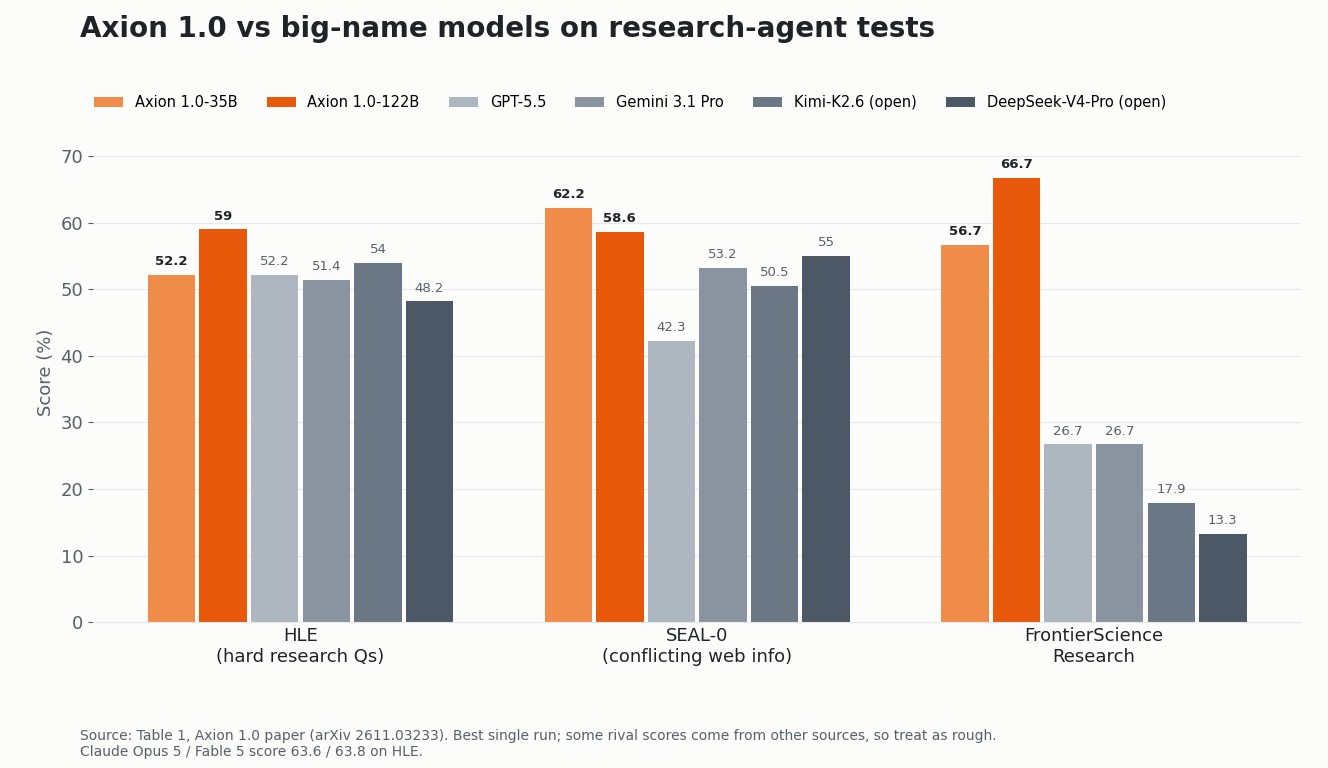
On these research tests, yes, by the paper's own numbers. I redrew the chart above from Table 1 of the paper:
| Model | HLE | SEAL-0 | HiPhO | FrontierScience Research |
|---|---|---|---|---|
| Axion 1.0-35B | 52.2% | 62.2% | 45.7% | 56.7% |
| Axion 1.0-122B | 59.0% | 58.6% | 46.2% | 66.7% |
| GPT-5.5 | 52.2% | 42.3% | 43.3% | 26.7% |
| Gemini 3.1 Pro | 51.4% | 53.2% | 38.5% | 26.7% |
| Kimi-K2.6 (open) | 54.0% | 50.5% | 41.1% | 17.9% |
| DeepSeek-V4-Pro (open) | 48.2% | 55.0% | 38.7% | 13.3% |
| Claude Opus 5 / Fable 5 | 63.6% / 63.8% | n/a | n/a | n/a |
Three things stand out to me. A model with 3 billion active parameters ties GPT-5.5 on HLE. The FrontierScience Research gap is huge: 56.7% and 66.7% against about 27% for GPT-5.5 and Gemini. And Claude still leads on HLE (my Claude models comparison explains the line-up).
The authors are open about the weak spots, which I appreciate:
- Scores are the best single run, not an average of several.
- Some rival scores come from other sources with different tools and settings, so the comparisons are rough.
- Axion's HLE scores in the table were run with some websites blocked. Without those limits the paper reports 59.1% (35B) and 64.8% (122B).
- Reinforcement learning didn't help everywhere. FrontierScience Research went down for the 35B model after that stage.
So I'd read the table as "a strong open research agent", not "better than GPT-5.5 at everything". It also lines up with Apodex 1.1, the agent team I wrote about earlier, which scores 56.1% on HLE in the same table.
Why Is the Training Recipe a Big Deal?

Because it's small enough for a university or a mid-size company to copy. Most top labs use long, expensive training pipelines with many stages. Axion skips several of them (mid-training, preference tuning and distillation from a bigger model) and uses just three steps:
- Stage I: fine-tuning on hard reasoning problems. The team took public questions and made them harder, using the base model's own successful answers as a guide.
- Stage II: fine-tuning on tool use, with questions built from real data sources (such as the NASA Exoplanet Archive, OpenAlex and UniProt) where the answer can be checked by computer.
- Stage III: reinforcement learning, so it gets better at long tool-using sessions.
The whole training set is about 18,000 examples. The two fine-tuning stages for the 35B model took about 2 hours 48 minutes on 32 GPUs (around 90 GPU-hours), and the reinforcement learning ran for about 30 hours on 16 GPUs. That's tiny by 2026 standards. The team also released the data, the prompts and the training code. That's what makes Axion interesting to me: it's a recipe other people can actually follow. In my DeepSeek Super Agent explainer, most of the clever work happened in the system around the model. Axion puts more of it into the model itself.
Can You Run Axion 1.0 on Your Own PC?

Not yet, in practice. Three things stand in the way.
1. The weights you can download aren't official. There is an Axion-1.0-35B model on Hugging Face (Apache 2.0), but the project's own GitHub README calls it "a community release, not an official Axion checkpoint". It's a reproduction made with the published recipe. The 122B model hasn't been released at all. When I checked on 4 November, it had 33 downloads.
2. It's too big for a normal home PC. The files are in BF16, which is two bytes per parameter, so roughly 70 GB by my maths. The model card's example runs it on 8 GPUs with a 128K context. My PC has an RTX 4060 Ti with 8GB and 64GB of RAM (I described it in my PC for AI agents post), and 70 GB doesn't fit in either. There's no quantized or GGUF version yet, which is the format Ollama and llama.cpp use for home machines.
3. The model is only half of it. Axion doesn't search the web by itself. It asks for a search, a page or a Python run, and your own program has to do that and send the result back. The README says evaluation needs "a separate tool-execution harness". So even with the model running, you'd still need to set up search, page reading and a safe Python sandbox before it's useful.
Will that change? Probably, and maybe soon. Because only 3 billion parameters are active per token, a 4-bit version of the 35B model would be roughly 20 GB, and it should run at a usable speed on a PC like mine with part of it in system RAM. I'd test it the same way I tested Qwen3.8-Flash-Next on 8GB. When a GGUF version from a source I trust appears, I'll test it and write a follow-up for my Local AI series.
Should You Use Axion 1.0 Now?
If you're a researcher or a team that trains models, yes, look at it now. The recipe, data and code are the most useful part, and you can reproduce the 35B model for a fraction of what bigger agent models cost to train.
If you're like me, a home user with one gaming GPU, wait. Right now the only download is an unofficial copy, the files are too big, and you'd have to build the tool harness yourself. For research questions today, a cloud model with built-in search is the practical choice. I compared that trade-off in local LLM vs cloud API.
My honest feeling: this is one of the more exciting papers I've read this year, not because of one score, but because it shows a small, simple recipe can get close to the big labs on hard research tasks. I just don't want to run an unofficial 70 GB checkpoint on my home PC yet. Give it a few weeks.
Sources
- Jia et al., Axion 1.0: Open Agent Foundation Models, Simplified, arXiv 2611.03233 (v2): training recipe, tools, Table 1 results, limitations.
- Axion 1.0 project page: training data size, GPU-hours, model and dataset links.
- bytedance/axion1_0 on GitHub: Apache 2.0 licence, base models, "community release" note, harness requirements.
- Axion-1.0-35B model card on Hugging Face: BF16 safetensors, vLLM/SGLang serving examples, download count.
Checked 4 November 2026. Benchmark figures are the authors' own and I haven't verified them. I haven't run Axion 1.0 myself; the 70 GB and 20 GB sizes are my own estimates. The images were made locally with Qwen Image 2.1, the chart was redrawn from the paper's table, and AI helped me research and edit this post.