Runway, the AI video company, has released Praxis-1 as an open robot control model. It is a 27-billion-parameter model that watches a robot's cameras, reads an instruction like "put the red block in the bowl", and outputs the arm's next moves. The weights went public on 11 November 2026 under the Apache 2.0 licence, so companies can use them commercially. In Runway's tests it is the best open robot model on the RoboLab-120 benchmark, at 46.2%.
The short answer to "can I run it at home?" is no, unless you own a very big GPU. The full model needs an 80 GB card, and even the 4-bit version needs about 23.5 GB and an RTX 50-series (Blackwell) GPU. My 8 GB RTX 4060 Ti is nowhere near. Here is what Praxis-1 is, how it did in tests, and what you need to run it.
What is Runway Praxis-1?
Praxis-1 is what Runway calls a "world action model": one model that predicts both the next second or so of video and the robot actions to go with it. Runway first showed it in September 2026 and released the weights on 11 November.
- Size: 27.2 billion parameters in total. The video backbone is a mixture-of-experts (MoE) diffusion transformer with 26.9B parameters, but only about 2.8B are active per token. Each MoE layer has 128 experts and every token uses 8 of them.
- Action expert: a separate 314M-parameter transformer that turns what the backbone "sees" into arm movements.
- Borrowed parts: the frozen Wan2.2 video autoencoder and the Qwen3.5-2B text encoder.
- Inputs: a text instruction, the latest frames from an outside camera and a wrist camera, and the arm's current position.
- Outputs: 24 action steps at 15 per second (1.6 seconds of movement), plus the video it expects to see.
Why is a video company making a robot model?
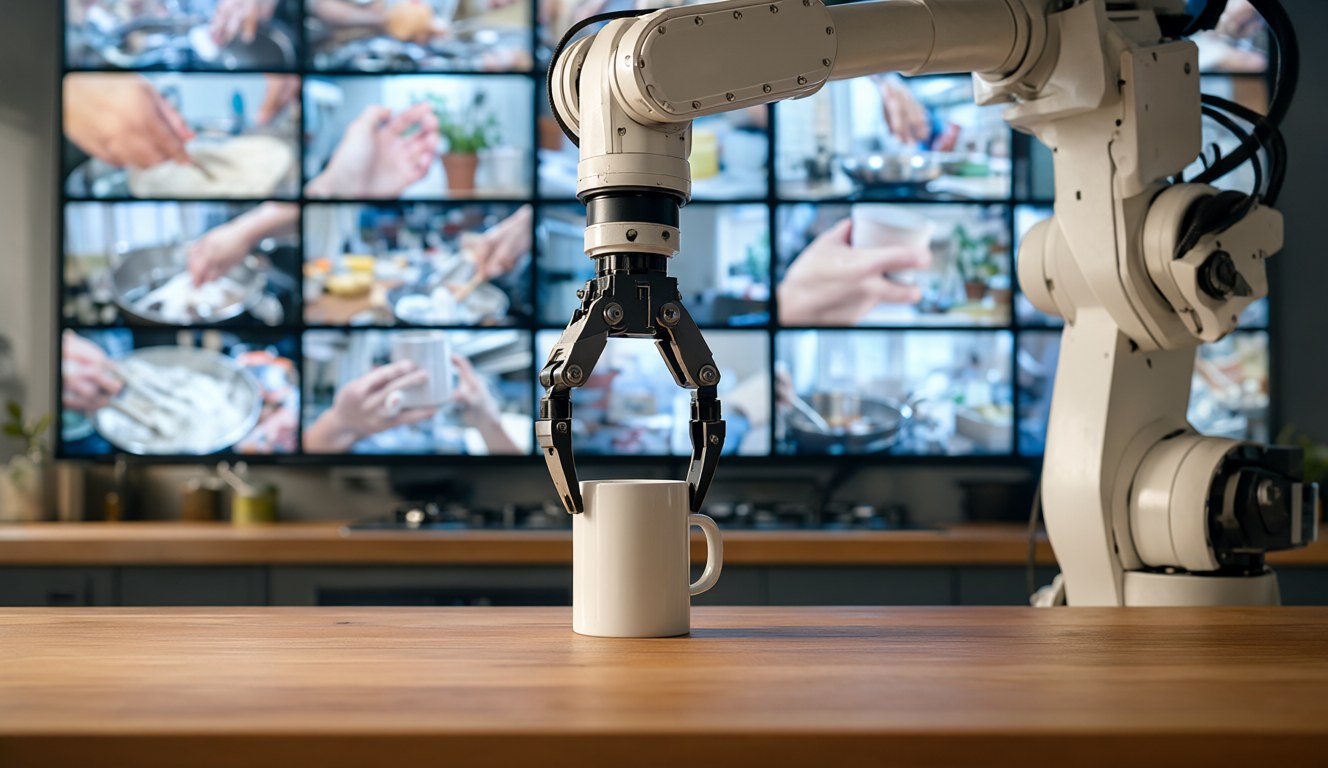
Because video is easy to get and robot data isn't. Recording robots doing tasks by remote control is slow and expensive. Runway says video of the real world is "effectively limitless", so it starts from its video model and teaches it to move a robot.
The most interesting result in Runway's research is that ordinary web video worked as well as robot video for pretraining. After fine-tuning, the placement error was 16.1 cm with web video and 16.0 cm with remote-controlled robot video, which Runway says is the same within the error bars. In the second training stage, 58% of the data was first-person video of human hands, 20% general video and only 18% real robot video.
That makes sense to me. Runway already has huge video models. If watching people cook and tidy teaches a model how objects move, robot data stops being the bottleneck.
Which robots does Praxis-1 work with?
Runway released checkpoints for four setups on Hugging Face:
| Checkpoint | Robot | 4-bit NVFP4 version |
|---|---|---|
| praxis-1-base | Starting point for fine-tuning on your own robot | No |
| praxis-1-droid | One arm (Franka) with an outside camera and a wrist camera | Yes |
| praxis-1-yam | Two YAM arms with three cameras | Yes |
| praxis-1-so101 | SO-100 / SO-101 hobby arm used with Hugging Face's LeRobot | Yes |
The SO-101 checkpoint is the one hobbyists will look at, because that small arm is popular in the LeRobot community. There are also LeRobot-format copies of the base, DROID and YAM models. You need to log in to Hugging Face and accept the access terms before downloading.
Runway's launch partners are Noble Machines (a legged humanoid), Standard Bots (a six-axis industrial arm) and Ultra (a dual-arm warehouse robot).
How good is Praxis-1?
On Runway's numbers, it is the best open robot model right now, but not the best robot system overall. On RoboLab-120, a simulation test with 120 tasks and 1,200 runs, it succeeded 46.2% of the time:
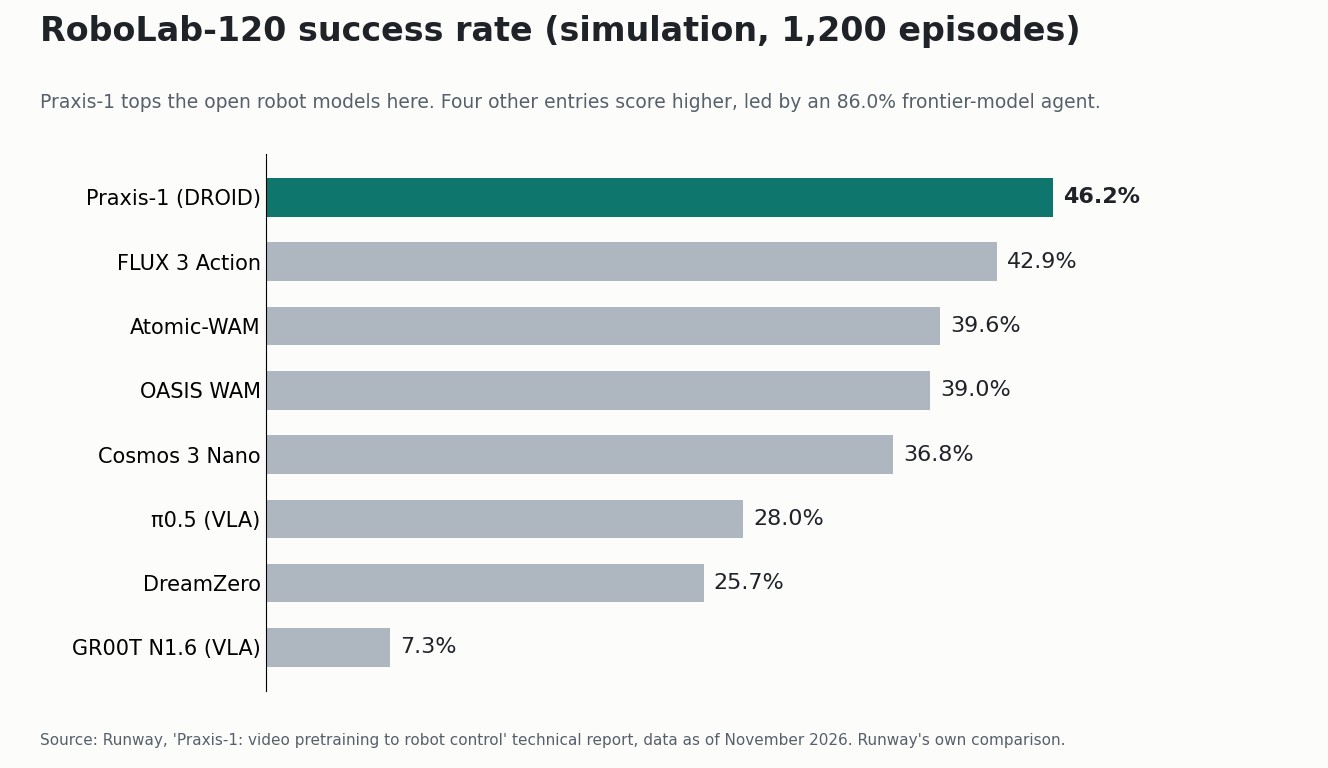
Four entries on the same leaderboard score higher, including an agent built on a frontier model at 86.0%. Runway's other results:
- Real robot: 88 of 100 tasks done on a real Franka FR3 arm, against 80 for FLUX 3 Action.
- A new robot: fine-tuned on Google's RT-1 robot, which wasn't in its training data, it reached 80.0% in the SimplerEnv test. RT-1's own published policy scored 52.4%.
- Against a chatbot driving the robot: on three two-arm tasks, Praxis-1 was 15.6 times faster and 51 times cheaper than GPT-6 Astra, about $0.04 per task against $1.87. Runway notes the sample is small.
- Speed: about 0.55 seconds per call on one H100, or about 0.13 seconds with the opt-in streaming mode.
These are Runway's own tests, and Runway says several of the head-to-head differences are not statistically significant.
Can you run Praxis-1 on your own GPU?
Only on a high-end card. The normal bf16 model is 54.4 GB, and Runway's install guide asks for one GPU with at least 80 GB of memory, such as an H100. Fine-tuning with LoRA also needs one 80 GB GPU.
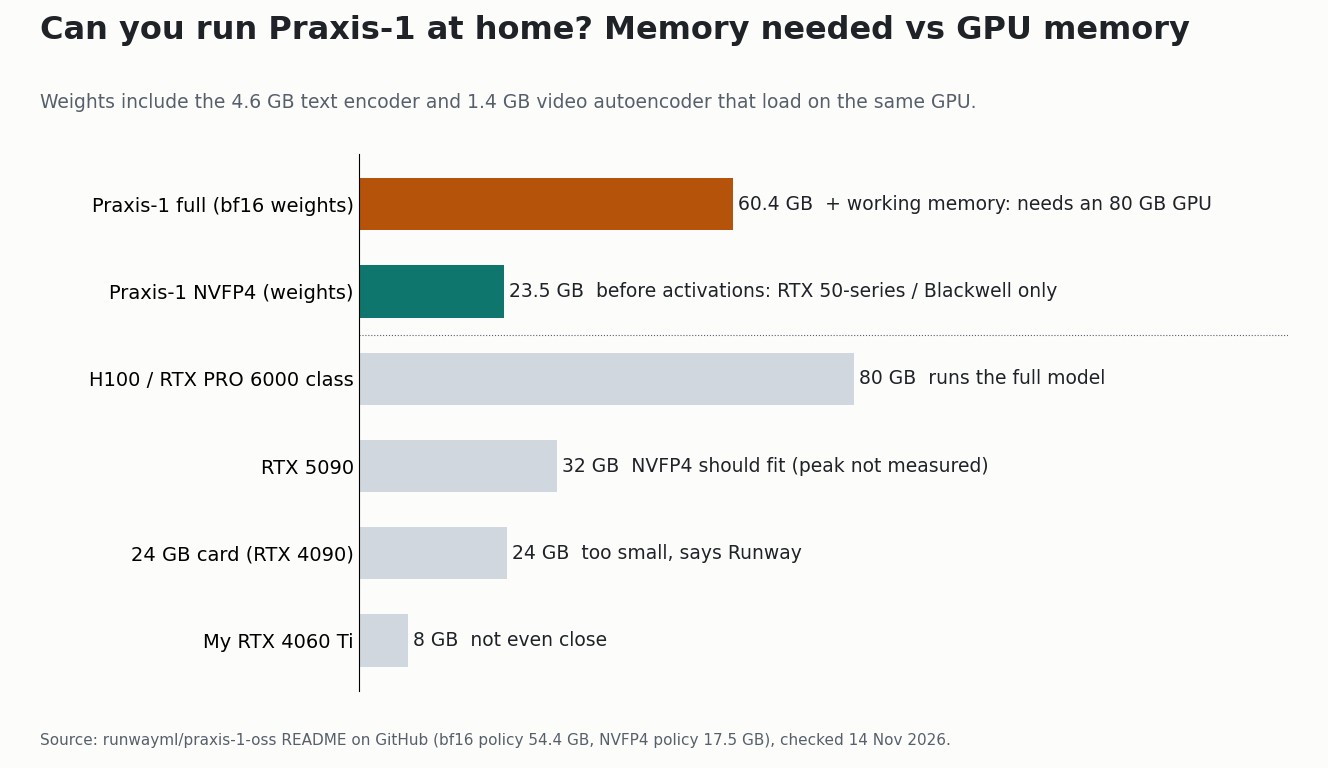
The 4-bit NVFP4 versions shrink the policy from 54.4 GB to 17.5 GB. Add the text encoder (4.6 GB) and video autoencoder (1.4 GB) and the weights take about 23.5 GB. Runway's README says a 32 GB RTX 5090 "should fit", but the peak memory isn't measured yet, and a 24 GB GPU does not fit.
There are two more catches:
- NVFP4 needs a Blackwell-generation GPU (SM100, SM110 Jetson Thor or SM120 like the RTX 5090). It doesn't run on an H100, and it won't run on older cards like my RTX 4060 Ti either.
- The download is still about 54 GB. The NVFP4 repos keep bf16 master weights and pack them to 4-bit when the model loads.
Accuracy barely drops with 4-bit. Runway measured 46.5% on RoboLab against 47.8% for bf16, and 26 of 30 against 28 of 30 on the two-arm robot, and says neither gap is significant.
For most people the realistic options are Runway's hosted demo on Runway Dev, Reactor's hosted inference, or a rented 80 GB cloud GPU. For a robot that needs to work offline, Runway lists NVIDIA's Jetson Thor as the on-robot option.
What can't Praxis-1 do yet?
Runway is open about the weak spots:
- Look-alike objects: the most common real-robot failure is grabbing a similar-looking object instead of the right one.
- Vague instructions: it works better when you name the colour or size.
- Long tasks: chaining several steps from one prompt is still hard, and it doesn't reliably remember which steps it has finished.
- Hard objects: transparent things like ice and clear plastic, cloth with no fixed grip point, and cluttered, overlapping tableware.
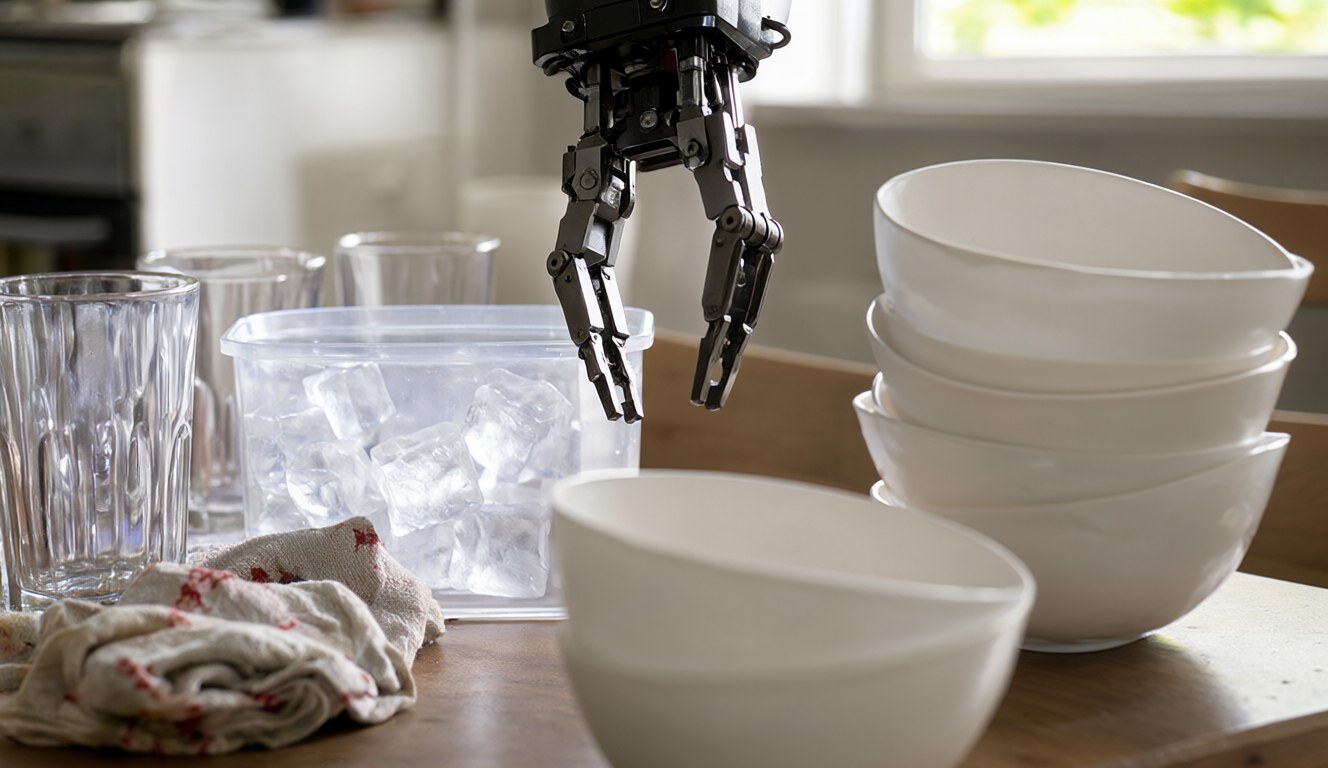
So a robot that does your washing up is still some way off. But a free, commercially usable model that can be fine-tuned to a new arm is a big step for small robotics teams.
Read next
- Muse Spark Open: Meta's 816B open model, can you run it?
- My PC now works for AI agents: i9, 64GB RAM, 8GB GPU
- Underdog Saluki 27B on an 8GB GPU: why I got 4.7 tokens/s
- Gemini 4 Hydrogen: price, benchmarks and the element names
Sources: Runway, "Introducing Praxis-1" (September 2026, updated 11 November 2026); Runway, "Praxis-1 is now available" (11 November 2026); Runway's technical report "Praxis-1: video pretraining to robot control"; the runwayml/praxis-1-oss README on GitHub; and the runwayml Praxis-1 collection on Hugging Face. All benchmark numbers are Runway's own. I redrew the charts from Runway's figures. I haven't run Praxis-1 myself, because my GPU is too small. Checked 14 November 2026. The images were made locally with Qwen Image 2.1, and AI helped me with the research and the English.