
Gemini 4 Hydrogen is the lightest and cheapest model in Google's Gemini 4 family. Google released it on 12 November 2026 for everyday coding and agent work. On the API it costs US$1.50 per million input tokens and $7.50 per million output tokens, it has a free tier, and in Google's own tests it beats Claude Sonnet 5.5 on 7 of the 10 benchmarks in its model card. And I like the name a lot more than "Flash".
This is my third Gemini 4 post. Carbon and Argon came first. Here is what Hydrogen is, what it costs, who can use it, and why I think element names beat Max, Pro and Flash.
What is Gemini 4 Hydrogen?
Hydrogen is Google's fast, efficient Gemini 4 model, built to get through a lot of agent tasks quickly. Google's model card says it is "adapted from Gemini 4 Carbon", the top model, and that Carbon and Argon are the frontier models "for deep, long-horizon reasoning", while Hydrogen "is built for rapid execution".
Google pictures it working as a team with Carbon. Carbon plans the job, and Hydrogen runs the steps as "worker" and "verifier" agents. You can also use it on its own.
- Model ID:
gemini-4-hydrogen - Context: 1,048,576 tokens, shared by input, thinking and output
- Output: up to 65,536 tokens per normal request, or up to about 1M with background "long decode"
- Thinking levels: low, medium, high (the default) and a new xhigh
- Input: text, images, audio and video
- Knowledge cutoff: March 2026
How much does Gemini 4 Hydrogen cost?
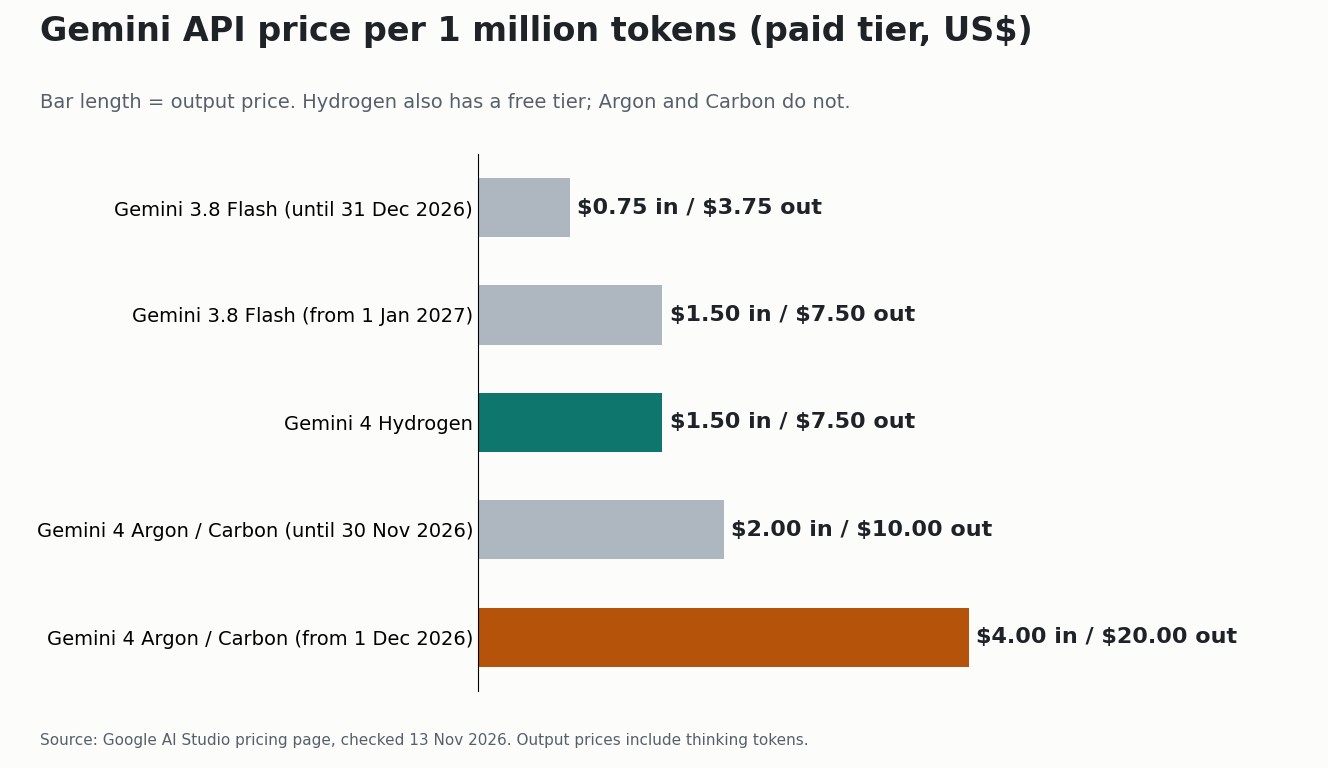
On the paid API tier, Hydrogen costs $1.50 per million input tokens and $7.50 per million output tokens, and the price stays the same across the whole 1M context. There is also a free tier with rate limits. Carbon and Argon have no free tier.
Two things stood out to me on Google's pricing page:
- Hydrogen costs double what Gemini 3.8 Flash costs today. Flash is $0.75 / $3.75 until 31 December 2026. From 1 January 2027 Flash rises to $1.50 / $7.50, exactly Hydrogen's price. So from next year the old model gives you no saving.
- Argon and Carbon have the same API price. Both are $2 / $10 until 30 November, then $4 / $20. From December, Hydrogen costs well under half of either.
Output prices include thinking tokens, and Hydrogen now thinks at "high" by default. A cheap price per token doesn't always mean a cheap task, so test the thinking level on your own work.
Is Hydrogen better than Gemini 3.8 Flash?
On Google's numbers, yes, by a wide margin. On Terminal-Bench 4.1, Hydrogen scores 57% against 18.2% for 3.8 Flash. Google says it finishes tasks 2.5 times faster than 3.8 Flash at the default setting, and that early partners saw runs 2 to 2.8 times faster while using 12% to 23% fewer tokens.
The surprising number is the Artificial Analysis Intelligence Index. Google lists Hydrogen at 51 (high) and 54 (xhigh), against 50 for Argon. If that holds up in outside tests, the "light" model scores about the same as the middle one.
How does it compare with Claude Sonnet 5.5 and GPT-6.1 Terra?
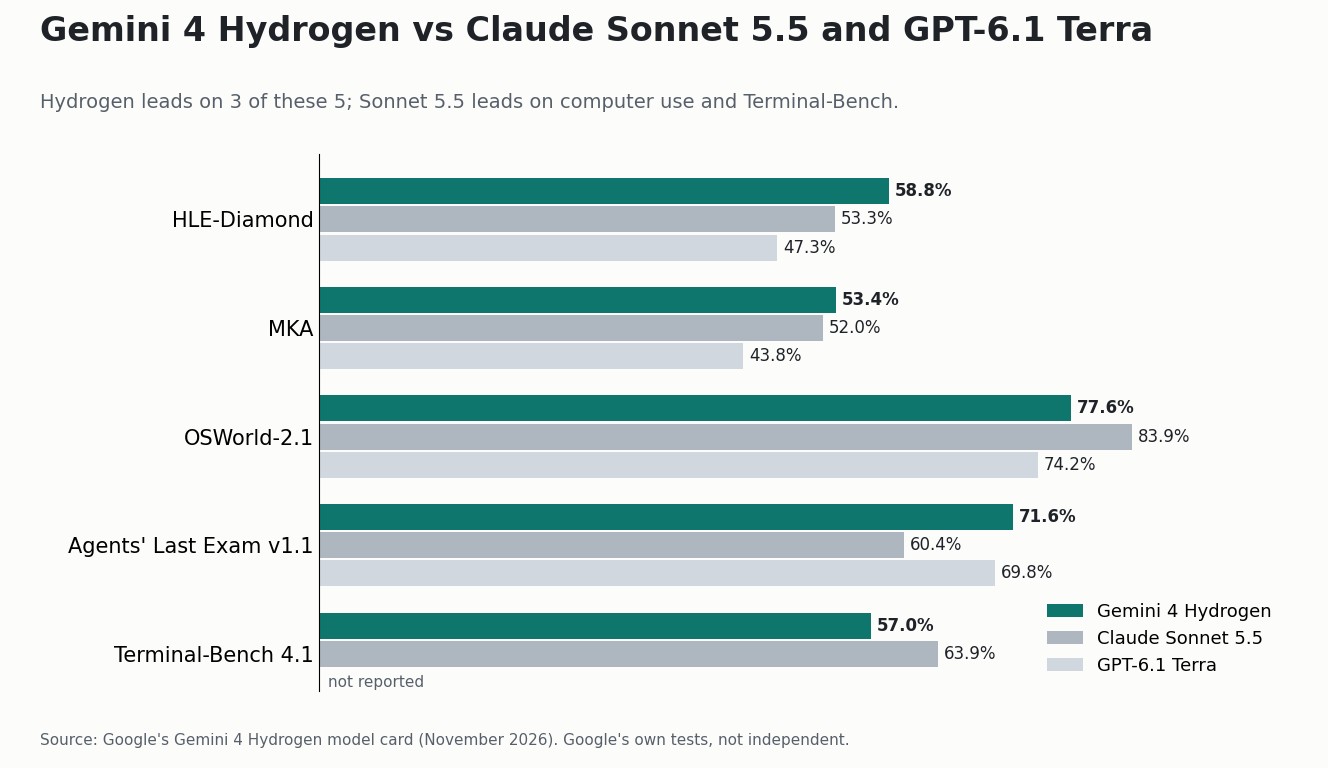
In Google's model card, Hydrogen beats Claude Sonnet 5.5 on 7 of 10 benchmarks, mostly reasoning, knowledge work and multimodal tasks. Sonnet 5.5 wins on computer use, Terminal-Bench 4.1 and Terminal-Bench-Science. I redrew five of the rows:
| Benchmark | Gemini 4 Hydrogen | Claude Sonnet 5.5 | GPT-6.1 Terra |
|---|---|---|---|
| SWE-sweep (coding) | 13.5% | 3.1% | 5.8% |
| Terminal-Bench 4.1 | 57.0% | 63.9% | not reported |
| Agents' Last Exam v1.1 | 71.6% | 60.4% | 69.8% |
| Vending-Bench 2 (bank balance) | $14,549 | $11,165 | $9,107 |
| OSWorld-2.1 (computer use) | 77.6% | 83.9% | 74.2% |
| HLE-Diamond (reasoning) | 58.8% | 53.3% | 47.3% |
These are Google's own tests, so treat them as a starting point. The model card also admits one step back: compared with 3.8 Flash, Hydrogen refuses more harmless requests, "particularly for multimodal prompts". The full safety report is still "coming soon".
Why are the Gemini 4 models named after elements?
Google hasn't explained it. Not on the announcement, the developer blog, the AI Studio guide or the model card. So this part is my own opinion.
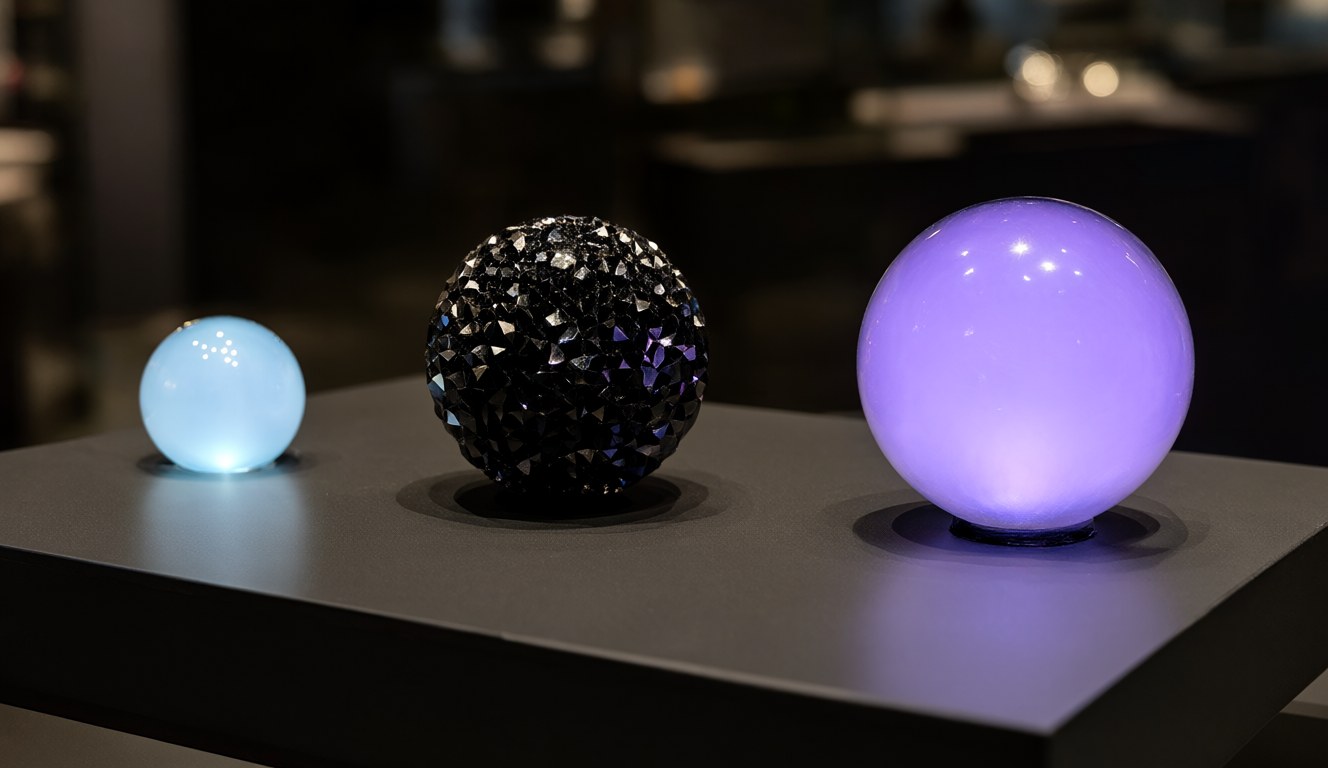
I really like it. Max, Pro, Flash, Plus, Lite, Mini: every AI company uses the same few words, and they all blur together. Is "Pro" better than "Plus"? Is "Max" bigger than "Ultra"? Nobody remembers. Element names feel more real. They are things that exist, and most of us learned them at school, so they stick.
Hydrogen is the perfect example. It is element number 1, the lightest element there is. You see "Hydrogen" and you already know it's the small, fast one. No marketing page needed.
The other two are less neat, though:
| Model | Element number | Role in Gemini 4 |
|---|---|---|
| Hydrogen | 1 (the lightest) | Fast, cheap, free tier |
| Carbon | 6 | Top model, "most capable" |
| Argon | 18 | "Efficient" frontier model, below Carbon |
If the names followed the periodic table, Argon would be the heaviest model. It isn't; Carbon is the top. My guess is the names are about character, not weight. Carbon is the element of life, and it becomes diamond under pressure, which suits a model that thinks hard. Argon is a stable, calm noble gas. Hydrogen is light and fast. Again, that's my reading, not Google's.
The element idea also leaves a lot of room. There are 118 elements, so Google won't run out of names soon. Funny enough, the OpenAI model in Google's comparison table is called GPT-6.1 Terra, another name from nature. Maybe the industry is getting tired of "Pro" too.
Can you use Gemini 4 Hydrogen on Google AI Plus?
Yes. Google's plans page lists "Access to Gemini 4 Hydrogen" for Google AI Plus, and Pro and Ultra get it too. That's good news for me. I'm on Plus, and I couldn't test Carbon because it's Ultra only.
Free users get Hydrogen in the Gemini app when automatic model selection picks it. It's also in Google Search for all users, and to Gemini in Google Sheets for AI Pro and Ultra. Developers can use it in Google AI Studio and the Gemini API on the free and paid tiers, and in Android Studio. Google Antigravity needs a paid AI Pro or Ultra plan.
I haven't tested Hydrogen myself yet. That's next.

Should developers switch from Gemini 3.8 Flash?
If you want better results, probably yes, but don't just swap the model ID. Until 31 December, Flash is half the price. Google's migration guide lists a few changes that can break older code:
- Change the model ID from
gemini-3.8-flashtogemini-4-hydrogen. temperature,top_pandtop_kare now ignored. Remove them.- Explicit context caching is gone. Implicit caching applies to prompts of at least 4,096 tokens, at $0.075 per million cached tokens.
- The default thinking level moves from medium to high. That can mean more output tokens and a higher bill, so compare medium and high on your own evals.
- Input and output now share one 1M window. Raise any low
max_output_tokenslimits to 65,536.
Read next
- Gemini 4 Carbon: Google's strongest model and its benchmarks
- Gemini 4 Carbon now available, but only on Ultra
- I built my homepage with Gemini 4 Argon
- Play the 3D Noah's Ark that Qwen4-Max built in my last model test
Sources: Google, "Introducing Gemini 4 Hydrogen" (12 November 2026); Google's developer blog "Build with Gemini 4 Hydrogen"; the Google AI Studio "What's new in Gemini 4 Hydrogen" guide and pricing page; the Gemini 4 Hydrogen model card (November 2026); and the Google AI plans page. All benchmark numbers are Google's own and not independent. I redrew the charts from Google's figures. Checked 13 November 2026; prices and plans can change. The images were made locally with Qwen Image 2.1, and AI helped me with the research and the English.