
Illustration · image created for this article
Will the RBA Raise Rates?
Australia's jobs and inflation, August 2026 · Michael Leung
📉 ABS & RBA data · 24 September 2026 · Not financial advice
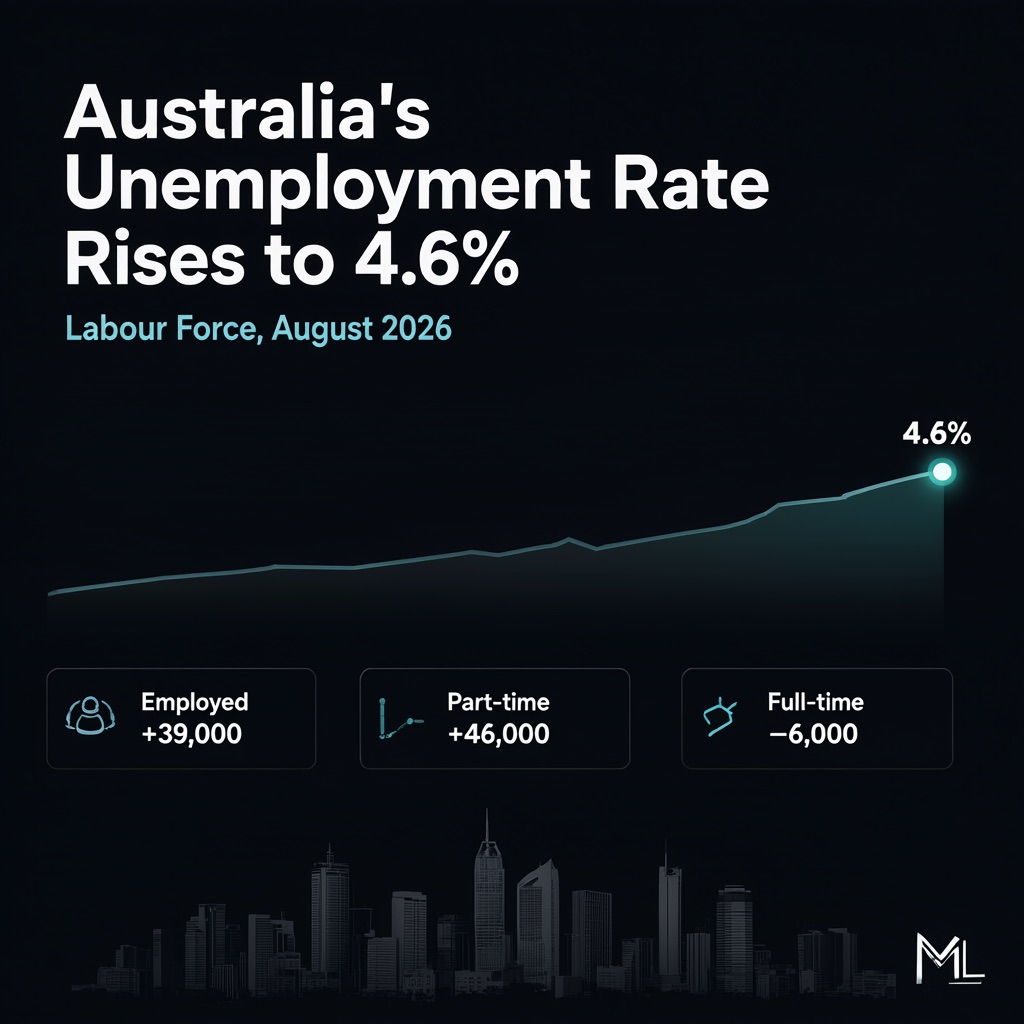
Australia's unemployment rate rose to 4.6 per cent in August 2026 — even though 39,500 more people found work. Almost all of the new jobs were part-time, and the rate went up because more people started looking for work, not because of mass sackings.
Two weeks earlier the Reserve Bank of Australia held the cash rate at 4.35 per cent after three increases this year, saying inflation is “still too high”. So which way does the next decision go?
Here is the read on both releases — and, at the bottom, the call.
The numbers, in short
- Unemployment rate
- 4.6% (seasonally adjusted), up 0.2 pts — trend “rose marginally to 4.6%”
- Employment
- +39,500 to 14,836,600 — part-time +45,800, full-time −6,300
- Unemployed people
- 722,900, up 28,200 — +12.4% over the year
- Participation rate
- 67.1%, up 0.2 pts
- Underemployment
- 6.2%, down 0.1 pts — underutilisation steady at 10.8%
- Hours worked
- 2,009 million hours, up 0.7% in the month, up 1.7% over the year
- Cash rate
- 4.35% — held on 11 August 2026, after three increases earlier this year
- Inflation
- 3.5% headline (12 months to July 2026), down from a 4.6% peak in March — but trimmed mean steady at 3.6%. Both above the 2–3% target band.
- Reference period
- 2–15 August 2026 · released 24 September 2026, 11:30am AEST
Sources: Australian Bureau of Statistics and Reserve Bank of Australia. See the full source list at the bottom of the page.
Why unemployment rose while jobs grew
Employment grew by 39,500 people in seasonally adjusted terms, taking the number of employed Australians to 14,836,600. But the split matters: part-time employment rose by 45,800 while full-time employment fell by 6,300. The extra work this month was mostly shorter hours.
The unemployment rate still lifted 0.2 percentage points, because the labour force grew faster than employment. There were 28,200 more unemployed people and the participation rate rose to 67.1 per cent. When more people decide to look for work, the unemployment rate can go up even in a month when jobs are being created — and the ABS notes this month recorded a higher proportion of people moving from outside the labour force into unemployment than in recent years.
For households the picture is mixed rather than bad. Hours worked rose 0.7 per cent to 2,009 million hours — a bigger rise than the 0.3 per cent increase in employment — and underemployment eased to 6.2 per cent, which suggests people who wanted more shifts are gradually getting them. Underutilisation held at 10.8 per cent. But over the year the number of unemployed people is up 12.4 per cent, and that is the number worth watching.
One caveat from the ABS itself: after removing its old February/August “Supplementary Survey effect” adjustment, the Bureau “recommends being aware when using the August 2026 seasonally adjusted Labour Force data of this potential effect, and continues to recommend trend data as providing the best measure of the underlying behaviour of the labour market.” On trend, unemployment rose marginally to 4.6 per cent and underemployment and underutilisation were steady at 6.3 and 10.8 per cent.
The inflation picture
The Reserve Bank's 11 August statement is blunt. Inflation “picked up materially in the second half of 2025”, and some of that increase “reflected greater capacity pressures”. Since then: “headline inflation is still too high”, and “trimmed mean inflation also remains elevated and is little changed from the March quarter”.
The drivers are still there. Oil and most related commodity prices “remain higher than they were prior to the Middle East conflict”. Some firms are raising prices in response to cost pressure, others are looking to. Short-term inflation expectations have eased, but “remain higher than earlier in the year”.
The Board's own horizon is the constraint on any cut: inflation “is not expected to return to around the midpoint of the target range until late 2027 and there are upside risks”. Target band is 2–3 per cent, so getting back to the midpoint means getting back to roughly 2.5 per cent — still eighteen months away on the RBA's own numbers.
What the ABS inflation numbers say
The published figures back that up — with a twist. Headline inflation is easing. It peaked at 4.6 per cent in the 12 months to March 2026 and has fallen for four consecutive months to 3.5 per cent in the 12 months to July 2026, “down from 3.8 per cent in the 12 months to June”.
Underlying inflation is not easing. The trimmed mean was 3.6 per cent in the 12 months to July 2026, “unchanged from 3.6 per cent in the 12 months to June” — and it has drifted up from 3.3 per cent earlier in the year. On a quarterly basis the trimmed mean has been flat at 0.8 per cent for two quarters running (March and June quarters 2026, pre-October 2025 basis). That is exactly what the RBA meant by “little changed from the March quarter”.
Both readings sit above the target. The ABS states the band plainly: since 1993 the Reserve Bank “has targeted inflation of between 2 and 3 per cent, on average, over the course of the business cycle”. Headline at 3.5 per cent and underlying at 3.6 per cent are both outside it.
Where it is coming from: Housing (+5.0 per cent) is the largest contributor to annual inflation, followed by Food and non-alcoholic beverages (+3.2 per cent) and Recreation and culture (+2.6 per cent). Electricity costs 22.4 per cent more than a year ago, and new dwelling costs are at their highest in almost three years, at 5.8 per cent. For anyone with a mortgage or a power bill, that is the number that lands.
One date worth keeping: the August 2026 CPI release is due 30 September 2026 — about five weeks before the RBA’s next decision. That release, not the jobs data, is what will most likely set the tone.
What the RBA actually did on 11 August
The Board left the cash rate target unchanged at 4.35 per cent. That was not a pause in a cutting cycle — it followed three increases in the cash rate target this year. Financial conditions have tightened accordingly: money market rates and government bond yields are up, the exchange rate has appreciated, and consumer spending growth is “slowing gradually as expected”.
The statement is explicit about its own trigger for more: it will do “what is necessary to bring inflation back to target, including increasing the cash rate target further if upside risks materialise”. It also notes plainly that “labour market conditions have eased by a little more than expected in recent months”. The decision was unanimous, under Governor Michele Bullock.
No — I don't expect the RBA to raise the cash rate at its next meeting. A hold at 4.35 per cent, with cuts still further away.
Confidence: moderate. This is a view from published data, not a forecast or advice.
Why I land on “no rise”
- The Board's own trigger points the wrong way for hikers. It framed further increases as conditional — “if upside risks materialise”. August moved the other way: more people looking for work, fewer full-time jobs, and unemployment up 0.2 pts.
- The RBA already flagged the cooling. “Labour market conditions have eased by a little more than expected in recent months” is not the sentence a central bank writes when it is about to tighten again.
- Three hikes this year are still working through. The Board itself says financial conditions have tightened and consumer spending growth is slowing gradually “as expected”. Rate rises act with a lag; the reasonable move is to let them land.
- The one hot month is methodologically shaky. The ABS explicitly warns about the August seasonally adjusted estimate and recommends trend data, which shows only a marginal rise. No board tightens into a series it has been told to distrust.
- But it cannot cut either — so “hold” is the only move. Trimmed mean inflation is elevated, headline is too high, and the return to the target midpoint is not expected until late 2027 with upside risks. That is the classic reason to sit still.
What would change my mind
- A re-acceleration in trimmed mean inflation in the next CPI release. This is the single most important thing to watch — the RBA has said as much.
- A fresh oil or commodity price shock pushing headline inflation further up, since the Board already treats oil prices as a live upside risk.
- Unemployment falling back below 4.5 per cent with participation holding at 67.1 per cent — that would say August was noise, and restore the case for another hike.
- Wage growth re-accelerating, which would turn capacity pressure into persistent inflation.
- Conversely: a sharp slide in employment toward 5 per cent unemployment would move the debate from “will they hike?” to “when will they cut?” — and that is a worse problem than a pause.