
The RBA Raised Rates to 4.85%. Why It Hiked, and What It Means for Your Mortgage

Illustration generated with Qwen Image 2.1
The Reserve Bank raised the cash rate by 0.25 points to 4.85% on 3 November 2026, its fifth rise this year. The vote was 6 to 3. The reason is inflation: the RBA now expects headline inflation to reach 4.5% by December and not to return to the middle of its 2–3% target until mid-2028.
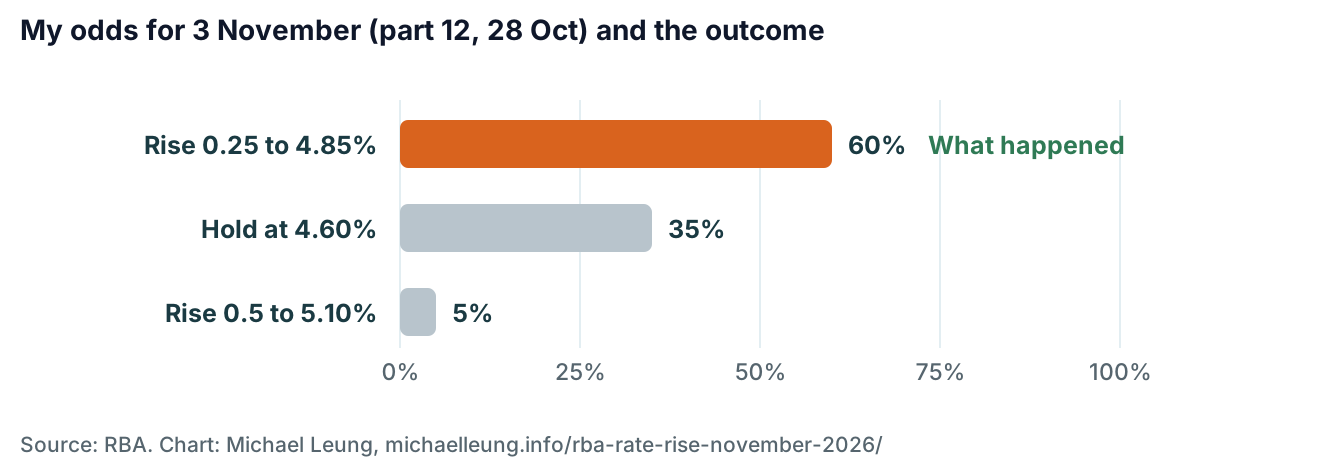
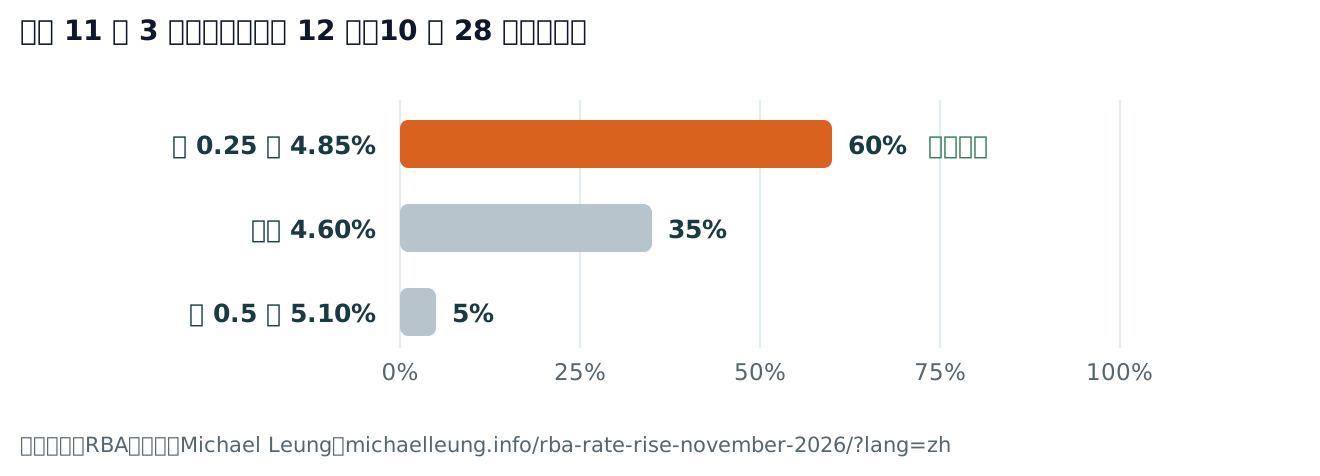
Six days ago, in part 12, I wrote that I expected a 0.25-point rise to 4.85% on 3 November, at about a 60% chance. That is exactly what happened. Below I explain why the Board moved, what it means for repayments in Brisbane, and what the new forecasts say about jobs, house prices and the next decision.
The November 2026 rate rise in short
- Decision
- Cash rate +0.25 to 4.85%, effective 4 November. Vote 6–3; three members wanted to hold at 4.60%.
- This year
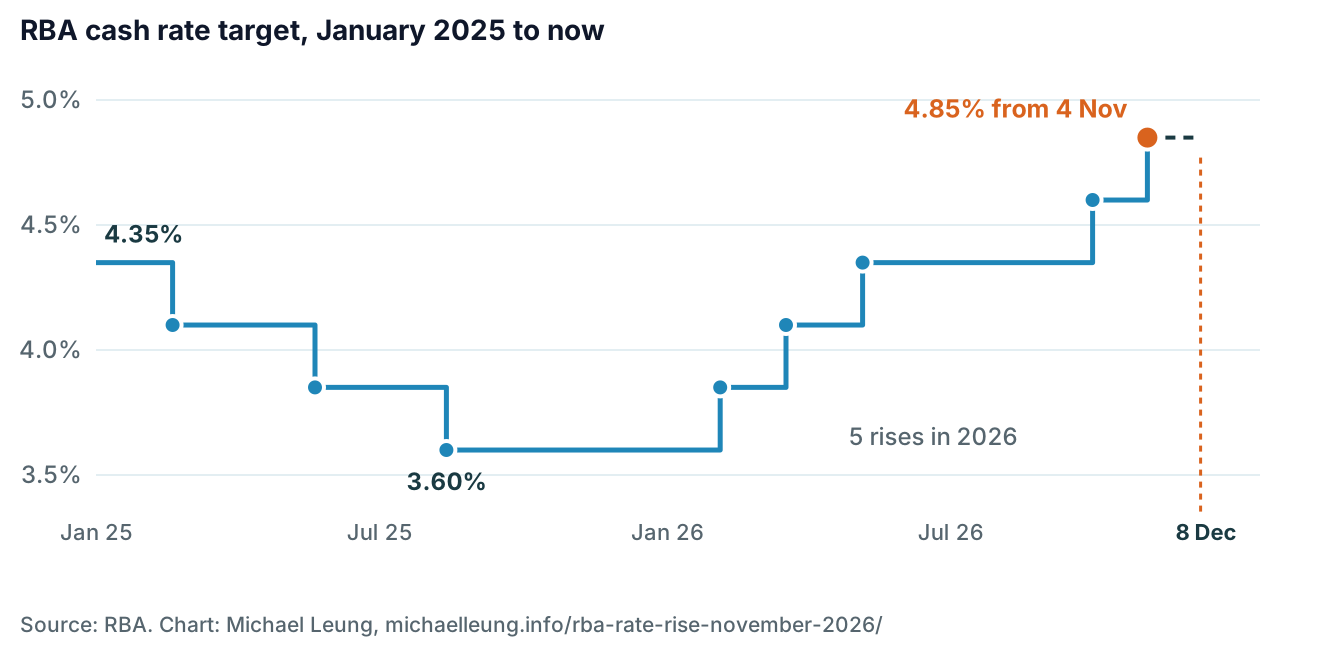
- Fifth rise of 2026 (February, March, May, September, November): +1.25 points from 3.60%
- Inflation now
- CPI 3.9%, trimmed mean 3.7% over the year to the September quarter. Target: 2–3%.
- New forecast
- CPI 4.5% in December 2026 (August forecast: 3.6%); mid-point of the target only by mid-2028
- Jobs
- Unemployment averaged 4.6% in the September quarter; forecast to reach 5.1% by December 2028
- Housing
- Prices in September almost 5% below their March peak; new housing loans down sharply
- Mortgage
- About $100 a month more on a $600,000 loan from this rise; about $487 more than in January
- My call
- Part 12 expected 4.85% on 3 November (about 60%). Correct. Next decision: 8 December.
Useful already? ☕ Buy me a coffee and keep these explainers free and ad-free.覺得有用?☕ 請我喝杯咖啡,讓這些解說繼續免費、無廣告。
Why did the RBA raise rates in November 2026?
- Inflation is broad. The RBA says price rises are spread across goods and services. CPI rose 3.9% and the trimmed mean 3.7% over the year to the September quarter. (The monthly CPI for September alone, which I covered in part 12, was 4.3%.)
- Fuel. The Middle East conflict is unresolved and oil supply is disrupted, which keeps energy prices high.
- Technology goods. Prices for chips and tech products are rising fast because of the worldwide AI investment boom.
- Costs passed on. Firms are passing their higher costs on to customers, and capacity pressures are “a little greater” than the RBA thought in August.
- Expectations. Some measures of inflation expectations have risen, and the Board sees “an increasing risk” that higher expectations become embedded. Once people expect prices to keep rising, inflation is much harder to bring down.
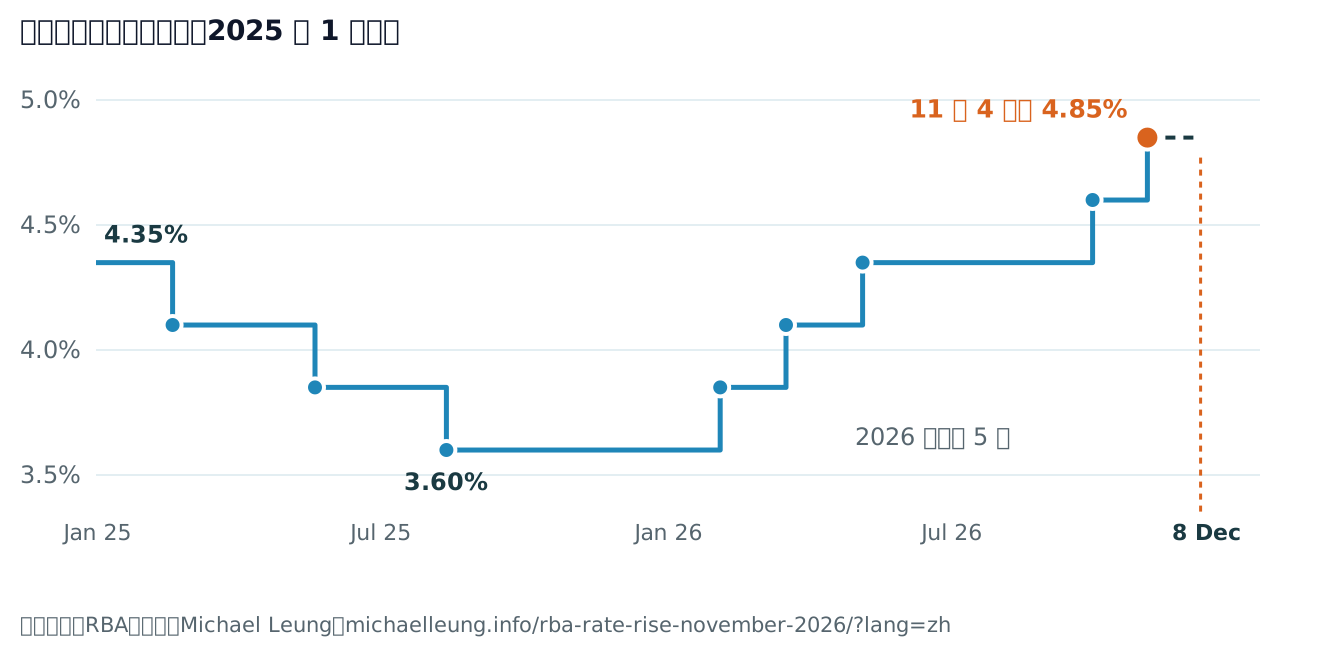
RBA cash rate target since January 2025: three cuts in 2025, five rises in 2026. The dashed line runs to the next decision on 8 December. Source: RBA cash rate target.
Did my part 12 prediction get it right?
My odds for the 3 November decision, published on 28 October 2026 in part 12, and the outcome. The odds were my own judgement, not market pricing. Source: michaelleung.info part 12; RBA media release 3 November 2026.
I should be honest about the path. In part 11 I expected a hold. When the September CPI came in hot, I changed my call in part 12 to a rise, because the quarter was strong, services inflation was speeding up and the RBA’s forecasts were drifting away. Those are the same reasons the Board gave today: broad inflation, a higher forecast and rising expectations.
I put a hold at about 35%, and three of the nine members did vote to hold. So the hold case was real: jobs are weakening, house prices are falling and spending has slowed. The majority decided that waiting was the bigger risk, as the September minutes had hinted.
How high will inflation go now?
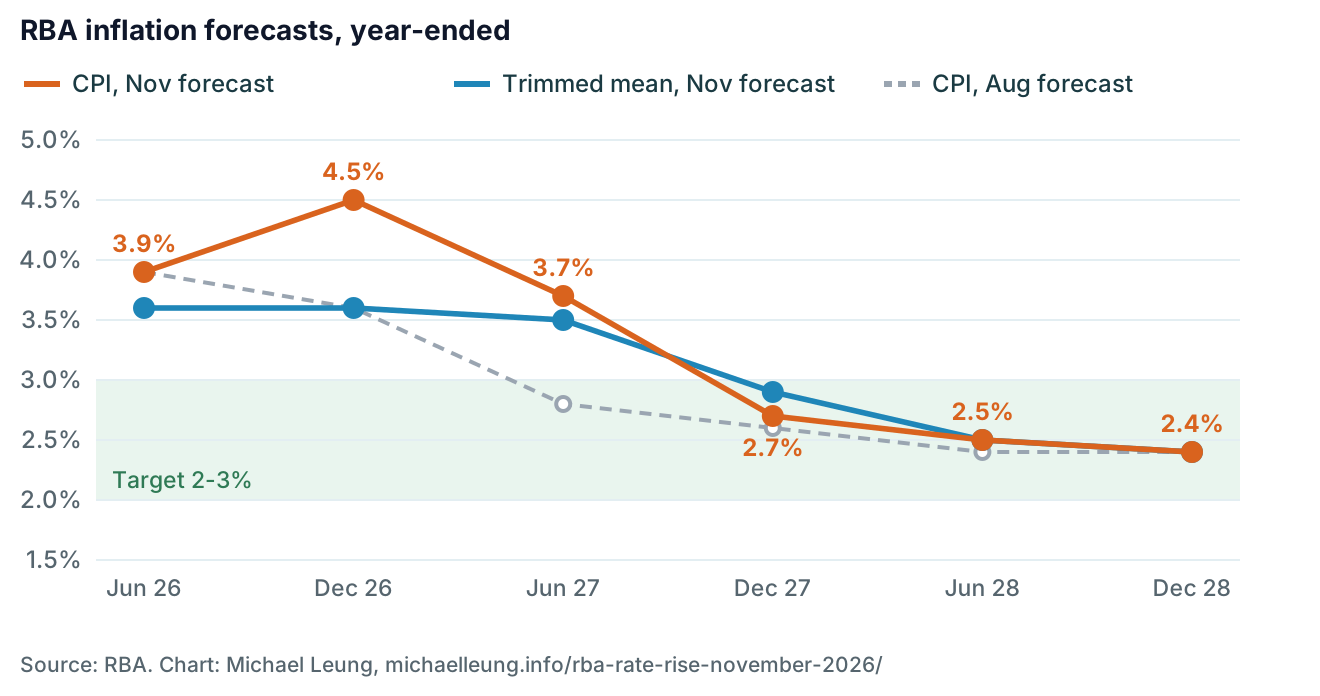
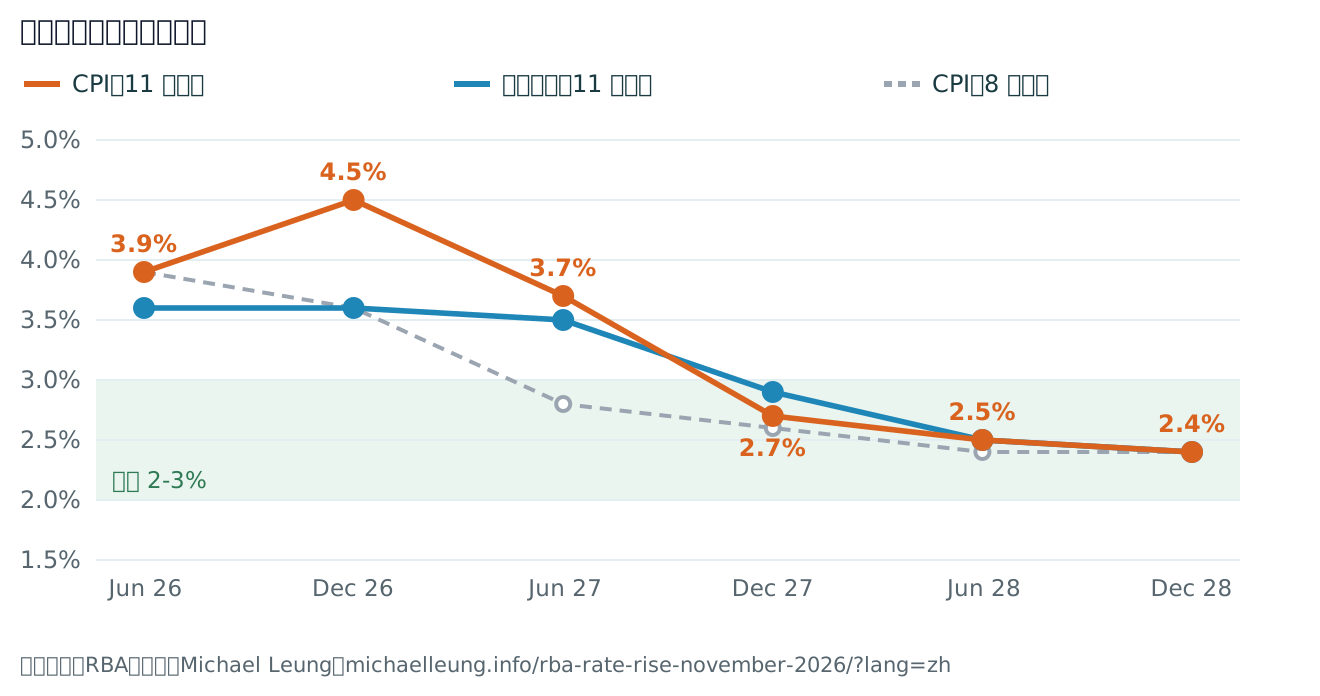
This is the biggest change in the November Statement on Monetary Policy. In August the RBA expected 3.6% for December 2026; now it expects 4.5%. The trimmed mean, its preferred measure, is forecast at 3.6% instead of 3.3%. Both stay above 3% until late 2027, about three quarters later than the August forecast.
RBA forecasts for annual inflation, November 2026 Statement on Monetary Policy, against the August forecast for headline CPI (dashed). The shaded band is the 2–3% target. Source: RBA Statement on Monetary Policy, November and August 2026.
The RBA also says the risks are “skewed to the upside”. Its forecast assumes energy prices ease. If shipping and refining problems in the Middle East drag on, fuel could stay high or rise further.
What happens to jobs and growth?
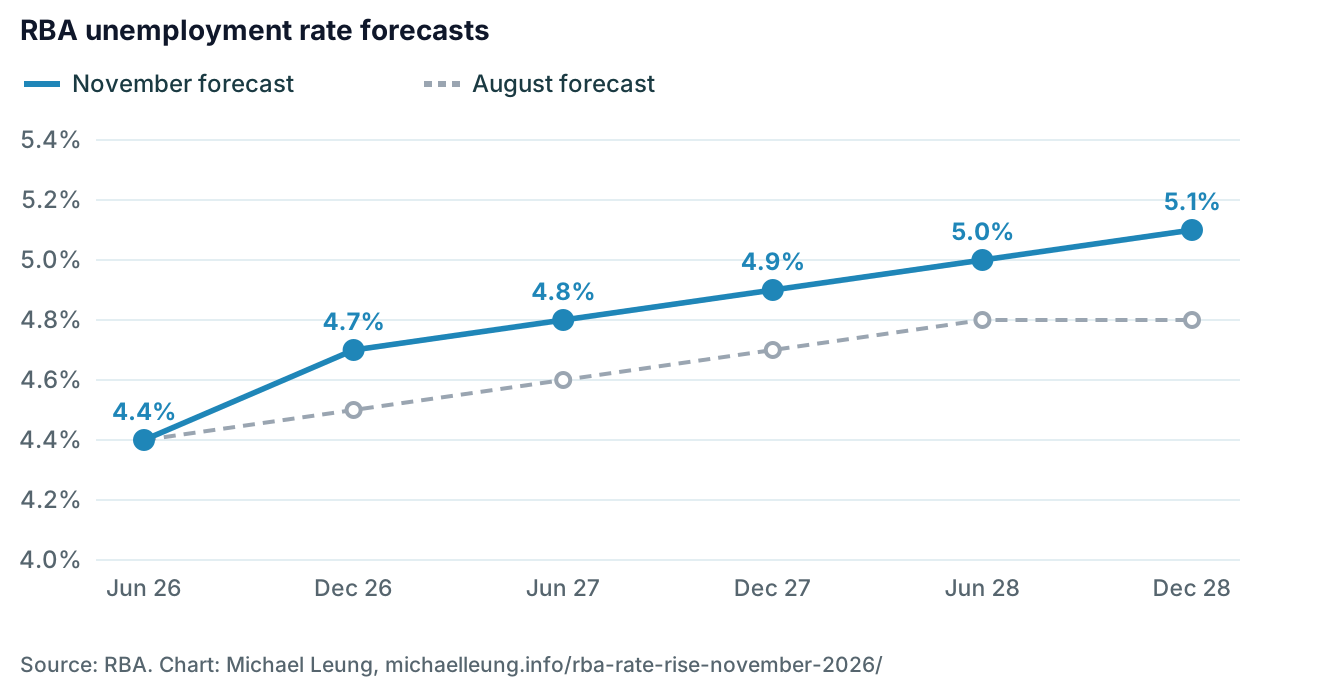
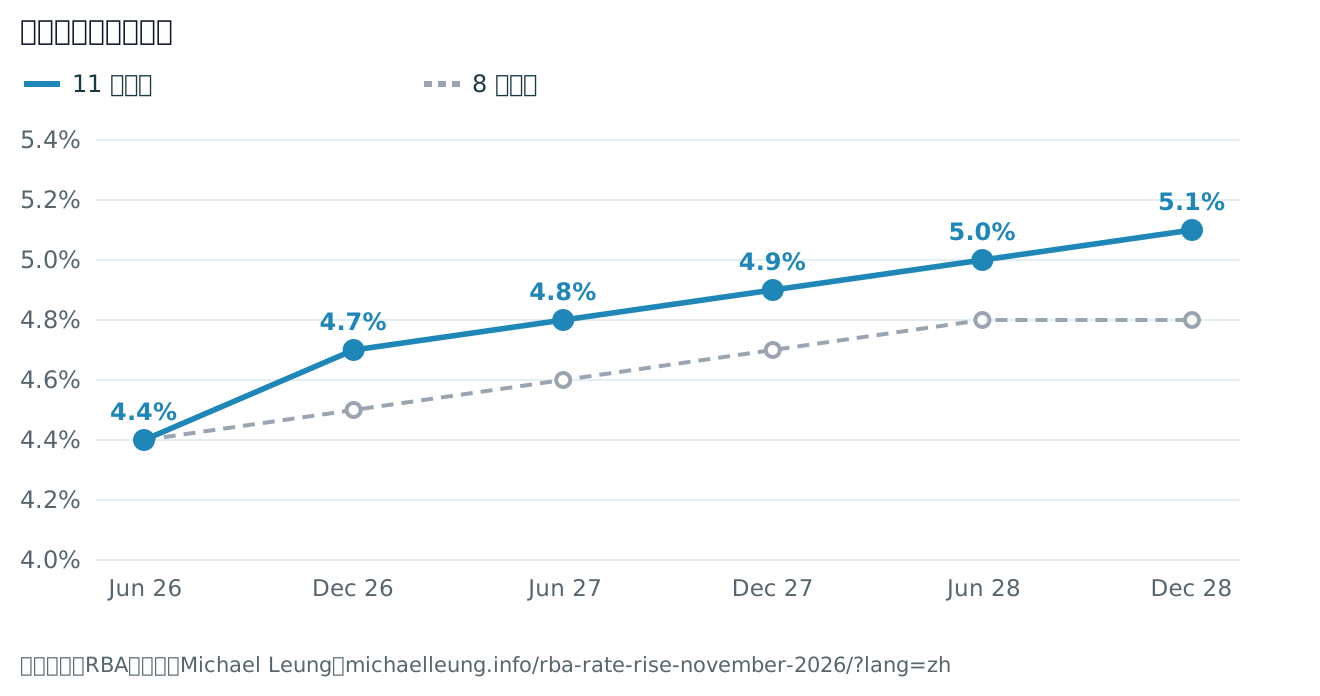
Unemployment averaged 4.6% in the September quarter, more than the RBA expected. It now forecasts 4.7% by December and 5.1% by December 2028, up from 4.8% in the August forecast. The number of jobs is still expected to grow; part of the rise in unemployment is more people staying in or joining the workforce.
RBA forecasts for the unemployment rate (quarterly average), November 2026 against August 2026 (dashed). Source: RBA Statement on Monetary Policy.
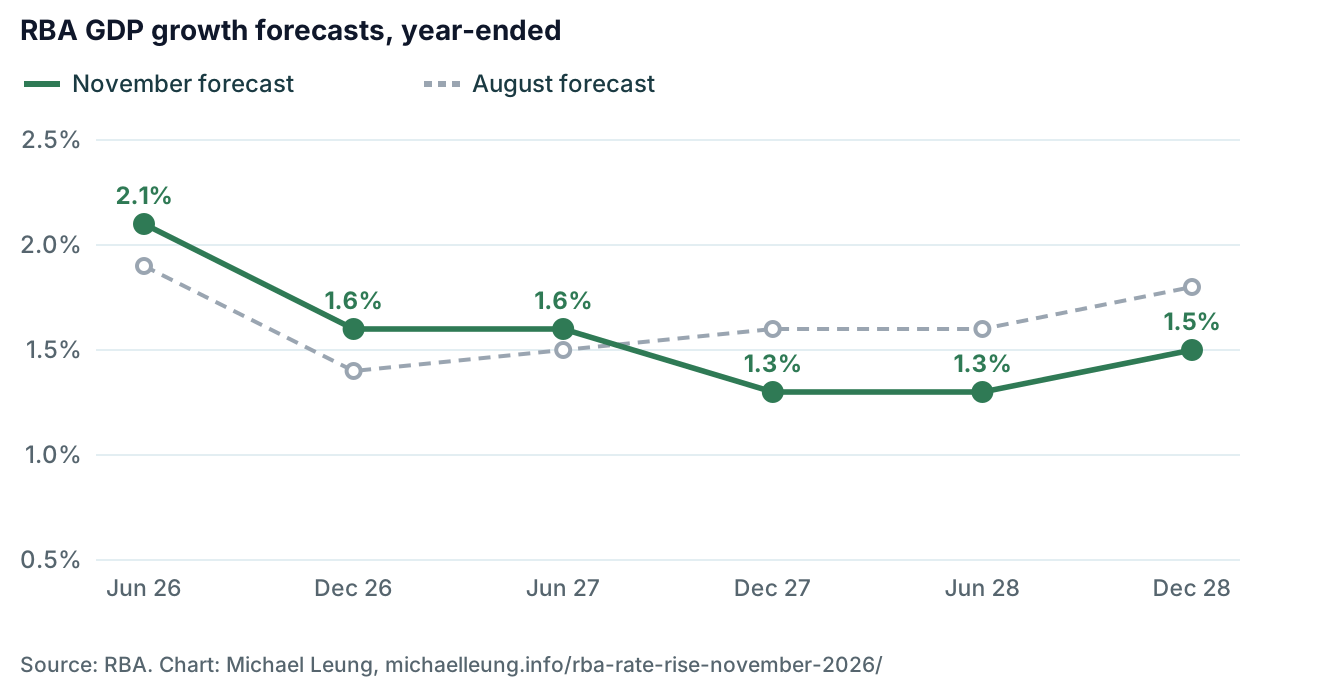
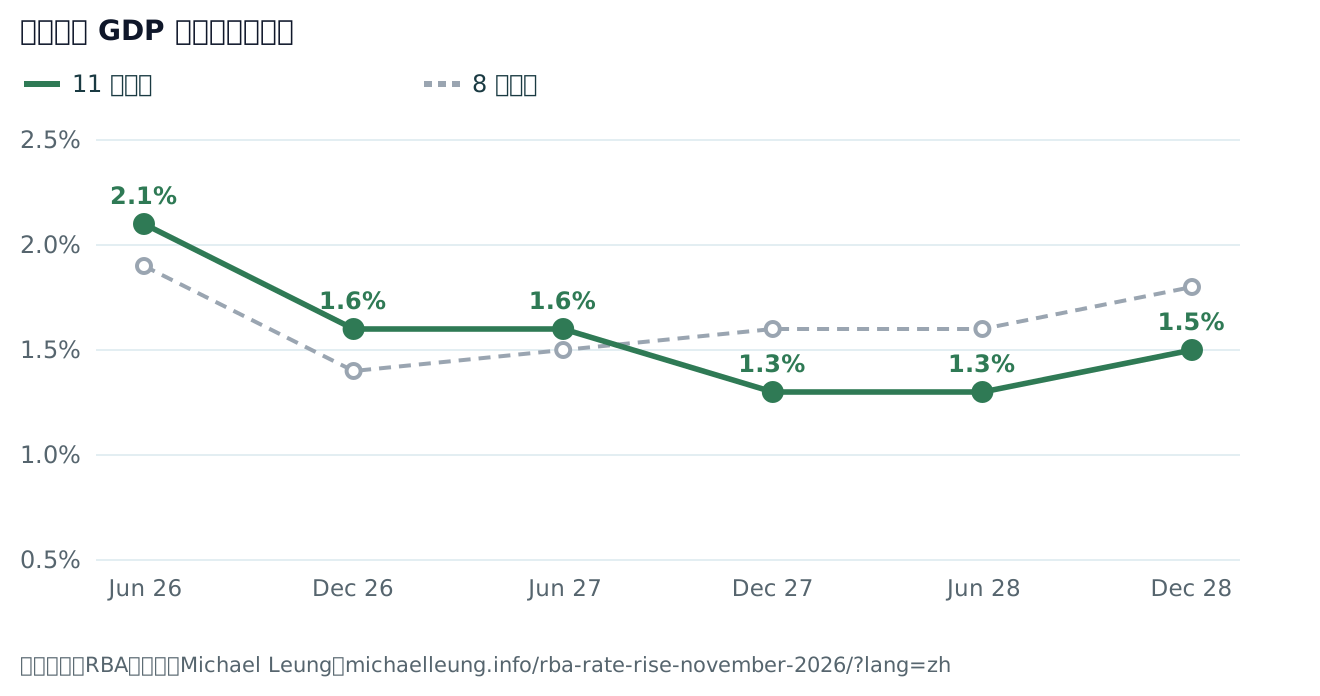
Growth tells the same story. GDP growth was 2.1% over the year to June 2026, a little stronger than expected, but the RBA sees it slowing to 1.6% by December and 1.3% through 2027. Weak productivity growth keeps a lid on how fast the economy can grow without pushing up prices.
RBA forecasts for annual GDP growth, November 2026 against August 2026 (dashed). Source: RBA Statement on Monetary Policy.

Illustration generated with Qwen Image 2.1
What does a 4.85% cash rate mean for my mortgage?
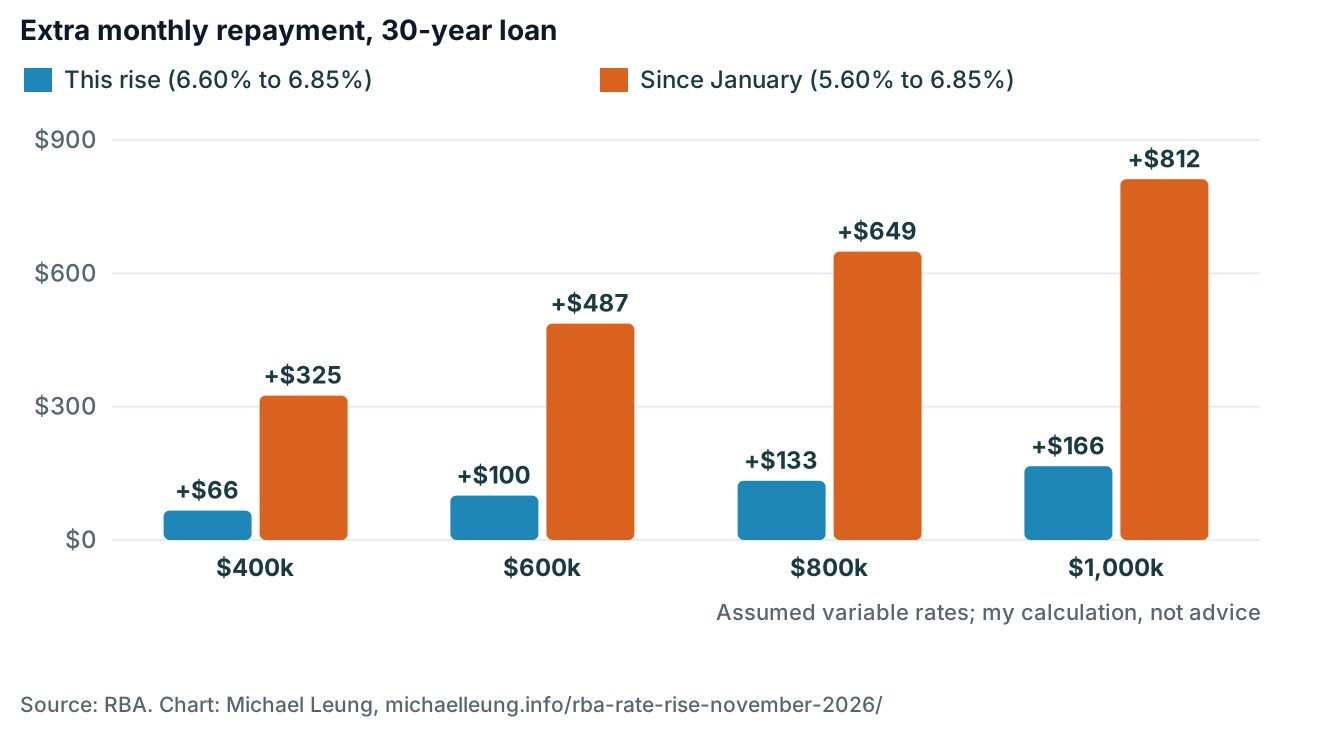
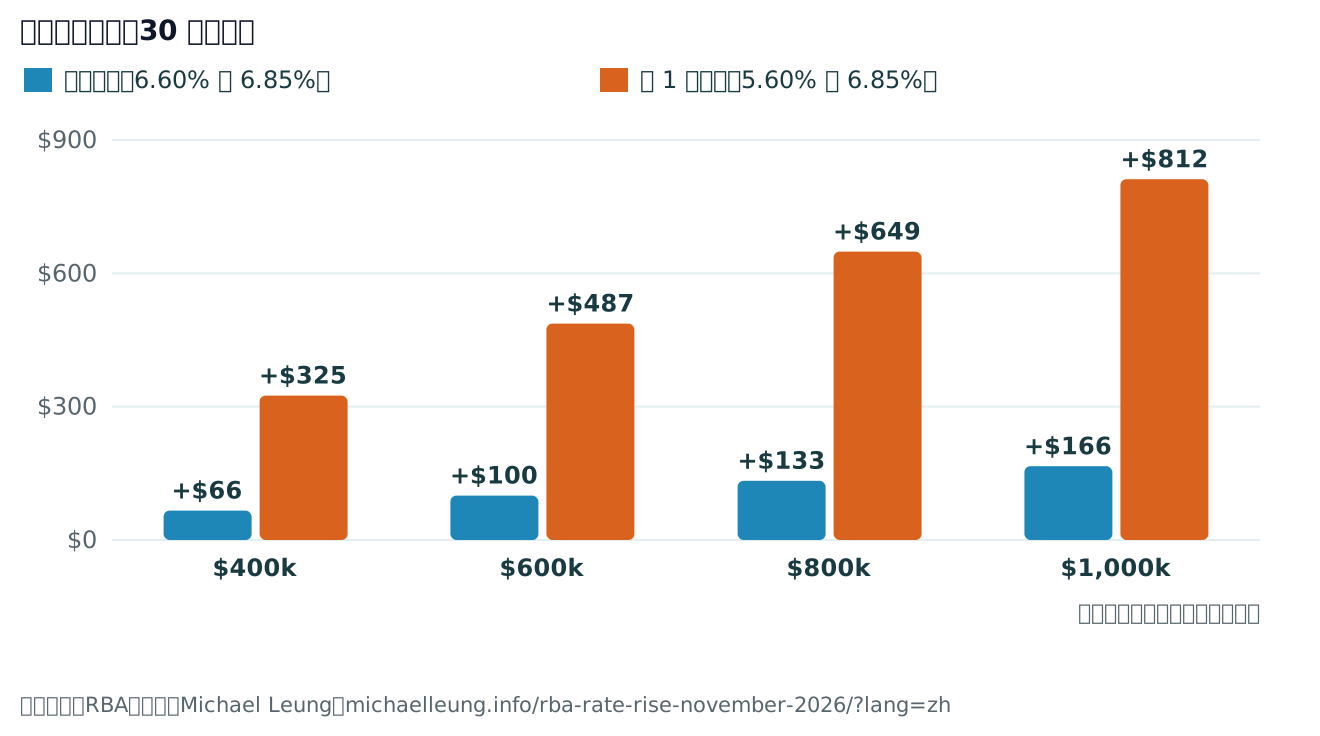
The table uses a 30-year principal-and-interest loan and assumes a variable rate of 6.60% before this rise (6.85% after) and 5.60% in January, before the first rise of 2026. Your own rate and loan terms will differ, so treat these as rough guides.
| Loan | Monthly repayment at 6.85% | Extra from this rise | Extra since January | Extra a year since January |
|---|---|---|---|---|
| $400,000 | $2,621 | +$66 | +$325 | +$3,897 |
| $600,000 | $3,932 | +$100 | +$487 | +$5,845 |
| $800,000 | $5,242 | +$133 | +$649 | +$7,793 |
| $1,000,000 | $6,553 | +$166 | +$812 | +$9,742 |
Extra monthly repayment by loan size: from this 0.25-point rise, and since January 2026. 30-year principal and interest; assumed variable rates 5.60%, 6.60% and 6.85%. My own calculation, not financial advice.
Banks usually announce their changes within a few days. If you are on a variable loan, check whether your bank has lowered your repayment amount in the past; some only change it if you ask. If you have a buffer in an offset account, the rise matters less. If you are close to your limit, talk to your lender early rather than late.
Illustration generated with Qwen Image 2.1
What does the rate rise mean for the wider economy?
- Households. Spending has already slowed, and the RBA says this year’s rises will slow it further. That is the point of the policy: less demand, less room for firms to raise prices.
- Housing. Prices in September were almost 5% below their March peak and new housing lending has fallen sharply. The RBA points to higher rates and the federal budget’s tax changes.
- Renters. Landlords with mortgages face higher repayments, which can flow into rents over time, although slowing demand works the other way.
- Jobs. Unemployment is rising slowly. If you are looking for work, expect more competition than a year ago.
- Savers. Term deposit and savings rates usually follow the cash rate up, so it is worth checking what your bank pays.
- Business investment. Data-centre building is growing fast and the AI boom overseas has supported our trading partners. The RBA says this only partly offsets the headwinds, and too much AI investment could add to costs.
Will the RBA raise rates again?
My view has not changed from part 12: after a rise in November, I lean towards a pause on 8 December while this year’s rises work through. I put a December hold at about 65% and another 0.25-point rise at about 35%. A hot October CPI on 25 November would push me towards a rise. These are my own judgements, not RBA guidance.
- 18 November 2026: Wage Price Index, September quarter (ABS)
- 19 November 2026: October jobs figures (ABS)
- 25 November 2026: CPI for October (ABS)
- 8 December 2026: next RBA decision
Show the RBA forecast table (November vs August 2026)
| Period | GDP growth | Unemployment | CPI | Trimmed mean |
|---|---|---|---|---|
| Jun 2026 | 2.1 (1.9) | 4.4 (4.4) | 3.9 (3.9) | 3.6 (3.6) |
| Dec 2026 | 1.6 (1.4) | 4.7 (4.5) | 4.5 (3.6) | 3.6 (3.3) |
| Jun 2027 | 1.6 (1.5) | 4.8 (4.6) | 3.7 (2.8) | 3.5 (3.0) |
| Dec 2027 | 1.3 (1.6) | 4.9 (4.7) | 2.7 (2.6) | 2.9 (2.6) |
| Jun 2028 | 1.3 (1.6) | 5.0 (4.8) | 2.5 (2.4) | 2.5 (2.4) |
| Dec 2028 | 1.5 (1.8) | 5.1 (4.8) | 2.4 (2.4) | 2.4 (2.4) |
Year-ended %, unemployment as a quarterly average. August 2026 forecasts in brackets. Forecasts finalised 28 October 2026. Source: RBA Statement on Monetary Policy, November 2026.
Download the charts
Every chart on this page is a free SVG file you can open, print or reuse with a link back to this page.
- RBA cash rate since January 2025, now 4.85%
- My part 12 odds vs the outcome
- RBA inflation forecasts, November vs August 2026
- RBA unemployment forecasts, November vs August 2026
- RBA GDP growth forecasts, November vs August 2026
- Extra mortgage repayments by loan size
Common questions
What is the RBA cash rate in November 2026?
4.85%. The RBA raised it by 0.25 points on 3 November 2026, effective 4 November. It is the fifth rise of 2026 and the highest cash rate since December 2008.
Why did the RBA raise interest rates in November 2026?
Inflation is high and broad, and the RBA raised its forecast sharply: headline inflation is now expected to reach 4.5% by December 2026. Fuel prices, technology goods, firms passing on costs and rising inflation expectations were the main reasons given.
How much will my mortgage repayments go up?
If your bank passes on the full 0.25 points, about $16 to $17 a month for every $100,000 borrowed, or about $100 a month on a $600,000, 30-year loan at around 6.6% to 6.85%.
When will inflation come down in Australia?
The RBA expects inflation to stay above 3% until late 2027 and to reach the middle of its 2–3% target in mid-2028.
Will the RBA raise rates again in December 2026?
The RBA has not said. Before the November meeting, markets expected about 1.5 more rises by mid-2027. My own view is that a pause on 8 December is more likely, at about 65%, unless the October CPI on 25 November is hot.
Why did three Board members vote to hold?
The RBA’s statement does not give individual reasons. The case for holding is in its own data: growth is slowing, unemployment is rising, house prices have fallen and earlier rises this year are still working through.
Sources
General information only, not financial advice. Research was AI-assisted; every figure was checked against RBA publications on 3 November 2026. The odds, mortgage assumptions and views on future rates are my own.
Found this useful?
Buy me a coffee ☕
Everything here is free and ad-free. A coffee or a AU$1/month membership keeps new articles, games and tools coming.
Also in the shop:VoidFill · The Architect’s Monologue · Brisbane photo prints
Series: Australian Economy 2026 (part 13 of 13)系列:2026 澳洲經濟(第 13 / 13 篇)
Rates, wages, housing and prices: what the 2026 numbers mean for Australian households.利率、工資、樓價與物價:2026 年的數字對澳洲家庭意味著甚麼。
- Will the RBA Raise Rates? Australia's Jobs and Inflation儲備銀行會加息嗎?澳洲就業與通脹
- RBA Raises the Cash Rate to 4.60%儲備銀行加息至 4.60%
- Wages vs Inflation 2019–2026: CPI +26.8%, WPI +20.8%工資對通脹 2019–2026
- Negative Gearing & CGT Reform: House Prices in Every Capital負扣稅與資本增值稅改革:各首府房價
- Card Surcharge Ban: Who Really Pays Now?禁止刷卡附加費:誰在埋單?
- University vs TAFE: Who Goes Where After Year 12?大學定 TAFE?中學畢業生去向
- Trade Surplus Falls to $495m: Computers, Fuel and Iron Ore貿易順差跌至4.95億:電腦、燃油與鐵礦石
- Bracket Creep: Median Tax Rate 21.6%→25.5%稅級攀升:中位數稅率 21.6%→25.5%
- Medicare Explained: Cover, Costs and LevyMedicare 全解:保障、費用與徵費
- Building Approvals August 2026: Is Australia Building Enough?2026年8月建築審批:澳洲建屋夠快嗎?
- Jobs Fall 39,300: RBA to Hold, Then Hike?就業減少39,300:儲備銀行先按兵不動,再加息?
- CPI Hits 4.3%: Will the RBA Hike on 3 November?通脹升至4.3%:儲備銀行11月3日會加息嗎?
- The RBA Hiked to 4.85%: Why, and What It Costs Your Mortgage儲備銀行加息至4.85%:原因及對供樓的影響