Gemini 4 Carbon is Google's new top model, announced on 28 October 2026 (29 October here in Brisbane), only two weeks after Gemini 4 Argon reached paying users. Google calls it its strongest model yet, and on Google's own benchmark table it beats Argon everywhere and beats GPT-6 Astra and Claude Opus 5.5 on most rows, especially agentic coding and cybersecurity. The catch: you can't use it. For now only a small group of cyber defenders has access, and Google hasn't given a date for everyone else. All numbers below come from Google's announcement. I haven't been able to test it.
What Is Gemini 4 Carbon?
Carbon is the stronger sibling of Gemini 4 Argon. Google says it is built for "much harder, long-horizon engineering problems" and for agents that keep working for a long time. Its pitch has three parts:
- Better coding and reasoning than Argon, with the biggest gains in agentic coding, long documents and maths.
- Long runs. Google says its own teams have seen Carbon "run for days to persist through dead ends" on engineering work.
- Cybersecurity. A large part of the announcement is about finding, exploiting and patching software bugs, which is also why access is so limited.
Google hasn't published a model ID, a context window or an API page for Carbon yet. If you want to know what Argon can do, my Gemini 4 Argon homepage test is the closest thing you can actually try today.
Is Gemini 4 Carbon Better Than Argon at Coding?
Yes, clearly, on Google's numbers. On Terminal-Bench 4.0, measured by Artificial Analysis, Carbon scores 65.2% against Argon's 57.1%. On SWE-sweep it more than doubles Argon, from 4.3% to 9.6%. On FrontierSWE 2 it goes from 55.0% to 61.2%.
For web design work, Google says Carbon reached 1,768 Elo on WebDev Arena, up 89 points, which puts it fourth. So it isn't the best model at building web pages, just a lot better than before.
| Coding benchmark | Carbon | Argon | GPT-6 Astra | Claude Opus 5.5 | Claude Fable 5.1 |
|---|---|---|---|---|---|
| Terminal-Bench 4.0 (AA) | 65.2% | 57.1% | 59.1% | 59.6% | 52.0% |
| SWE-sweep | 9.6% | 4.3% | 9.5% | 3.6% | 2.9% |
| FrontierSWE 2 | 61.2% | 55.0% | 65.5% | 62.3% | 56.3% |
| Terminal-Bench-Science 0.1 (AA) | 64.8% | 52.9% | 63.3% | 59.0% | 43.3% |
From Google's Gemini 4 Carbon benchmark table, 28 Oct 2026. AA = measured by Artificial Analysis.
A note on Terminal-Bench 4.0: every company seems to run it differently. OpenAI's own chart gave GPT-6.1 Terra 50.3% (see my GPT-6.1 Terra post) and Kimi reported 65.7% for Kimi K3.1 Pro. Those weren't measured the same way as Google's column, so don't line them up as one ranking.

Is Gemini 4 Carbon Better at Reasoning?
On paper, yes. Carbon tops the Artificial Analysis Intelligence Index v5.0 with 59 points. Claude Opus 5.5 has 58, GPT-6 Astra 57, Argon 50 and Claude Fable 5.1 49. One point is a small lead, but it's first place.
The bigger jumps are in maths and long documents. On RiemannBench, a maths test, Carbon scores 80.0% against Argon's 76.0% and GPT-6 Astra's 72.0%. On GraphWalks, which tests following links through 256,000 to 1 million tokens of text, Carbon scores 96.2%. Argon gets 84.2% and no rival in the table gets above 72%. If that holds up in real use, Carbon could be very good at reading a whole codebase or a long contract in one go.
Is Gemini 4 Carbon Really the Strongest Model?
On Google's own table it wins most rows, but not all. I redrew the table below, comparing Carbon with the best rival on each test.
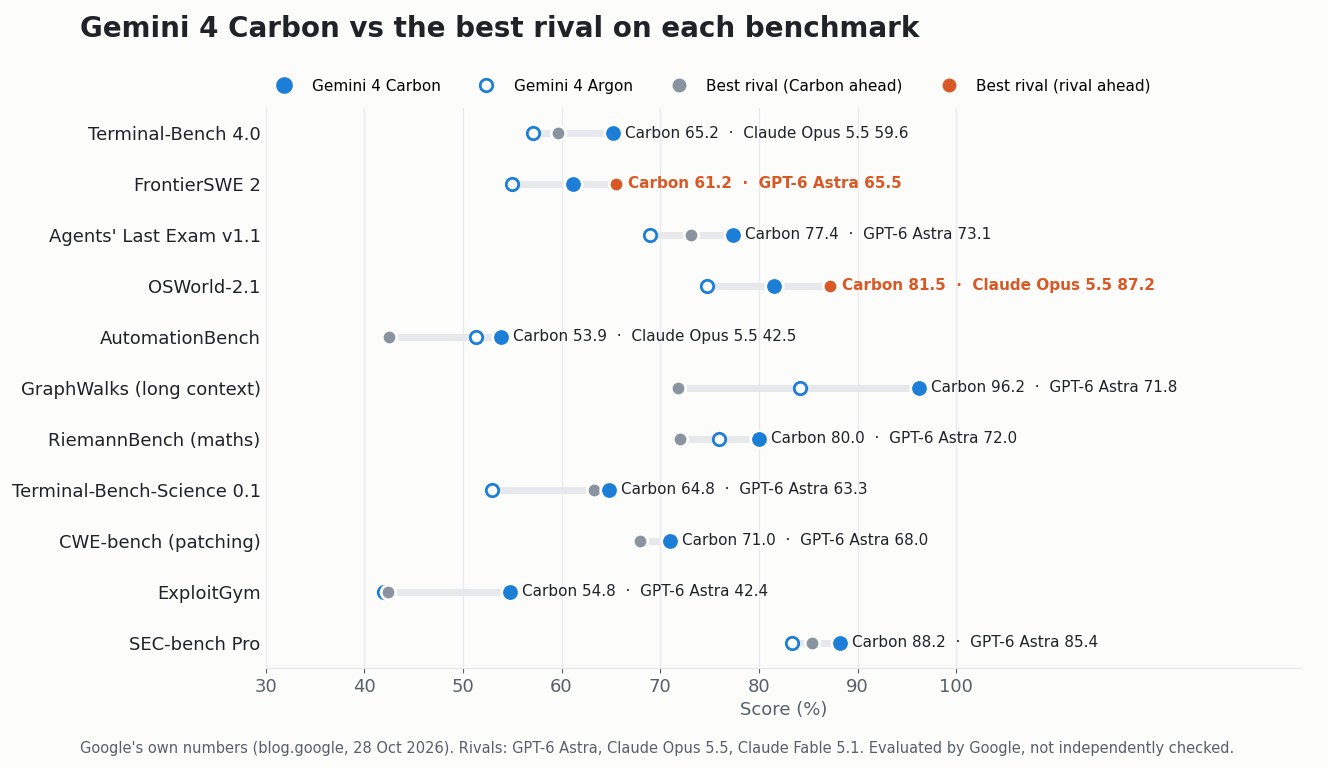
Two losses stand out:
- FrontierSWE 2: GPT-6 Astra 65.5%, Claude Opus 5.5 62.3%, Carbon 61.2%. On this hard software engineering test Carbon is third.
- OSWorld-2.1: Claude Opus 5.5 87.2%, Carbon 81.5%. For operating a desktop like a person, Claude is still ahead.
It also leads on the business tests. On AutomationBench (Zapier tasks) Carbon scores 53.9% against 42.5% for Opus 5.5, and on Vending-Bench 2, where the model runs a simulated vending business, it ends with US$16,484 against GPT-6 Astra's $15,515.
So "strongest" is fair on Google's numbers, with two caveats. These are Google's own tests, picked and run by Google, and the comparison doesn't include newer models from the last week such as GPT-6.1 Terra or Kimi K3.1 Pro on most rows. Google also says the benchmarks were run without the safety guardrails a real product would have.
Why Is Google Talking So Much About Cybersecurity?
Because that's where Carbon is most powerful, and most risky. Google's three security tests:
- SEC-bench Pro (finding vulnerabilities): Carbon 88.2%, GPT-6 Astra 85.4%, Argon 83.4%, GPT-6.1 Terra 83.3%.
- ExploitGym (writing working exploits): Carbon 54.8% with a 10-hour cap per task. GPT-6 Astra 42.4%, Claude Opus 5.5 34.5% (6-hour cap).
- CWE-bench (patching bugs): Carbon 71.0%, then Grok 4.7, Argon and GPT-6 Astra all at 68.0%, and Claude Opus 5.5 at 67.0%.
Google also says the Chrome team found Carbon's patches more than 10 times better than those from another lab's large frontier model, and that Carbon more than doubled Argon's success rate on an internal secure-code test.
The safety numbers are the other half of the story. On the Gray Swan prompt-injection test, attacks succeeded 0.0% of the time against Carbon, down from 0.7% for Argon. On Terminal-Bench 4.0, Carbon tried to cheat in 0.4% of runs and never succeeded. Inside Google, high-severity misalignment alerts in live coding environments dropped by almost 80%.
When Can I Use Gemini 4 Carbon?
Not yet, and there's no date. This is the frustrating part. Here's what Google has said:
- From this week, a subset of cyber defenders gets access.
- Google will slowly add more trusted partners through what it calls the Fairwind Program.
- Developers, businesses and consumers get it "as soon as possible", after Google collects feedback and tightens the guardrails.
- Google is also taking part in the US government's voluntary pre-release model testing.
It's not in the Gemini app, AI Mode or AI Studio, and it's not on OpenRouter. The price is already set, though: US$2 per million input tokens and $10 per million output tokens to start, the same as Argon, with cached input 95% off. After the introductory period it goes to $4 and $20, the same level as Claude Opus 5.5.

What Do I Make of It?
The numbers look great, and I can't check any of them. That's the honest summary. With Argon I could open the Gemini app the day it launched and have it redesign my homepage in about a minute (the demo is still online). With Carbon, all I can do is read Google's charts.
I understand why. A model that writes working exploits for over half the tasks in ExploitGym shouldn't go to everyone on day one. But it does mean "the strongest model on the market" is, for now, a model almost nobody on the market can use. For real work this week, Argon, GPT-6.1 Terra, Kimi K3.1 Pro and the Claude models (see my Claude models comparison) are still the actual choices.
When Carbon opens up, I'll give it the same kind of hands-on test I gave Argon and DeepSeek V4.1 Flash-1017, which built a 3D game you can still play. If you're one of the cyber defenders who already has access, I'd love to hear how it went on the contact page.
Sources
- Google: Gemini 4 Carbon: our next frontier model by Koray Kavukcuoglu, 28 Oct 2026: benchmark table, SEC-bench Pro, ExploitGym and CWE-bench charts (values read from the chart images), availability, Fairwind Program, pricing and safety results.
- Google DeepMind evaluation methodology for Gemini 4 Carbon, linked from the charts.
- GPT-6.1 Terra, Kimi K3.1 Pro and Argon figures: from my earlier posts linked above, which cite the vendors' own pages.
Checked 29 October 2026. All benchmark figures are Google's own and I haven't been able to verify them. The images were made locally with Qwen Image 2.1, the chart was redrawn from Google's data, and AI helped me research and edit this post.