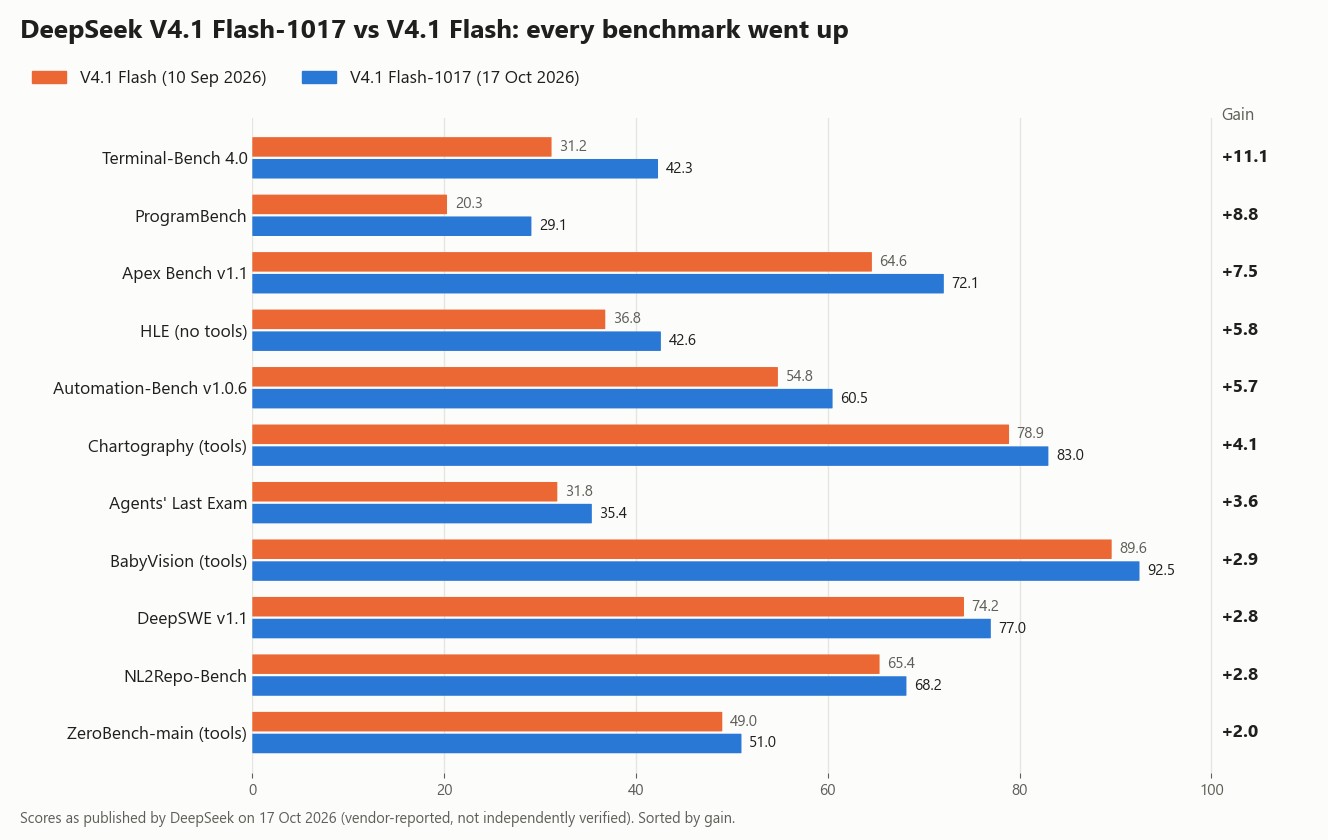
DeepSeek V4.1 Flash-1017 is an update to DeepSeek V4.1 Flash, not a new model, and it is better on every benchmark DeepSeek published, at the same API price. The biggest jump is in agentic coding: Terminal-Bench 4.0 went from 31.2 to 42.3. If you already call deepseek-flash through the API, you are using it now, with no code change. It came out on 17 October 2026, five weeks after V4.1 Flash.
What Changed in DeepSeek V4.1 Flash-1017?
DeepSeek's model card calls it "a minor update". It brings gains in reasoning, coding, agentic tasks and vision, and it finishes tasks faster with shorter answers. DeepSeek says it was trained with reinforcement learning using self-feedback, aimed at whole projects "from game creation to 3D modeling". Its demos include a 3D Forbidden City, a browser racing game and a Portal 2 remake in the Godot engine.
It is also tuned for DeepSeek's own coding agent, DeepSeek Harness, and for Tencent's CodeBuddy and WorkBuddy. If you use DeepSeek Harness, DeepSeek recommends upgrading to v0.2.1-rc.1 or later.
How Much Better Is It on Benchmarks?
Every one of the 11 scores went up, by between 2.0 and 11.1 points. The gains are largest on agentic and coding tests, and smallest on vision tests that were already high.
| Benchmark | V4.1 Flash | Flash-1017 | Claude Opus 5 | Kimi K3 | GLM 5.3 |
|---|---|---|---|---|---|
| HLE (no tools) | 36.8 | 42.6 | 56.3 | 43.5 | 42.0* |
| Terminal-Bench 4.0 | 31.2 | 42.3 | 51.8 | 12.6 | 37.9 |
| DeepSWE v1.1 | 74.2 | 77.0 | 74.0 | 67.5 | 66.9 |
| ProgramBench | 20.3 | 29.1 | 37.0 | 17.5 | 19.0 |
| NL2Repo-Bench | 65.4 | 68.2 | 75.3 | 58.0 | 58.0 |
| Automation-Bench v1.0.6 | 54.8 | 60.5 | 50.3 | 46.7 | 48.8 |
| Agents' Last Exam | 31.8 | 35.4 | 28.6 | 27.6 | 28.5 |
| Apex Bench v1.1 | 64.6 | 72.1 | 65.8 | 47.8 | 56.6 |
| Chartography (tools) | 78.9 | 83.0 | 84.0 | 68.1 | – |
| BabyVision (tools) | 89.6 | 92.5 | 94.1 | 85.7 | – |
| ZeroBench-main (tools) | 49.0 | 51.0 | 52.0 | 41.0 | – |
All scores from DeepSeek's announcement. *GLM 5.3's HLE score is on the text-only subset; on that subset Flash-1017 scores 44.0. Terminal-Bench used the Claude Code harness, DeepSWE the mini-SWE-v2 harness, and ZeroBench Pass@5.
On DeepSeek's own table, Flash-1017 beats Claude Opus 5 on four tests: DeepSWE, Automation-Bench, Agents' Last Exam and Apex Bench. Opus 5 still scores higher on the other seven, most clearly on HLE (56.3 vs 42.6) and Terminal-Bench (51.8 vs 42.3). Note that DeepSeek compared against Claude Opus 5, not the newer Opus 5.5. I compared those two in Meta Muse Wonder vs Claude Opus 5.5. Kimi K3 and GLM 5.3 are covered in my Mistral Large 4 comparison.
Is It Cheaper to Use Than V4.1 Flash?
The price per token is the same, but each task costs less, because the model writes shorter answers. DeepSeek also charted DeepSWE v1.1 score against average cost per task. Reading that chart, Flash-1017 on its "max" setting scores 77.0% for about US$0.20 a task. The old V4.1 Flash scored 74.2% for about US$0.48. So it gets a higher score for well under half the cost. On the same chart, Claude Opus 5 sits near 74% at roughly US$12 a task. These cost figures are my reading of DeepSeek's log-scale chart, so treat them as approximate.
The token prices on DeepSeek's pricing page:
deepseek-flash, per 1M tokens (USD) | Peak | Off-peak |
|---|---|---|
| Input, cache hit | $0.006 | $0.003 |
| Input, cache miss | $0.30 | $0.15 |
| Output | $1.20 | $0.60 |
Peak hours are 01:00–04:00 and 06:00–10:00 UTC on weekdays. In Brisbane that is 11am–2pm and 4pm–8pm, Monday to Friday. Sydney and Melbourne are an hour later while daylight saving is on. Everything else, including weekends, is half price. The context window is 1M tokens with up to 384K tokens of output, and Flash also accepts images.
Do I Need to Change Anything to Use It?
Probably not. The API model name stays deepseek-flash, and DeepSeek's pricing page now lists it as DeepSeek-V4.1-Flash-1017. The old names deepseek-v4-flash and deepseek-v4-flash-vision-exp still work, but those models are retired, so requests sent to them are also answered by Flash-1017 at the Flash price.
One thing to check: if you had prompts tuned to the old model's longer answers, test them again. Shorter output is cheaper, but it can also drop detail that a script expected.
I used the DeepSeek Harness with GLM-5.3-Flash in One Night of Agentic Coding for Under $1. With this update, DeepSeek's own Flash model is now a strong option inside the same harness.
What Are the New Search and Fetch APIs?
DeepSeek has opened its own web search and page-fetch APIs to everyone. It says the search engine behind them serves "hundreds of millions of requests daily worldwide". Each costs US$0.75 per 1,000 successful calls.
When they are used as server-side tools inside DeepSeek Harness, Claude Code or Codex, the calls are free for now. Billing starts at 16:00 UTC on 31 October 2026, which is 2am on 1 November in Brisbane.
Can I Run DeepSeek V4.1 Flash-1017 Locally?
Not on a normal PC. The weights are open under the MIT licence on Hugging Face and ModelScope, but the model has 763 billion parameters. Even at about one byte per parameter, that is roughly 760 GB of weights, about a hundred times more than my 8GB RTX 4060 Ti holds. In this name, "Flash" means fast and cheap to serve in a data centre. It doesn't mean small.
It is the same story as Meta's 816B Muse Spark Open: open weights matter for companies and researchers who run their own servers, but home users get these models through the API. For what really fits on an 8GB card, see my local AI photo search with MiniCPM-V 4.7 1B. For when the cloud is the better deal, see Local LLM vs Cloud API.
Should You Switch to DeepSeek V4.1 Flash-1017?
If you already use DeepSeek Flash, you have already switched. If you are choosing a cheap model for coding agents or automation, it now looks like one of the best scores per dollar available, on DeepSeek's own numbers. For the hardest reasoning tasks, Claude Opus 5 and newer still lead clearly.
These are vendor benchmarks, published on release day. I haven't tested Flash-1017 myself yet, so I'd wait for independent results before relying on the small gains, but an 11-point jump on Terminal-Bench is hard to ignore.
Sources
- DeepSeek: DeepSeek-V4.1-Flash-1017 release notes (17 Oct 2026), including the benchmark table and the DeepSWE cost-per-task chart.
- Hugging Face model card: 763B parameters, MIT licence, 1M context, benchmark table.
- DeepSeek API pricing: model ID, token prices, peak hours, Search and Fetch pricing.
- DeepSeek: V4.1 Flash release (10 Sep 2026): launch prices, identical to today's.
Checked 18 October 2026. Prices are in US dollars and DeepSeek says they may change. The cover image was made locally with Qwen Image 2.1, and I made the benchmark chart from DeepSeek's published scores. AI helped me research and edit this article.