Tencent has released Hy4 flash, a new open-weight model you can download from Hugging Face today. It is a 220B mixture-of-experts model, but only about 12B parameters are active for each token, and it reads text and images with a context window of up to 1 million tokens. Tencent's pitch is cost: on its own work tests it scores a little above Hy4 preview (42.1 against 39.7) for about RMB 0.2 per task, against RMB 3.2.
My short verdict: this is a cheap model for everyday office and agent work, not a top coding model, and it is far too big for my 8GB home GPU. It is also one more open-weight release in a month that has already been full of them, and as someone who supports open source, I'm glad to see it.
What is Tencent Hy4 flash?
Hy4 flash is the smaller, cheaper sibling of Tencent's Hy4 model. Tencent calls it "our most cost-effective Hy model to date", and the model card went up on Hugging Face on 17 November 2026.
Tencent released three versions:
- Hy4 flash, the instruct model for chat and agents.
- Hy4 flash-FP8, a smaller 8-bit version for serving.
- Hy4 flash-base, the pre-trained base model for people who want to fine-tune it themselves.
Tencent recommends it for deep search, document processing, slide creation, simple frontend demos and computer use. For long software engineering jobs, Tencent itself says to use the bigger Hy4 instead.
How big is Hy4 flash, and why is it so cheap to run?
It has 220B parameters in total, but about 11.3B text parameters (plus a 0.43B vision encoder) do the work for each token. Most of the saving comes from that: each token uses 16 of 512 experts, plus one shared expert.
A few other design choices from the model card:
- Engram: 63.5B of the 220B are a lookup table of word pairs and triples (bigrams and trigrams). It adds knowledge without adding much compute per token.
- Hybrid attention: three short-window attention layers for every sparse attention layer. Tencent says this cuts the memory needed for long chats (the KV cache) to 1/24 of Hy3 and 1/6 of Hy4.
- Shorter answers: Tencent says reinforcement learning cut the average output length by 50%, and fewer output tokens means a smaller bill.
- A built-in drafter, DFly2: a small 0.85B helper that guesses the next few tokens. With 4-bit weights, Tencent reports decoding speeds above 150 tokens per second on its servers.

Is Hy4 flash as good as Claude Haiku 5.5?
In Tencent's own blind test, users rated it almost the same: 2.79 out of 4 for Hy4 flash against 2.81 for Claude Haiku 5.5. The difference is the price. Tencent puts Hy4 flash at RMB 0.26 per task and Claude Haiku 5.5 at RMB 4.73, about 18 times more.
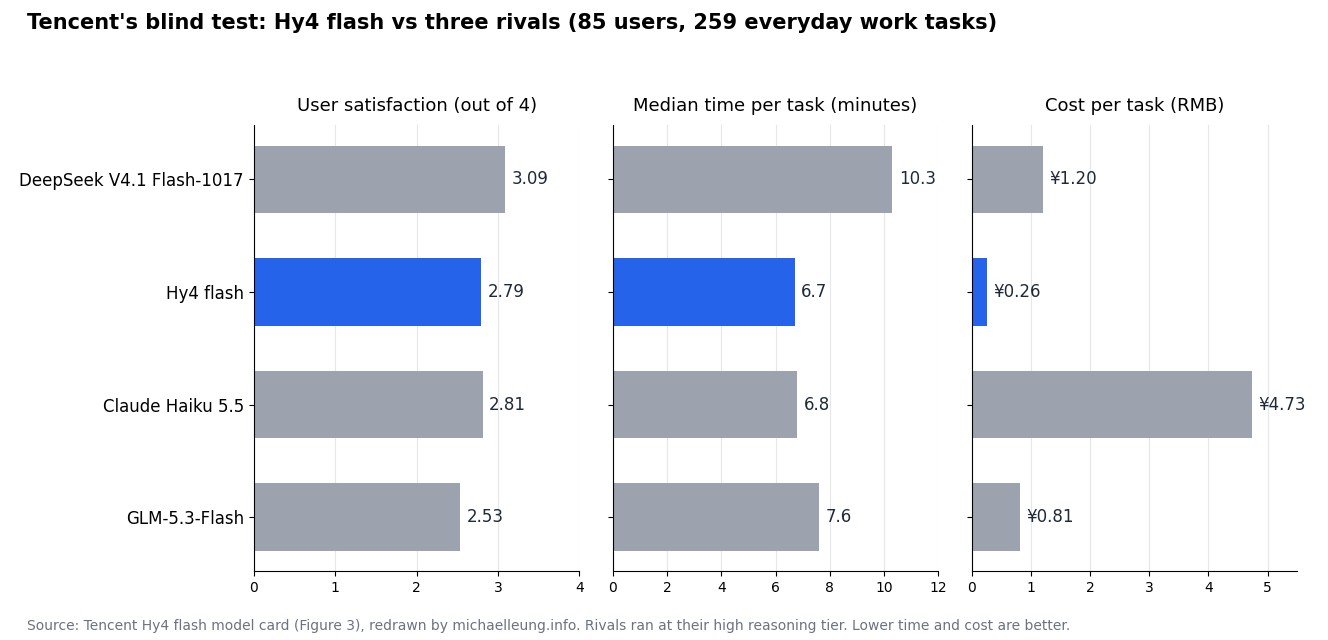
The test used 85 of Tencent's own WorkBuddy users on 259 tasks across 27 categories. DeepSeek V4.1 Flash-1017 actually scored highest at 3.09, but it took 10.3 minutes per task against 6.7 for Hy4 flash, and cost about four and a half times more. Keep in mind this is Tencent testing its own model with its own users and tasks. I'd treat it as a good sign, not as proof.
How does Hy4 flash score on public benchmarks?
It's mid-pack against other cheap "flash" models: close on office-agent and computer-use tests, clearly behind on hard coding tests. Here are rows from Tencent's benchmark table:
| Benchmark (Tencent's table) | Hy4 flash | DeepSeek V4.1 Flash-1017 | Qwen3.8-Flash-Next | GLM-5.3-Flash | GPT-6 Luna |
|---|---|---|---|---|---|
| DeepSWE v1.1 (coding) | 64.6 | 73.8 | 65.1 | 67.8 | 67.1 |
| Terminal-Bench 4.0 | 19.2 | 40.0 | 29.5 | 35.4 | 13.3 |
| APEX-Agents v1.1 | 63.1 | 72.9 | 57.6 | 51.5 | 44.7 |
| AutomationBench v1.0.6 | 52.2 | 54.3 | 49.3 | 48.4 | 38.1 |
| OSWorld 2.1 (computer use) | 68.1 | 68.4 | 58.8 | 64.0 | 55.7 |
| HLE-Full (with tools) | 55.2 | 57.1 | 54.1 | 52.2 | 49.7 |
| MMMU-Pro (images) | 75.8 | 76.7 | 77.2 | 77.0 | 77.5 |
| ZeroBench (images, with tools) | 45.8 | 16.5 | 41.7 | 35.3 | 33.6 |
| Cost per DeepSWE task (RMB) | 0.29 | 1.30 | 3.25 | 3.23 | 1.54 |
Scores from Tencent's Hy4 flash model card; higher is better, except the cost row. Bold = best in each row. Tencent ran every model at its highest reasoning setting and worked out costs from each model's official API price.
The weak spot is clear. On Terminal-Bench 4.0, Hy4 flash scores 19.2, less than half of DeepSeek V4.1 Flash-1017's 40.0. It also trails on ProgramBench (16.0 against 29.0). If you write code with agents all day, DeepSeek's flash model is still the stronger cheap option, as I found when it built a 3D game for 5 cents.
Its strong point is the cost row. It finished DeepSWE tasks for RMB 0.29 each, against RMB 1.30 for DeepSeek and over RMB 3 for Qwen and GLM. Tencent says it also gets close to the much bigger Hy4 on Markdown editing (56.9 against 57.7) at a small fraction of the cost.
How much does the Hy4 flash API cost?
On OpenRouter it costs US$0.035 per million input tokens and US$0.1405 per million output tokens, with cached input at US$0.0015 per million. That's very cheap. For comparison, DeepSeek V4.1 Flash costs US$0.30 input and US$1.20 output at peak time, as I covered in my DeepSeek V4.1 Flash-1017 article, so Hy4 flash costs about one-eighth as much per token.
OpenRouter lists it with text and image input, a 1M-token context and up to 65,536 output tokens, with tool calling and structured outputs. I haven't run my own speed or quality test yet, so these are listed prices, not my bill.
Is Hy4 flash really open source?
The weights are open, but the licence isn't a standard open-source licence. Hy4 flash uses the Tencent Hy License 1.0, which is based on Apache 2.0 with one extra section for big API businesses.
You need a separate licence from Tencent only if you sell general model access (an API, for example) and either earn over US$50 million a year or serve more than 100 million monthly users. Using it inside your own company is exempt, as long as the model and its outputs aren't offered to outsiders. For students, hobbyists and small businesses, it works much like Apache 2.0. I didn't find any country restrictions in the licence text.
Can you run Hy4 flash on an 8GB GPU?
No. Even the smallest file is far too big. Tencent's AngelSlim team published GGUF files for llama.cpp, and the smallest one, IQ2-AH, is 125.73 GiB. The standard Q4_K_M build is 156.79 GiB.
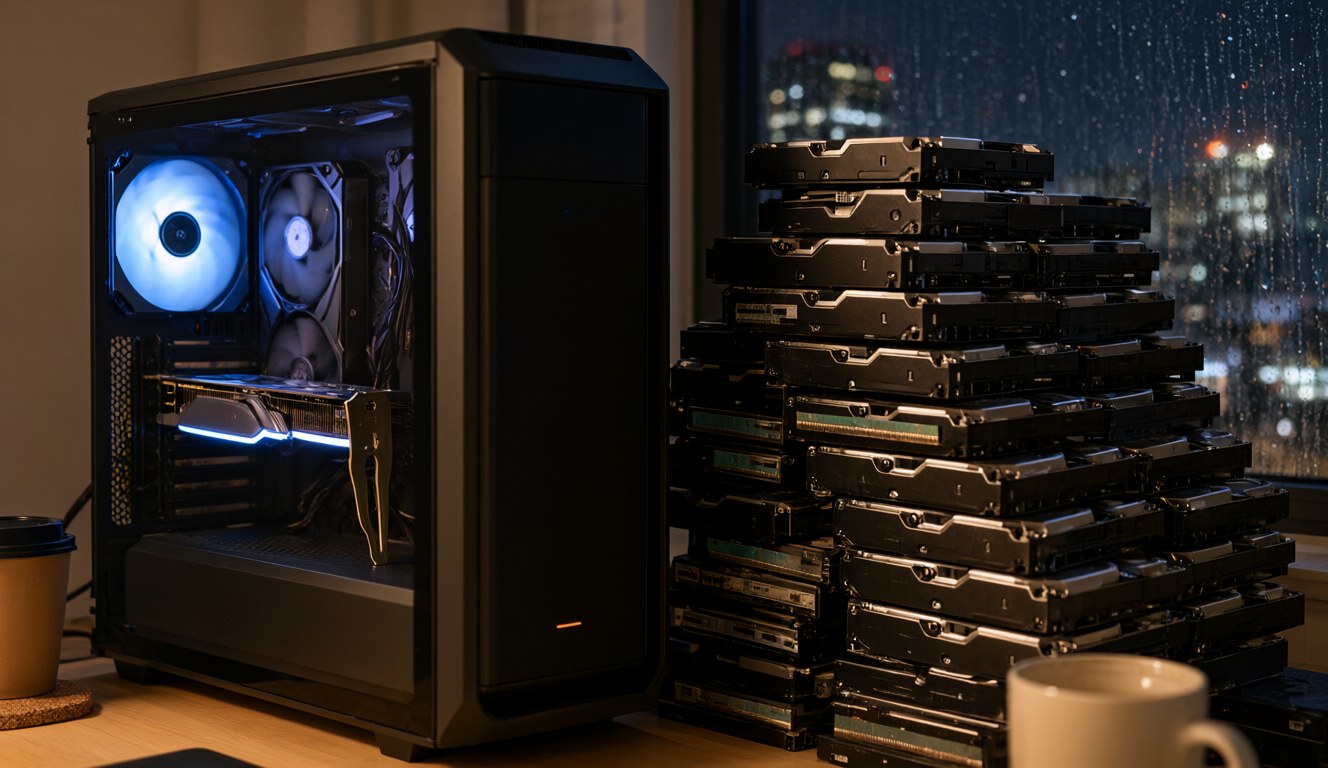
My PC has an 8GB RTX 4060 Ti and 64GB of RAM (the build is in my 64GB RAM, 8GB GPU article), so 72GB in total. That's well short of 126 GiB before you add any memory for the context. llama.cpp support also isn't merged yet; you have to build from an open pull request (#32517).
AngelSlim's own speed tests show what kind of machine you need. A Mac with an M5 Max and 128GB ran the Q4_K_M build at about 48 tokens per second at a 4K context, and an RTX Spark with 128GB ran the SPARK-4Bit-Fast build at about 32 tokens per second. For servers, Tencent's recipes use the FP8 model across 8 GPUs with vLLM or SGLang.
If you want a big model that does fit on an 8GB card, Qwen3.8-Flash-Next ran at 38 tokens per second on my 4060 Ti, because only 6B of its parameters are active per token.
Should you use Hy4 flash?
Yes, if your work is documents, slides, spreadsheets, search or computer-use agents and you watch your API bill. At these prices it's worth trying through OpenRouter, and the open weights mean a company can host it itself later. If your main job is hard coding with agents, DeepSeek V4.1 Flash-1017 still scores much higher, and Tencent itself points coders to the bigger Hy4.
It's also part of a bigger trend. This week alone I wrote about NVIDIA's open Nemotron for Science model, and last month Meta released the 816B Muse Spark Open. Cheap, capable open-weight models keep arriving, and that's good for everyone who builds with AI. Have you tried Hy4 flash? Tell me how it went on the contact page.
Sources
- Hugging Face model card: tencent/Hy4-flash, for the size, architecture, benchmarks, blind test, cost figures and deployment notes.
- Licence: Tencent Hy License 1.0 (Section 10 covers the commercial terms).
- GGUF files and speed tests: AngelSlim/Hy4-flash-GGUF (Tencent's AngelSlim team).
- API price: OpenRouter: Tencent Hy4 flash.
Checked 19 November 2026. All benchmark, blind-test and cost figures are reported by Tencent; I haven't run Hy4 flash myself yet. I redrew the blind-test chart from Tencent's figure; the other images were made locally with Qwen Image 2.1. AI helped me research and edit this article.