I've been a programmer for more than 20 years, since 2004, and lately I've noticed something strange: I write less code than ever. AI coding agents in late 2026 are that good. In October I typed about 8,800 words to them from my desk in Brisbane, and they wrote about 36,000 lines of code. So is the programmer outdated? I don't think so. Programming was never just about writing code. What AI has done is take the heavy lifting off our backs, so we can spend more of our time on the part that always mattered most: the context of the software, and thinking through its design.
Am I Really Writing Less Code?
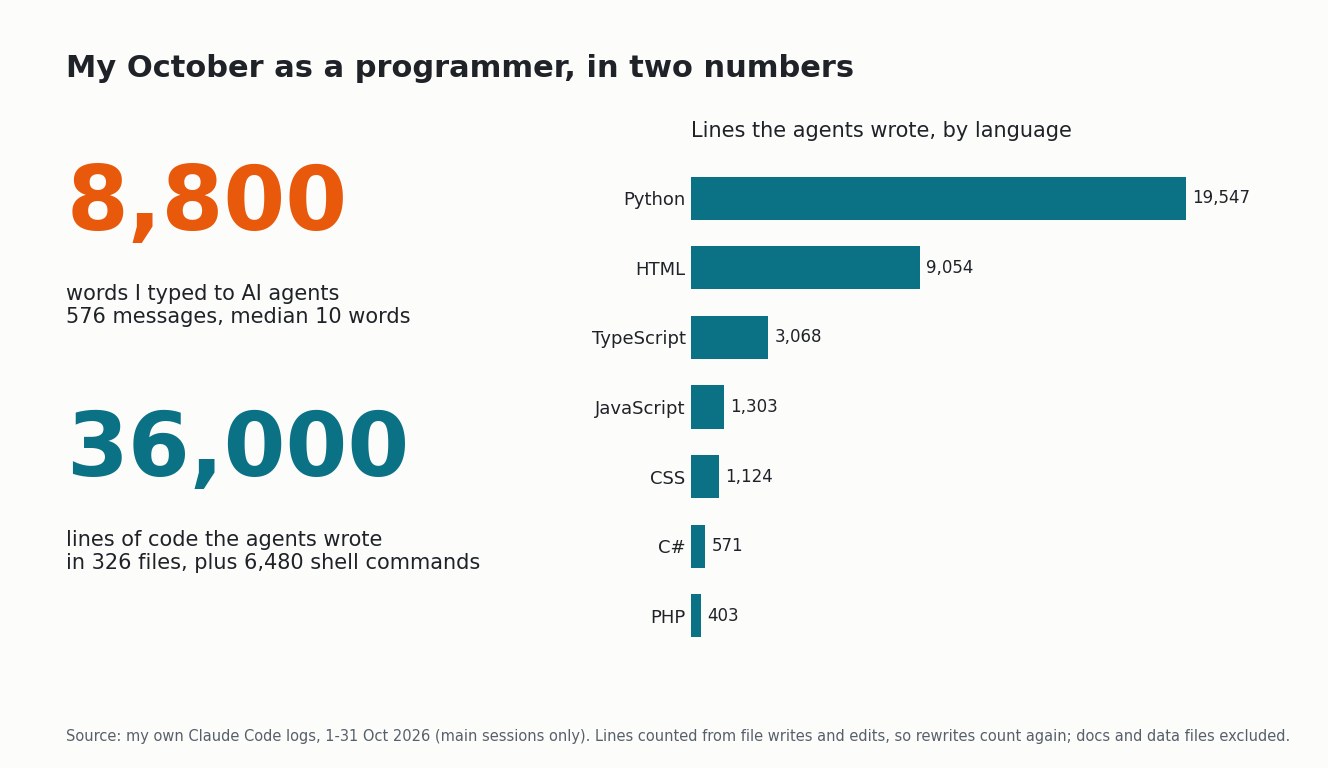
Yes, and I have the numbers. I went through my Claude Code logs for October 2026. I sent the agents 576 messages, and the typical one was 10 words long. Short instructions like "do the video clips one by one" or "the article needs to be in English". In return, the agents wrote or edited about 36,000 lines of code in 326 files, mostly Python and HTML, and ran about 6,500 shell commands.
That count isn't perfect. When an agent rewrites a file, those lines count again, and a lot of that code was throwaway scripts. But the ratio is clear. I now produce far more working software than I did a few years ago, and I type far less of it myself.
In June I wrote that AI won't replace real programming skills and that IT degrees still matter. Five months later, this is what that shift actually looks like from my chair.
Is the Programmer Outdated?
No. The coder who only turns a clear spec into lines of code is under real pressure, because that is exactly the part agents now do well. But that was never the whole job.
Over 20 years, the hard problems were rarely "how do I write this loop". They were things like: what does the customer actually need? What happens when the network drops? Who is allowed to see this data? What will this cost to run? What will break when we change it next year? Writing the code was the part that came after those questions were answered. Often it was the easy part, just the slow part.
Agents have made the slow part fast. The questions are still there, and someone still has to answer them.
What Does AI Take Off a Programmer's Plate?
The heavy weights. The parts of the job that took hours but didn't need much judgement:
- Boilerplate and glue code: upload scripts, data conversions, build steps, the same CRUD screen for the tenth time.
- Looking things up: the exact ffmpeg filter, the right Blender Python call, the API parameter I used once two years ago.
- The boring checks: does the page load, are the links 200, does the JSON parse, did the image upload.
- Trying an idea quickly: a prototype that used to take a weekend now takes an evening, so I can test three ideas instead of one.
With that weight gone, my time goes to the part of the job that needs a person.
What Do Programmers Focus on Now?

Context and design. Looking back at October, my most important messages to the agents weren't about code at all. They were decisions only someone who knows the whole situation could make:
- Trust: my AI news posts quote only the vendors' own pages and my own tests, never news sites, because news sites had added model names and prices that the official pages didn't say.
- Resources: video clips must render one at a time, because a batch job filled the RAM on my 64GB PC.
- People and privacy: no faces in podcast photos, and number plates blurred before a video goes online.
- Legal and naming: my 3D block game is called Block Drop 3D, not after a famous trademark.
- Audience: this site is written in English, and its topics lead with life in Brisbane.
None of these is hard to code. All of them are easy to get wrong if you don't understand the context. An agent can write a perfect upload script. It can't know, unless someone tells it, that the business wants every image licensed, or that one word in a title could cause legal trouble.
Agents also still make system-level mistakes. A few days ago, while publishing my Mistral Large 4 article, an agent checked whether an image file name was free before uploading it. The site's CDN remembered that "not found" answer for five days, so the new cover showed as broken. The code was fine. The mistake was not knowing how the whole system behaves. It took someone thinking about the design, not more code, to fix it, and now it's written down so it won't happen again.
Should New Programmers Still Learn to Code?
Yes, but for a different reason. You learn to code so you can read what the agent wrote, notice when it's wrong, and explain clearly what you want. You can't review a design you don't understand, and you can't judge a shortcut if you've never seen why it fails.
What I'd add for anyone starting now: spend as much time on the "why" as on the "how". Learn how systems fail, how data flows, how money and law shape software, and how to talk to the people who will use it. That's the part of the job that grew this year.
So What Is a Programmer in 2026?
Someone who decides what should be built, explains it clearly, checks what comes back, and owns the result. Less typist, more designer, editor and engineer. The title is the same, and so is the responsibility. If the software breaks, it's still my name on it, not the agent's.
So no, I don't think the programmer is outdated. I write less code, but I spend more of my day on the thinking part of programming: the context, the design and the decisions. AI took the heavy weights. The thinking is still ours.
Sources
- October figures: my own Claude Code session logs, 1 to 31 October 2026 (main sessions only). Code lines are counted from the agents' file writes and edits, excluding Markdown, text and data files; rewritten lines count again.
- Typed messages: messages I wrote myself, excluding pasted text and automatic system content.
- Examples: decisions from my own projects this month, described in the linked posts.
Checked 1 November 2026. The numbers come from my own logs and are not a study. The images were made locally with Qwen Image 2.1, the chart was drawn from my log counts, and AI helped me edit this post.