MiniCPM-V 4.7 came out last week, and its 1B version runs at about 240 tokens a second on my RTX 4060 Ti 8GB. That's no faster than MiniCPM-V 4.6, and in my tests it wasn't more accurate either. It also won't load in Ollama yet. You need a llama.cpp build from 10 October 2026 or later.
I gave 4.7, 4.6 and the 8B MiniCPM-V 4.5 the same two jobs: turn an ABS jobs media release into a web page, and read the prices off a chart. Below are the timings, the mistakes each model made, and which one I'd use.
What Is MiniCPM-V 4.7?
It's the newest small vision model from OpenBMB, the team behind the MiniCPM models. It reads images and video as well as text. The models appeared on Hugging Face between 6 and 14 October 2026 in two sizes: a 1B model for phones and small GPUs, and a 35B-A3B mixture-of-experts model that needs about 22 GB in Ollama, too much for an 8GB card.
OpenBMB says the 1B "continues to improve foundation capabilities over MiniCPM-V 4.6", but the model card gives no numbers in its text. Its predecessor, 4.6, came out on 11 May 2026 with 1.3B parameters, and Artificial Analysis scored it 13 on its Intelligence Index, the highest for any open model under 2B parameters at the time. Both are Apache-2.0 licensed.
Can You Run MiniCPM-V 4.7 in Ollama?
Not yet. Ollama lists openbmb/minicpm-v4.7:1b (1.8 GB) and it downloads fine, but on Ollama 0.40.4 every request, even plain text, fails with "Failed to load CLIP model". The vision part of the model uses a new format.
llama.cpp added support on 10 October 2026. My older build from 5 October gave the error unknown projector type: minicpmv4_7. Build b11643 worked. I pointed llama-server at the model files Ollama had already downloaded:
llama-server -m <model.gguf> --mmproj <mmproj.gguf> -ngl 99 -c 32768 --jinjaThere is still an open llama.cpp bug where 4.7 points too low when you ask where something is in an image, so I didn't test that.
How Fast Is MiniCPM-V 4.7 on an 8GB GPU?
About 225 to 255 tokens a second, the same as 4.6. On the same llama.cpp build, neither model was clearly faster. A whole web page took 2 to 6 seconds to write.
| Model and runtime | Tokens per second | Time to write the page |
|---|---|---|
| MiniCPM-V 4.7 1B, llama.cpp | 223–243 | 2.1–6.4 s |
| MiniCPM-V 4.6 1B, llama.cpp | 224–237 | 2.3–4.1 s |
| MiniCPM-V 4.6 1B, Ollama | 167 | 7.8 s |
| MiniCPM-V 4.5 8B, Ollama | 14.7 | 92.5 s (14 s loading) |
The Ollama runs aren't a fair race against llama.cpp. Ollama gave the models a 262,144-token context by default, and other programs were using the GPU at the time. For the 8B model, that context plus the weights came to about 11.5 GB, more than the card holds, so part of it ran on the CPU. If you try 4.5, set a smaller num_ctx first.
Is MiniCPM-V 4.7 More Accurate Than 4.6?
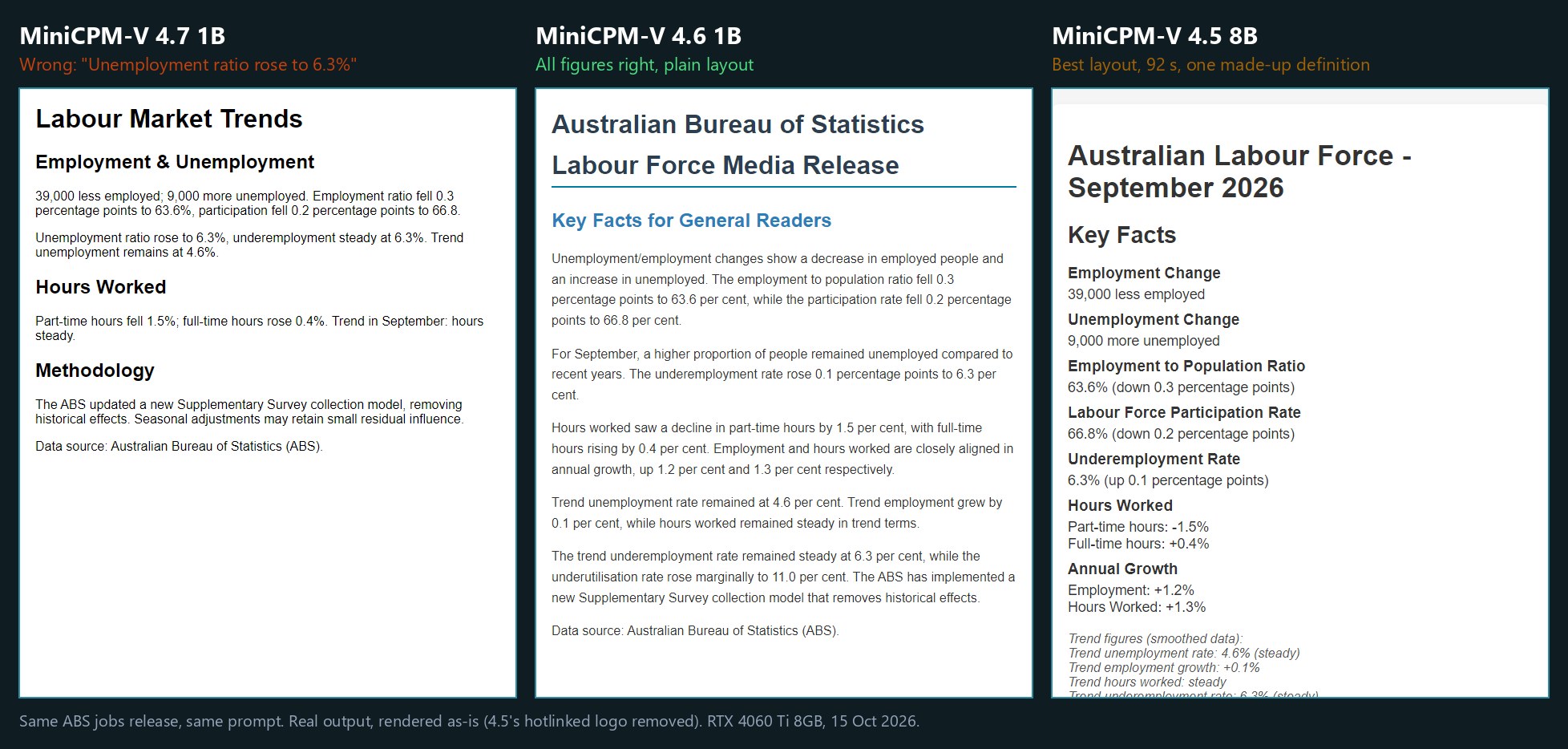
Not in my tests. I ran each 1B model four times on the ABS release, twice with thinking on and twice with it off. 4.6 never got a figure wrong. 4.7 made a mistake in two of its four pages.
| Model | Wrong figures | Other problems |
|---|---|---|
| 4.7 1B (4 runs) | "Unemployment ratio rose to 6.3%" (that's underemployment); "fell 0.3%" for 0.3 percentage points | Broken HTML in 2 runs; one run just pasted the release |
| 4.6 1B (4 runs + 1 Ollama) | None | Odd heading "Absence of Labour Statistics"; pasted the release twice; leaked its reasoning in Ollama |
| 4.5 8B (1 Ollama run) | Made-up definition: underutilisation "including discouraged workers" | Code fences; hotlinked an ABS logo from Wikipedia |
The 6.3% mistake is the one that worries me. Anyone reading that page would think unemployment had jumped by almost two points. The ABS figure for trend unemployment was 4.6%; 6.3% was the underemployment rate. A model that only copies the release is boring, but it is safer than one that mixes up two rates.
Four runs is a small sample, so I wouldn't call 4.7 worse. But I can't call it better either, and it isn't worth switching yet for this kind of job.
Can a 1B Model Read a Chart?
Mostly, yes. I gave both models a price chart from my Claude models comparison and asked for every input and output price as a table. Both got all eight bar prices right in nearly every run. 4.7 failed once, with thinking off, and produced a jumbled table with a made-up "$10.10 to $20.25".
Both models struggled with the small print. The footnote says Haiku cache reads cost $0.01, and every run of both models read it as $0.10. 4.6 also misread Opus's $0.20 as "$20" in one run and "$0" in another. For big, clear numbers, a 1B model is fine. For fine print, check it yourself.
Should Thinking Be On or Off?
For text jobs, turn it off. In my first Ollama test, 4.6 printed 57 lines of its own planning notes before the HTML, which was 54% of its answer. With llama.cpp and the --jinja option, that reasoning goes into a separate field instead of your output. With thinking off ("chat_template_kwargs": {"enable_thinking": false}), it skips the planning and the page arrives in about 2.5 seconds.
For charts, thinking helped 4.7: its only jumbled table came with thinking off. It costs 2 to 6 extra seconds, which is nothing for a single image.
Which MiniCPM-V Should You Use on an 8GB GPU?
For now, I'd stay on MiniCPM-V 4.6. It's the same speed, it runs in Ollama, and it made no factual mistakes in my runs. Try 4.7 when Ollama supports it and the llama.cpp position bug is fixed.
| If you want... | Use | Watch out for |
|---|---|---|
| Quick drafts or summaries in Ollama | 4.6 1B | Strip anything before <!DOCTYPE; check every figure |
| Reading prices or totals from charts | 4.6 or 4.7 1B, thinking on | Small footnote text |
| Trying the newest model | 4.7 1B on llama.cpp b11643+ | Wrong figures in 2 of 4 text runs |
| Better page layout and you can wait | 4.5 8B | Slow on 8 GB; made-up explanations |
Whichever model you use, read the page before it goes anywhere. All three models wrote something wrong or odd at least once, and the mistakes looked just as confident as the right answers. If you're weighing local models against paying for an API, see my local LLM vs cloud API guide. For a much bigger model on the same card, see Saluki 27B on an 8GB GPU.
Sources
- OpenBMB, MiniCPM-V 4.7 1B model card and MiniCPM-V 4.6 model card, Hugging Face, checked 15 Oct 2026.
- Artificial Analysis, OpenBMB launches MiniCPM-V 4.6, 11 May 2026.
- llama.cpp pull request #29416, "Support MiniCPM-V 4.7", merged 10 Oct 2026; issue #30508 on image positions (open at the time of writing).
- Ollama library, openbmb/minicpm-v4.7.
- Australian Bureau of Statistics, Labour Force, Australia, September 2026 media release (the test input). ABS underutilisation rate = unemployment rate + underemployment rate.
- Tests: my own runs on an RTX 4060 Ti 8GB, 15 Oct 2026, with Ollama 0.40.4 and llama.cpp b11643 (Q4_K_M models, 32k context). Two runs per setting is a small sample, not a benchmark. Your numbers will vary.
- This article was written with AI assistance from my own test logs; every figure was checked against the raw model output.