
Inflation Hit 4.9% in October. Will the RBA Raise Rates Again on 8 December?
Illustration generated with Qwen Image 2.1
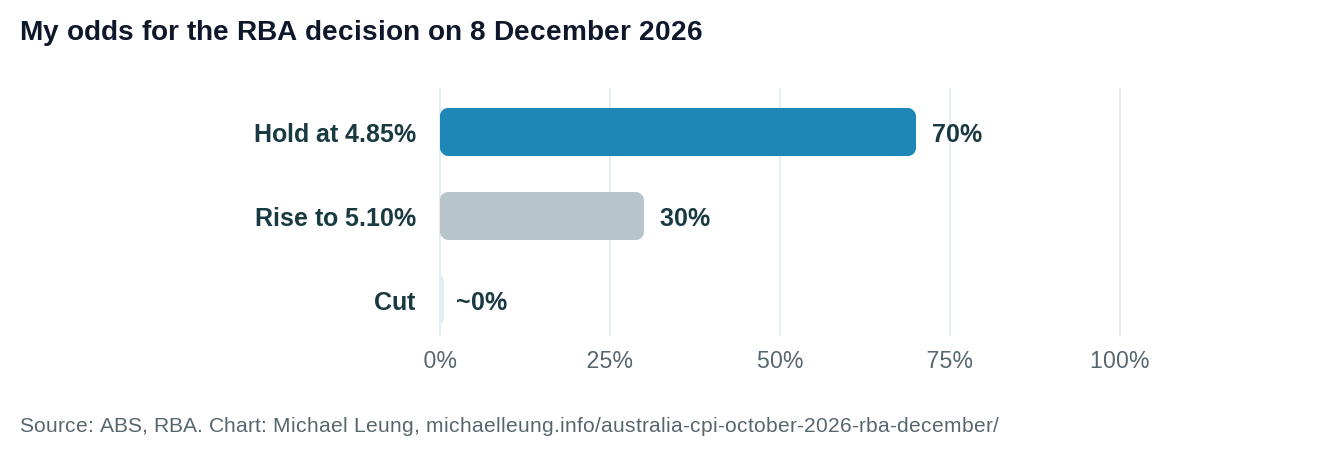
Australia’s inflation rate jumped to 4.9% in the year to October 2026, up from 4.3% in September, and unemployment is also 4.9%. For those of us living in Brisbane, prices are rising and jobs are harder to find at the same time. My short answer on rates: I expect the RBA to hold at 4.85% on 8 December, at about a 70% chance, with a rise at about 30%. Most of October’s jump was one-off and the RBA saw it coming. The part that worries me is underlying inflation, which is now running above the RBA’s own forecast.
Below: what drove October, why electricity jumped 25%, how Brisbane compares, what the RBA said in its minutes and speeches, and my reasons for and against a December rise. It follows part 17 on the October jobs figures, part 13 on the November rate rise and part 12 on the September CPI.
The October 2026 inflation figures in short
- Headline CPI
- 4.9% (September 4.3%). In October alone: +0.5%, or +0.7% seasonally adjusted.
- Underlying
- Trimmed mean 3.8% (September 3.6%); weighted median 3.4%
- Electricity
- +25.2% (September +12.8%), as Commonwealth rebates ended
- Fuel
- +32.5% over the year; +6.3% in October after +9.4% in September
- Housing
- +6.4%, the largest contributor; new dwellings +5.1%, rents +3.5%
- Essentials
- Non-discretionary +6.1% vs discretionary +3.2%
- Brisbane
- 4.7%, below the eight-capital average of 4.9%; Hobart highest at 6.0%
- RBA
- Cash rate 4.85%. Next decision 8 December, the last of 2026.
Useful already? ☕ Buy me a coffee and keep these explainers free and ad-free.覺得有用?☕ 請我喝杯咖啡,讓這些解說繼續免費、無廣告。
Watch in Cantonese
My Cantonese podcast Brisbane真好 has a 5-minute episode on these figures, hosted by 阿May, with Chinese and English captions.
Why did inflation jump to 4.9% in October 2026?
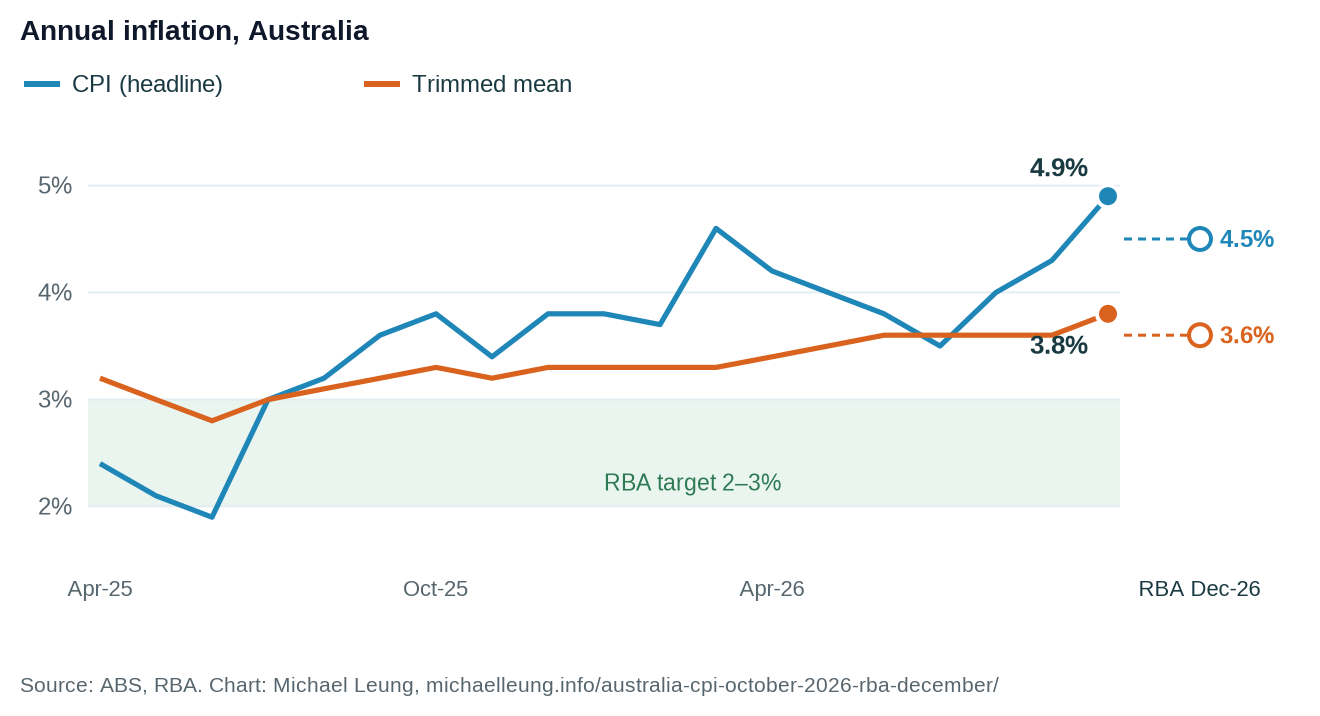
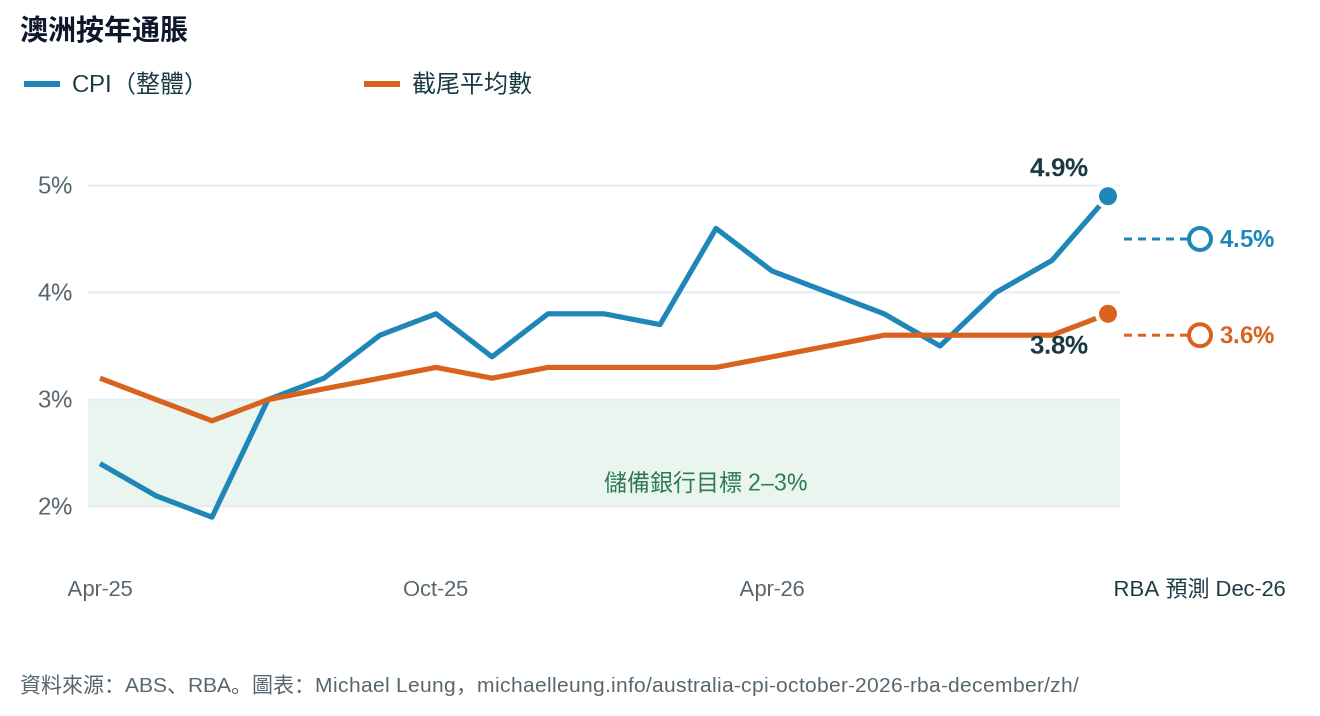
Annual CPI and trimmed mean inflation, April 2025 to October 2026, with the RBA’s November 2026 forecasts for the December quarter 2026. The shaded band is the 2–3% target. Sources: ABS Consumer Price Index, September and October 2026; RBA Statement on Monetary Policy, November 2026.
The chart shows both measures over the past 19 months. Headline CPI, in blue, has bounced around because energy prices and rebates move it a lot. The trimmed mean, in orange, removes the biggest rises and falls each month, so it moves slowly. It has crept up from 3.3% early in 2026 to 3.8% now, and both are well above the RBA’s 2–3% target band.
The circles on the right are the RBA’s November forecasts for the December quarter: 4.5% for headline and 3.6% for the trimmed mean. A monthly figure is not the same as the quarterly one the RBA forecasts, so the comparison is rough. But October is above both.
Illustration generated with Qwen Image 2.1
Why did electricity go up 25%?
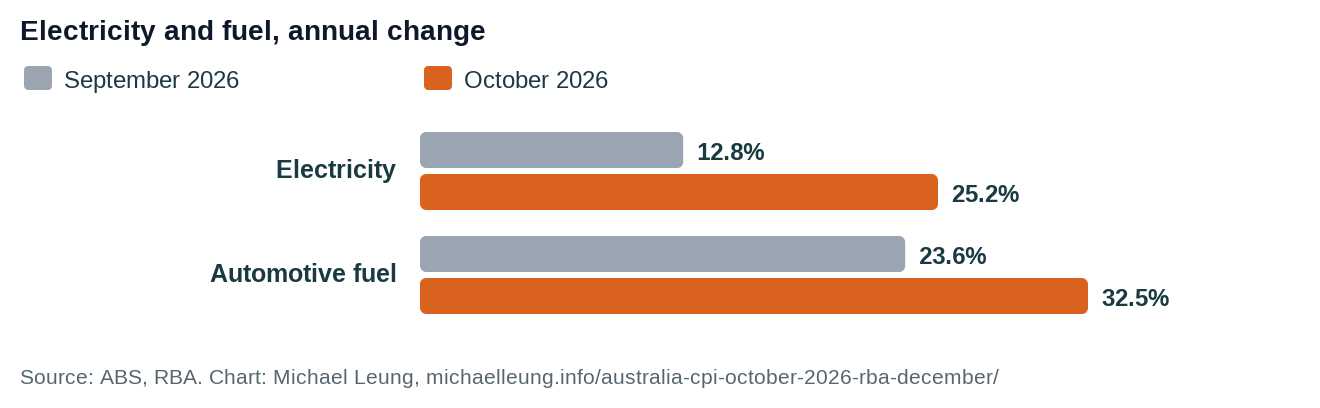
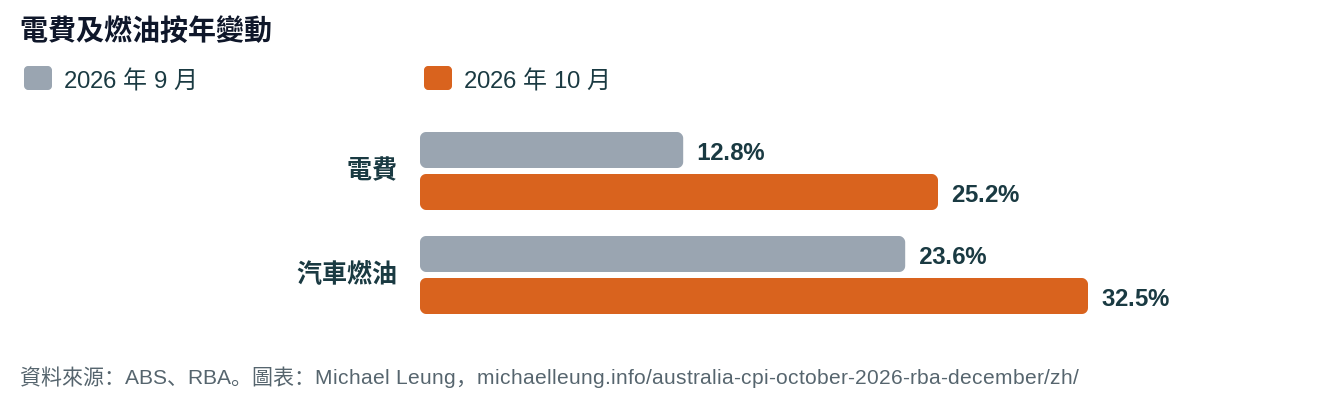
This is a quirk of how the CPI is measured. It records what households actually pay, after rebates. When a rebate stops, the price you pay jumps even if the retailer’s tariff barely moved. So the 25% is real for your budget, but it does not mean power companies raised prices by a quarter.
The RBA knew this was coming. Its minutes from the 3 November meeting say headline inflation “would be likely to be significantly higher in October than in September, as subsidies received by households a year earlier drop out”. That matters for December: a jump the RBA forecast is not a surprise it needs to react to.
Annual change in electricity and automotive fuel prices, September and October 2026. Sources: ABS Consumer Price Index, September and October 2026.
Illustration generated with Qwen Image 2.1
Fuel is different: that one is world oil prices. Automotive fuel rose 6.3% in October alone, after 9.4% in September. The RBA’s minutes say crude and refined fuel prices rose 20–25% between August and early November because of the Middle East conflict, and its forecasts assume oil falls back by about US$30 a barrel over two years. If that does not happen, fuel stays a problem.
What else got more expensive?
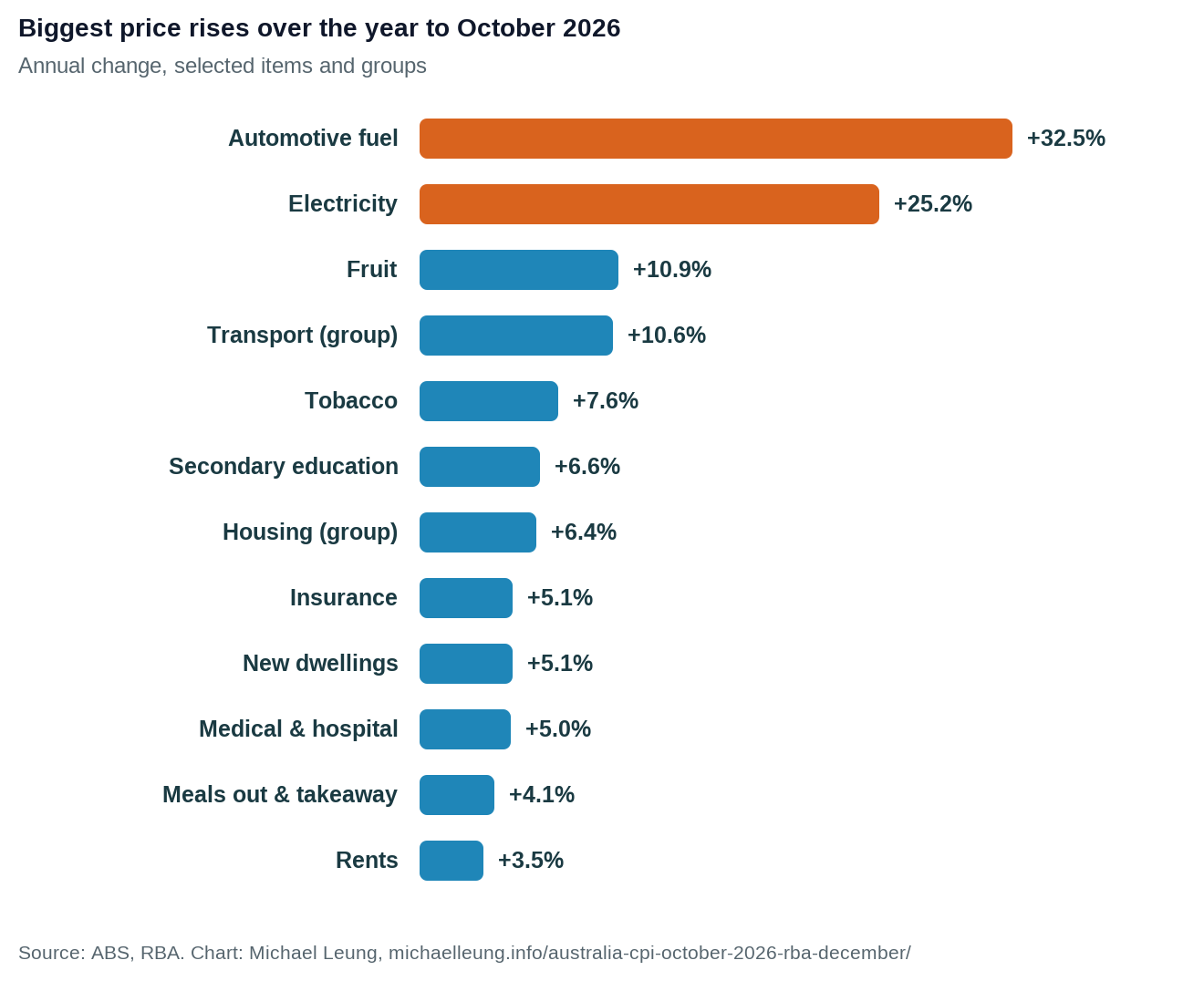
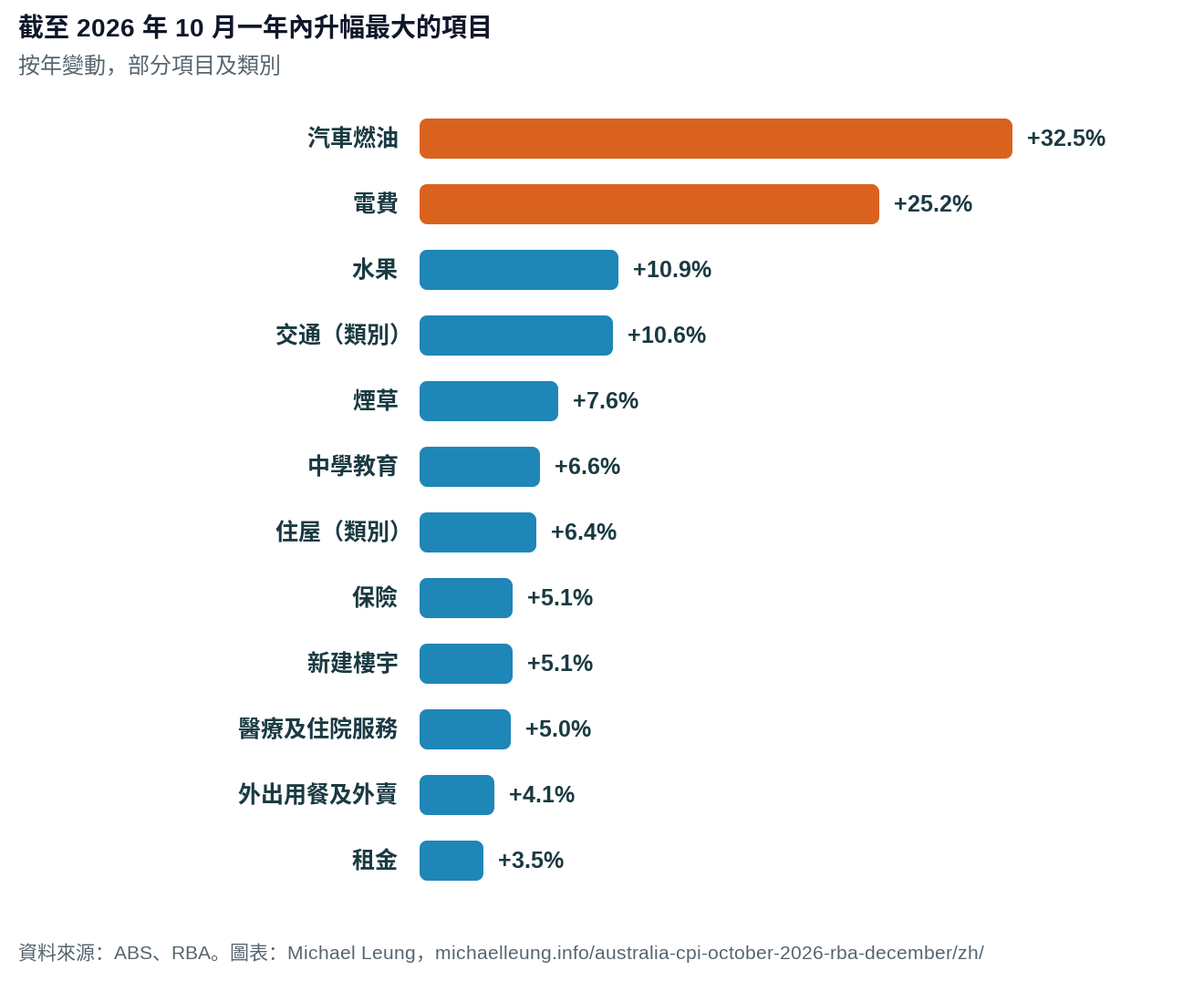
Annual price change to October 2026 for selected items and groups. Source: ABS Consumer Price Index, October 2026.
After electricity and fuel come fruit (+10.9%), transport as a whole (+10.6%), tobacco (+7.6%) and secondary school fees (+6.6%). Housing rose 6.4%: electricity, new home prices (+5.1%) and rents (+3.5%) all fed into it. Rents rose only 0.1% in October, but that was held down by the Commonwealth Rent Assistance increase on 20 September; without it, rents would have risen 0.3%.
The split I think matters most for households: non-discretionary prices rose 6.1% over the year, discretionary prices 3.2%. The things you have to pay for, like power, fuel, rent and food, are rising fastest. Goods rose 5.8% and services 4.0%, and services prices were flat in the month, which is one of the few soft spots in this release.
Illustration generated with Qwen Image 2.1
How does inflation in Brisbane compare?
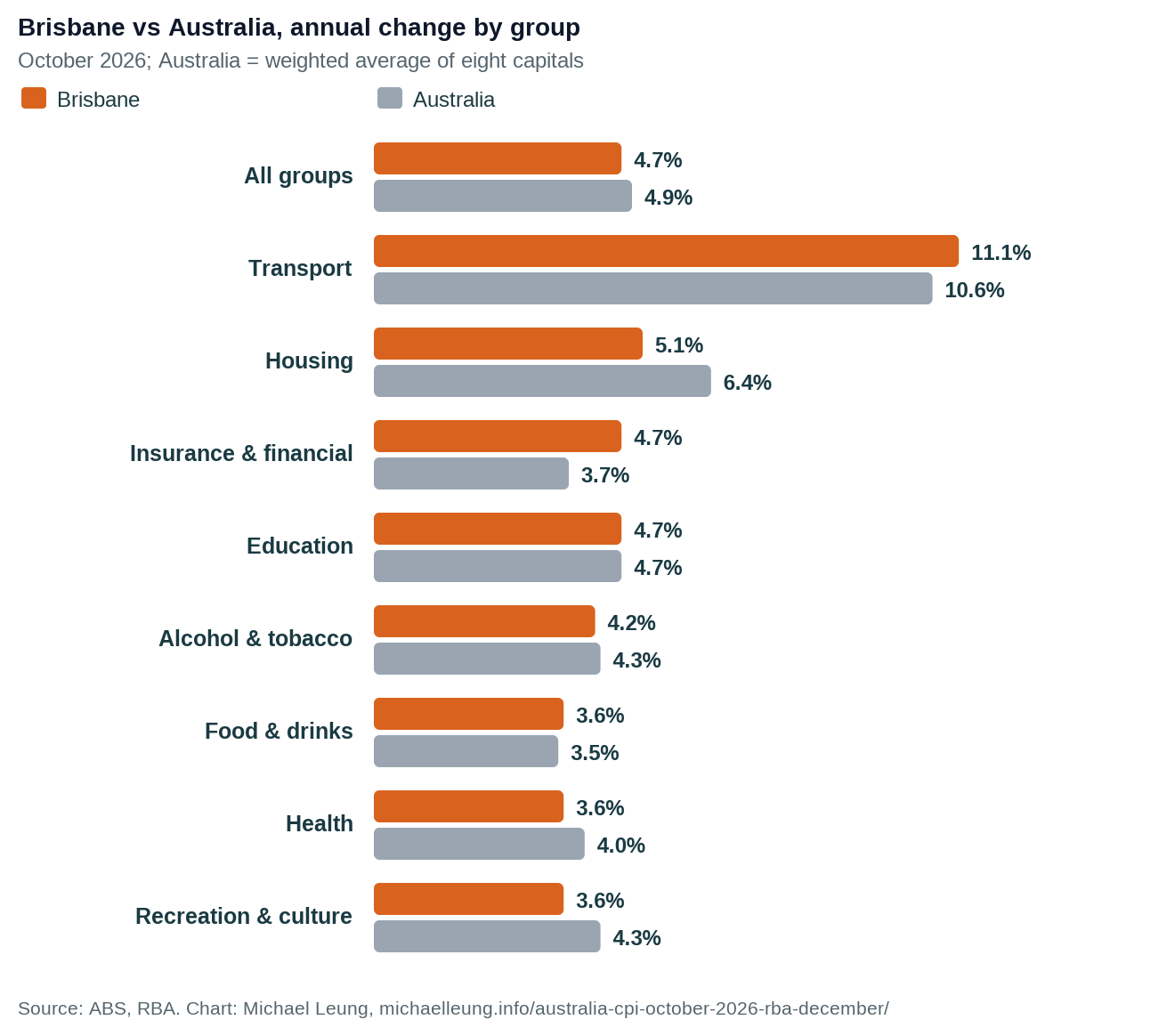
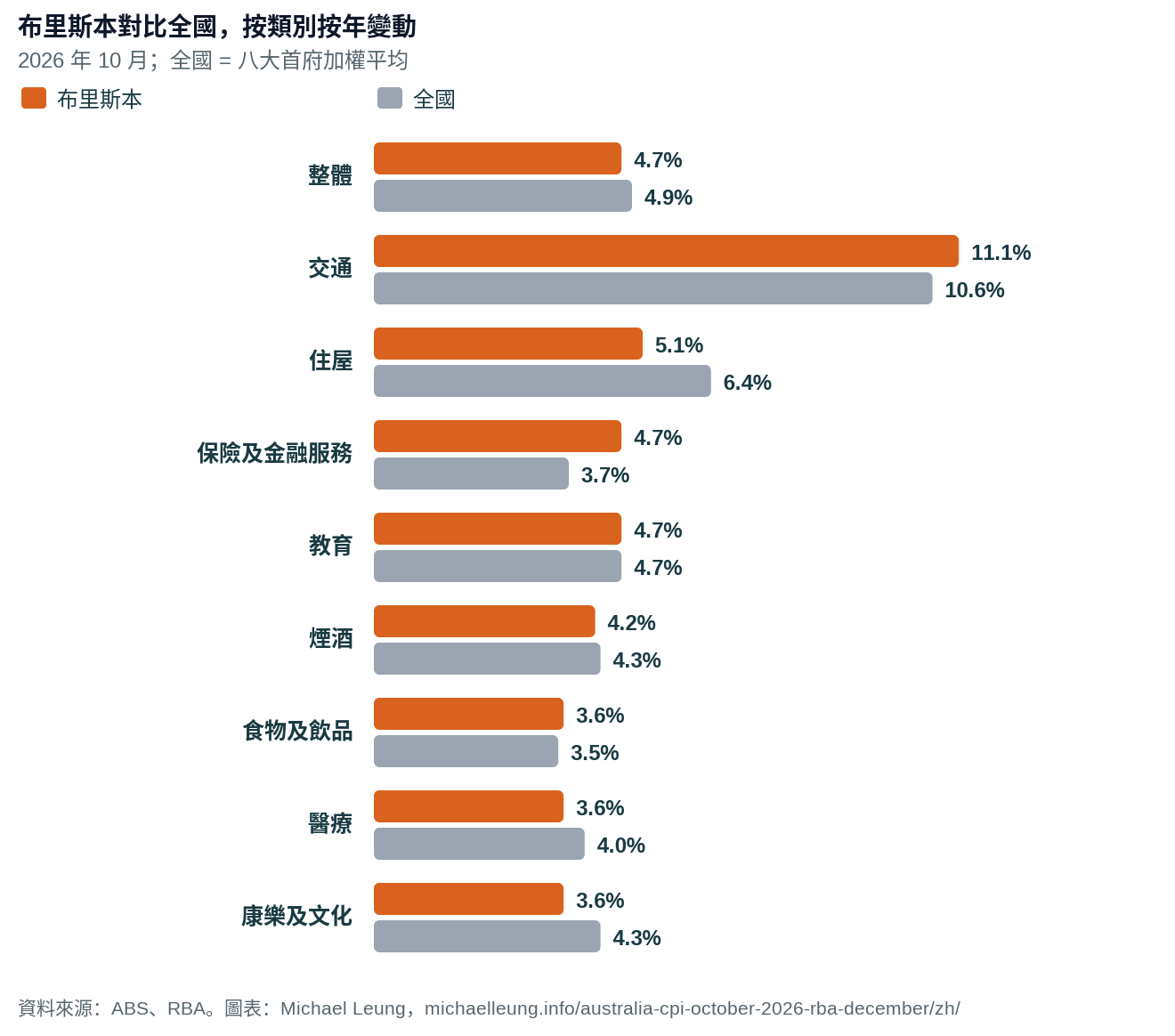
Annual price change to October 2026 by group: Brisbane against the weighted average of the eight capital cities. Source: ABS Consumer Price Index, October 2026.
Housing in Brisbane rose 5.1%, against 6.4% nationally and 8.0% in Sydney. Transport rose 11.1% here, above the national 10.6%, which fits a city where most of us drive. Insurance and financial services rose 4.7% in Brisbane against 3.7% nationally.
Among the capitals, Hobart is highest at 6.0%, then Adelaide 5.7% and Perth 5.5%. Melbourne is lowest at 4.4%. So Brisbane sits in the lower half, but 4.7% is still more than twice the bottom of the RBA’s target. It is no comfort if your power bill and petrol both jumped this month.
What has the RBA said since its November rate rise?
The minutes of the 3 November meeting show a split Board. Six members voted to raise to 4.85%; three wanted to hold at 4.60%. The three were worried that “the economy might be near the point of entering a materially sharper downturn”. All members agreed to be “attentive to the data”, which is standard wording, not a hint either way.
Governor Michele Bullock said on 17 November that the risks to inflation are “still skewed to the upside”, and that she worries about inflation expectations becoming ingrained. On 25 November, the day the October CPI came out, the RBA’s head of domestic markets said “policy is clearly restrictive”, while adding that whether it is restrictive enough is a matter for the Board.
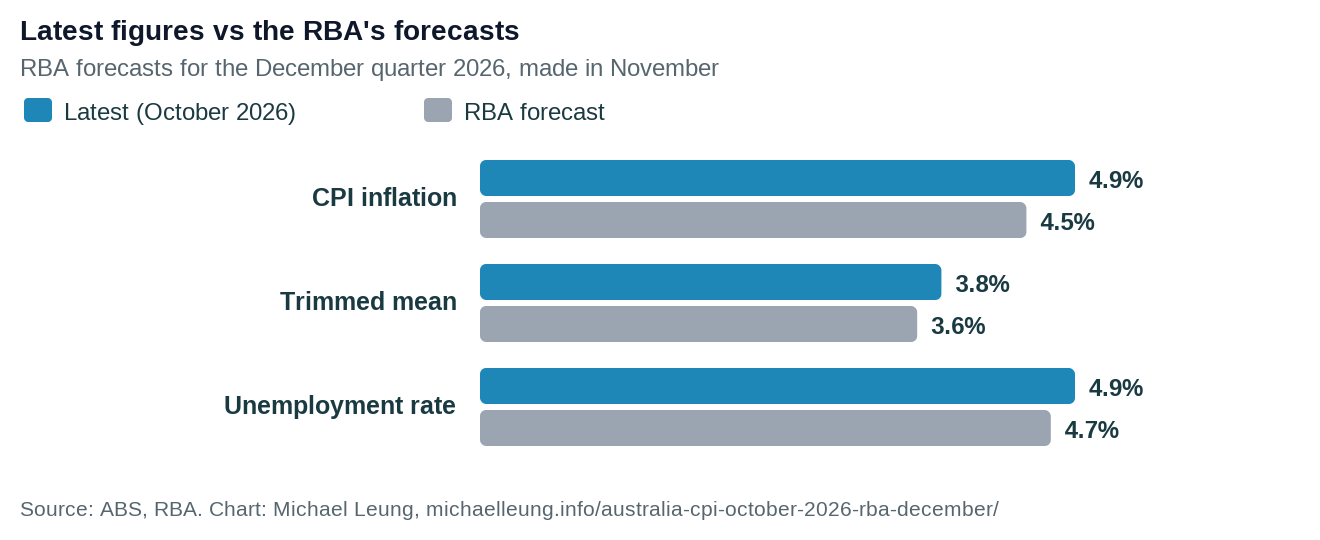
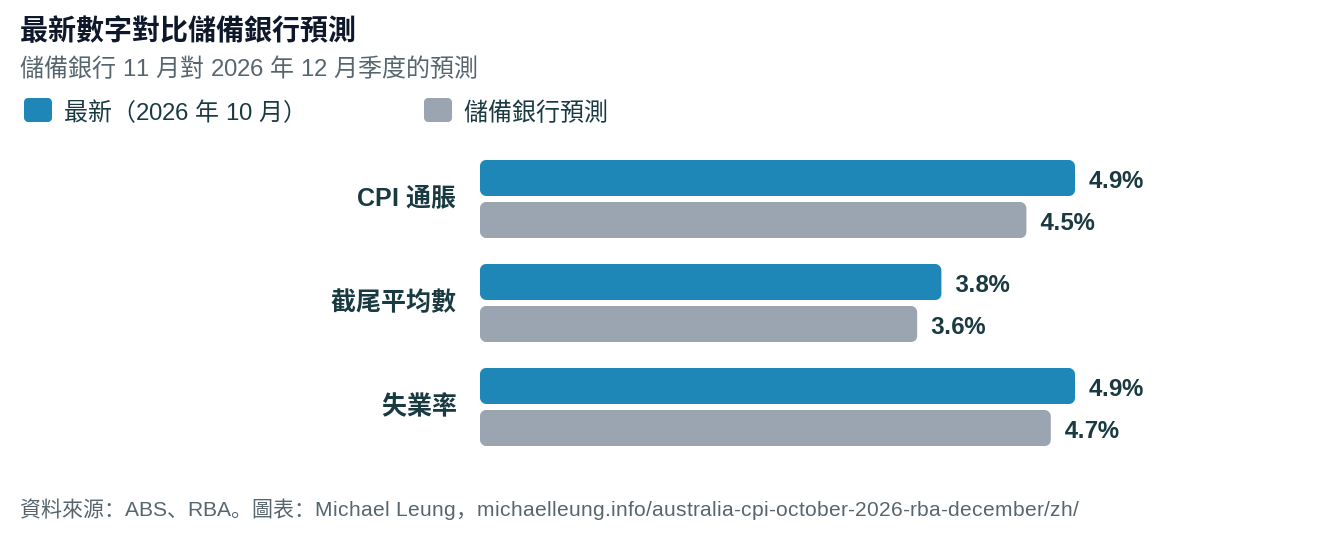
Latest figures against the RBA’s November 2026 forecasts for the December quarter 2026. CPI and trimmed mean: October 2026, annual. Unemployment: October 2026. The RBA forecasts quarterly figures, so the comparison is approximate. Sources: ABS; RBA Statement on Monetary Policy, November 2026.
This chart is the heart of the December decision. Inflation is running hotter than the RBA forecast, which argues for a rise. Unemployment is also higher than it forecast, which argues for waiting. The RBA has to weigh one against the other.
Will the RBA raise interest rates on 8 December 2026?
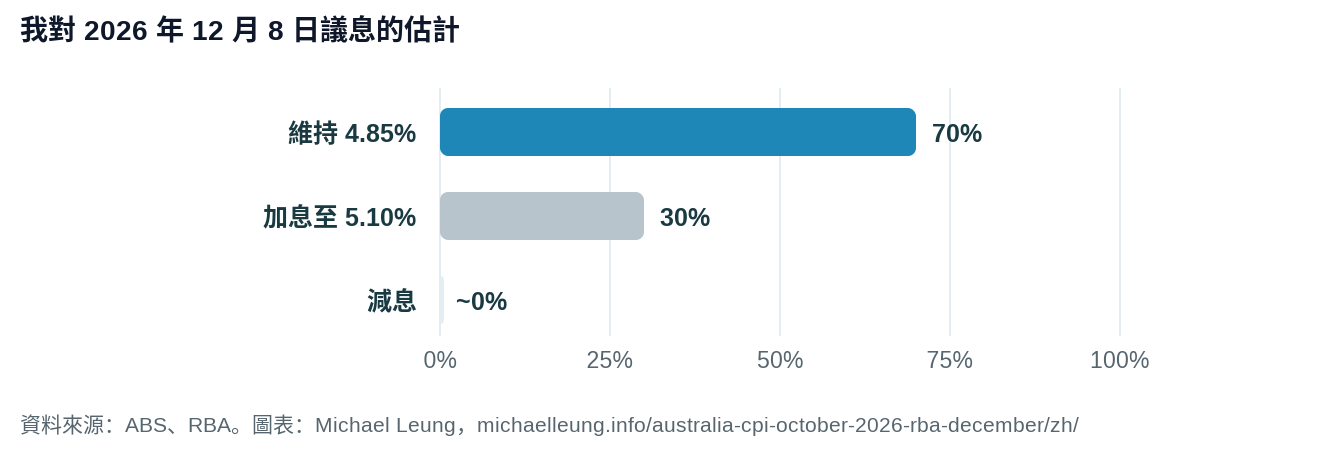
My own odds for the RBA decision on 8 December 2026. Not RBA guidance or market pricing.
Why I lean towards a hold:
- The jump was expected. The RBA wrote in its minutes that October would be significantly higher as rebates dropped out. A forecast coming true is not new information.
- Jobs are weakening faster than forecast. Unemployment is 4.9% against the RBA’s 4.7% for the December quarter, and hours worked fell in October (part 17).
- The last rise has barely started to work. The cash rate went up only five weeks before this meeting, and three of nine members already wanted to wait in November.
- Services cooled. Services prices were flat in October and annual services inflation eased to 4.0%. The RBA watches domestic, services-type inflation closely.
- February is a more natural time to move. The RBA next meets on 8–9 February 2027 with the full December-quarter CPI and new forecasts in hand.
Why a rise is still possible:
- Underlying inflation rose. The trimmed mean went from 3.6% to 3.8%, above the RBA’s 3.6% forecast for December. That is the number the RBA cares about most.
- Expectations. The RBA worries that a headline figure near 5% will push up what households and businesses expect, and the Governor repeated that worry this month.
- Oil. Its forecasts assume oil prices fall. If they do not, inflation stays higher for longer.
One more release lands before the meeting: September-quarter GDP on 2 December. If spending held up better than expected, the odds of a rise go up. These odds are my own judgement. In part 17 I had a hold at about 75%; the October CPI moves me 5 points towards a rise.
What does this mean for your mortgage and budget?
- Mortgage. On a 30-year loan at an assumed 6.85%, a rise to 7.10% would add about $67 a month per $400,000, $101 per $600,000 and $134 per $800,000. My own calculation; your rate will differ.
- Power. The rebates are gone, so the full bill is back. Compare plans on the government’s Energy Made Easy site.
- Essentials first. With non-discretionary prices up 6.1%, list which costs you cannot avoid and look at insurance, phone and subscriptions next.
- If you lose work or hours, check Services Australia early, because waiting periods and income tests apply.
Which dates should you watch?
- 2 December 2026: GDP for the September quarter (ABS)
- 8 December 2026: RBA decision, the last of the year
- 17 December 2026: November jobs figures (ABS)
- 6 January 2027: November CPI (ABS)
- 9 February 2027: first RBA decision of 2027, with new forecasts
Show the full data table (October vs September 2026)
| Measure (annual change) | Oct 2026 | Sep 2026 |
|---|---|---|
| CPI, all groups | 4.9% | 4.3% |
| Trimmed mean | 3.8% | 3.6% |
| Goods | 5.8% | 4.6% |
| Services | 4.0% | 4.1% |
| Tradables | 5.3% | 4.0% |
| Non-tradables | 4.7% | 4.5% |
| Electricity | 25.2% | 12.8% |
| Automotive fuel | 32.5% | 23.6% |
| Housing | 6.4% | 5.2% |
| Brisbane, all groups | 4.7% | 4.4% |
Original series unless stated. A dash means the figure is not in the ABS release I used. Sources: ABS Consumer Price Index, Australia, September and October 2026.
Download the charts
Every chart on this page is a free SVG file you can open, print or reuse with a link back to this page.
- CPI and trimmed mean, April 2025 to October 2026
- Electricity and fuel inflation, September vs October 2026
- Biggest price rises, October 2026
- Brisbane vs Australia by group, October 2026
- Latest figures vs RBA forecasts
- My odds for the RBA on 8 December 2026
Common questions
What is Australia’s inflation rate in October 2026?
4.9% over the year to October 2026, up from 4.3% in September. The trimmed mean was 3.8%. The ABS released the figures on 25 November 2026.
Why did electricity prices rise so much?
Electricity rose 25.2% over the year mainly because Commonwealth electricity rebates, which lowered bills a year earlier, have ended. The CPI measures what households pay after rebates.
What is the inflation rate in Brisbane?
4.7% over the year to October 2026, below the eight-capital average of 4.9%. Transport rose 11.1% and housing 5.1% in Brisbane.
Will the RBA raise interest rates in December 2026?
My own view is a hold at 4.85% on 8 December, at about a 70% chance, with a 0.25-point rise at about 30%. The October jump was expected by the RBA and unemployment is above its forecast, but underlying inflation is also above forecast. This is my judgement, not advice.
When is the next RBA meeting?
The Monetary Policy Board meets on 7–8 December 2026 and announces its decision on 8 December. The first meeting of 2027 is on 8–9 February.
How much more would my mortgage cost if rates rise?
For a 0.25-point rise from an assumed 6.85% to 7.10% on a 30-year loan: about $67 a month more per $400,000, $101 per $600,000 and $168 per $1 million. Your own rate and terms will differ.
Sources
- ABS · Consumer Price Index, Australia, October 2026
- ABS · CPI rose 4.9% in the year to October 2026
- ABS · Labour Force, Australia, October 2026
- RBA · Minutes of the Monetary Policy Board Meeting, November 2026
- RBA · Statement on Monetary Policy, November 2026
- RBA · Real Interest Rates – Restrictive Amid Cross-Currents
- RBA · Panel Participation at the ASIC Annual Forum
- RBA · Board Meeting Schedules
General information only, not financial advice. Research was AI-assisted; every figure was checked against ABS and RBA publications on 27 November 2026. The odds and views on future rates are my own.
Found this useful?
Buy me a coffee ☕
Everything here is free and ad-free. A coffee or a AU$1/month membership keeps new articles, games and tools coming.
Also in the shop:VoidFill · The Architect’s Monologue · Brisbane photo prints
Series: Australian Economy 2026 (part 18 of 18)系列:2026 澳洲經濟(第 18 / 18 篇)
Rates, wages, housing and prices: what the 2026 numbers mean for Australian households.利率、工資、樓價與物價:2026 年的數字對澳洲家庭意味著甚麼。
- Will the RBA Raise Rates? Australia's Jobs and Inflation儲備銀行會加息嗎?澳洲就業與通脹
- RBA Raises the Cash Rate to 4.60%儲備銀行加息至 4.60%
- Wages vs Inflation 2019–2026: CPI +26.8%, WPI +20.8%工資對通脹 2019–2026
- Negative Gearing & CGT Reform: House Prices in Every Capital負扣稅與資本增值稅改革:各首府房價
- Card Surcharge Ban: Who Really Pays Now?禁止刷卡附加費:誰在埋單?
- University vs TAFE: Who Goes Where After Year 12?大學定 TAFE?中學畢業生去向
- Trade Surplus Falls to $495m: Computers, Fuel and Iron Ore貿易順差跌至4.95億:電腦、燃油與鐵礦石
- Bracket Creep: Median Tax Rate 21.6%→25.5%稅級攀升:中位數稅率 21.6%→25.5%
- Medicare Explained: Cover, Costs and LevyMedicare 全解:保障、費用與徵費
- Building Approvals August 2026: Is Australia Building Enough?2026年8月建築審批:澳洲建屋夠快嗎?
- Jobs Fall 39,300: RBA to Hold, Then Hike?就業減少39,300:儲備銀行先按兵不動,再加息?
- CPI Hits 4.3%: Will the RBA Hike on 3 November?通脹升至4.3%:儲備銀行11月3日會加息嗎?
- The RBA Hiked to 4.85%: Why, and What It Costs Your Mortgage儲備銀行加息至4.85%:原因及對供樓的影響
- David Jones Administration: Why a 188-Year-Old Store FellDavid Jones 進入破產管理:188 年老店為何倒下
- Brisbane David Jones After Administration: Packed, Not Empty破產管理後的布里斯本 David Jones:人頭湧湧
- David Jones Collapse: Is Australian Retail Really That Bad?David Jones 倒閉:澳洲零售業真的那麼差?
- Unemployment 4.9%: Is the Job Market Cracking?失業率升至4.9%:就業市場開始崩裂?
- CPI 4.9%: Will the RBA Hike on 8 December?通脹升至4.9%:儲備銀行12月8日會加息嗎?